Arts, Crafts and Living Ateliers
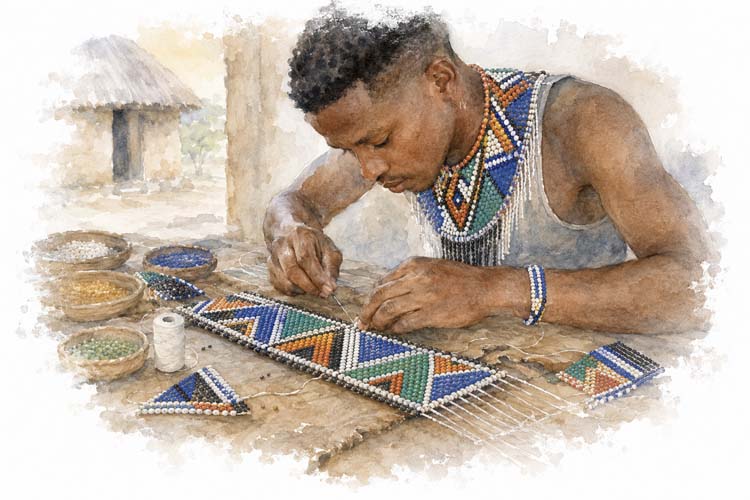
The beadwork is domestic work, done seated with sorted beads and a fine needle, frequently in groups and in conversation. The basketry is done with a needle and a bundle of grass, the coil built round and round and stitched down, and a large lidded vessel takes weeks. The pottery is built by hand from coils, scraped, burnished with a pebble before firing, and fired in a pit where the atmosphere is deliberately smothered. Three different materials, all worked without a machine anywhere in the process.
Reading Zulu Beadwork
Start with the geometry. The triangle is the base unit and its orientation carries information about gender and marital status, so a piece built from triangles is saying something before any colour is considered. Then look at bead consistency: old beads vary slightly in size and have a softer colour, and dense even modern seed beads produce a flatter, more regular surface. Check the thread and the edges, since the finish on a piece made for a person is careful and continuous, and the finish on a piece made quickly is not. Finally, ask for the reading. A genuine piece has one.
Reading a Coiled Basket
Quality in the basketry is measured by stitch count and by whether the vessel holds. The finest work has stitches so fine and so tight that the wall becomes effectively watertight when the grass swells, which is what the beer vessels were made to do, and the lid should sit down onto the body with an even fit all the way round. Look at the transition where the coil begins and where it finishes, since both are places where lesser work shows. Colour comes from natural dyes and from the different grasses themselves.
Reading a Black Pot
The blackware is fired to carbonise rather than glazed, so the surface is a burnish and not a coating, and it has a soft depth that a painted or polished substitute cannot reproduce. Run a finger over it: real burnishing leaves faint directional marks from the stone. The raised bosses should be crisp and evenly spaced around the form, and the vessel should sit true. These pots were made to be used and the good ones are balanced for lifting when full.
Why the Message Is the Fragile Part
The physical object here is durable and the information in it is not. Glass beads outlast almost everything, thread can be replaced, a burnished pot survives a century. But the reading depends on knowing the local convention at the time the piece was made, and once a beaded panel has passed through two dealers the maker is unreachable and the statement becomes unrecoverable. Museums hold considerable quantities of this work catalogued only by material and dimension. That is the loss worth guarding against, and it costs nothing to prevent at the point of purchase.
Ateliers, Villages and Artisan Encounters
The craft is spread across KwaZulu-Natal rather than concentrated in one town, with the Msinga and Nongoma districts and the areas around Hlabisa and the Zululand north known for particular strengths. Craft centres and cooperatives operate at several points across the province and are the practical route to meeting makers. The battlefields of 1879 and the royal sites in the north are the historical context and are worth the detour for anyone who wants the objects to make sense.
Tourwit Editions and Provenance
Tourwit works directly with beadworkers, basket makers and potters across KwaZulu-Natal, paying before work begins and leaving the major share of what a piece realizes with the maker. The record names her, states the object type, and for beadwork records the reading of the piece in her own account of it, which is the single most perishable thing about this tradition and the thing the market almost never captures.
Why These Works Matter
There are very few textile or ornament traditions anywhere that encode sentences rather than symbols, and fewer still where the code is paired, contextual and answerable. What was exchanged here between two people was a message with a sender, a recipient and a meaning, made from imported glass by a woman whose name was never recorded. Recording it now, along with what the piece says, is the difference between preserving an object and preserving a language.