

















Craft Map
The Craft Map
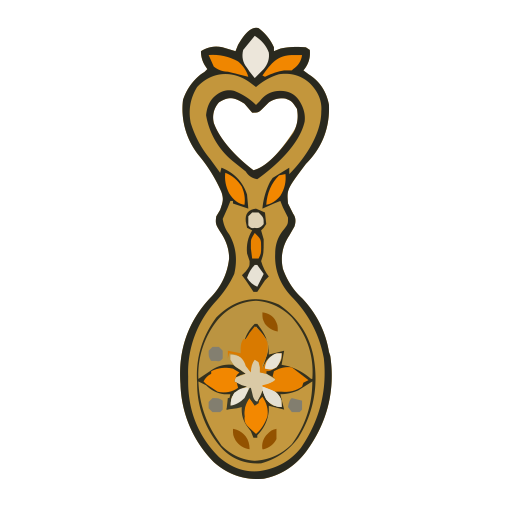
The lovespoon has no production centre, which makes its map the least conventional in this collection: it was made wherever a young man lived, which is to say across rural Wales. There is no Geographical Indication and no certifying body, and provenance for historic pieces rests on collection history and, where they carry one, on a carved date.
Rural Wales: The Practice
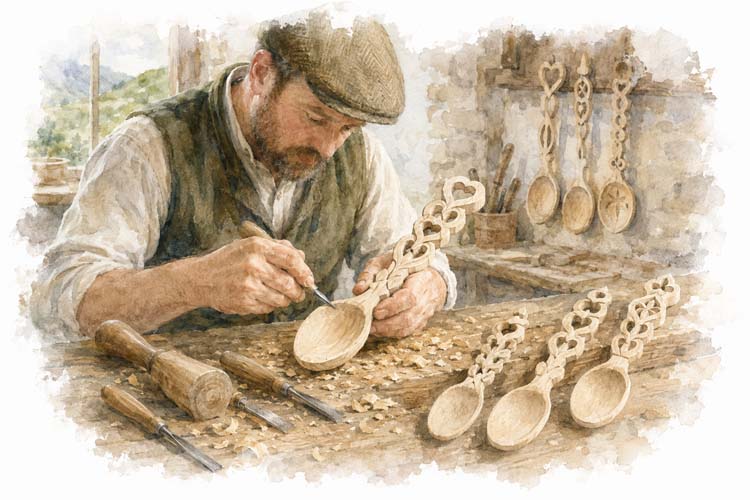
The craft belonged to farms and villages throughout the country rather than to any town or district, and it has no regional style in the way that a weaving tradition would. What variation exists reflects individual ambition and skill rather than local convention. A record of a historic spoon should say where it was collected from and resist the temptation to assign it to a region, because the evidence for regional attribution in this craft is thin and frequently invented after the fact.
St Fagans: The Evidence
The national museum of Welsh life near Cardiff holds the reference collection, including the oldest dated spoon at 1667. This is not a production site. It belongs on the map because a craft with no workshops, no marks and no records depends entirely on its surviving objects for its history, and this is where the largest and best documented body of them sits. Any claim about how old this practice is rests here.
The Contemporary Carvers
The living craft is a dispersed community of individual carvers across Wales and beyond, working to commission and selling directly, and they are the reason the technique has not been lost. Their work is generally more technically accomplished than the historic material and should be assessed on its own terms rather than against a folk standard. A contemporary spoon's record should name its carver, since with no regional style and no workshop, the individual is the only meaningful identity.
Also on the Map
The sycamore and fruit woods of Welsh hedgerows and woodlands, which are the material and which govern what a chain can survive. The Welsh diaspora, which carried the object worldwide as a portable emblem of home. And the wider European tradition of carved courtship gifts, within which the Welsh spoon is the most elaborate surviving form and to which it should be related rather than treated as standing alone. Who carved a lovespoon, from what, and for whom: three answers a record can rarely supply, and should try.