


Craft Map
The Craft Map
Japan's papermaking is distributed across mountain valleys in several prefectures, and the differences between them are technical rather than decorative. The 2014 UNESCO inscription names three papers specifically, and a record that claims the inscription for a paper not among them is claiming something untrue.
Mino, Gifu: Hon-minoshi
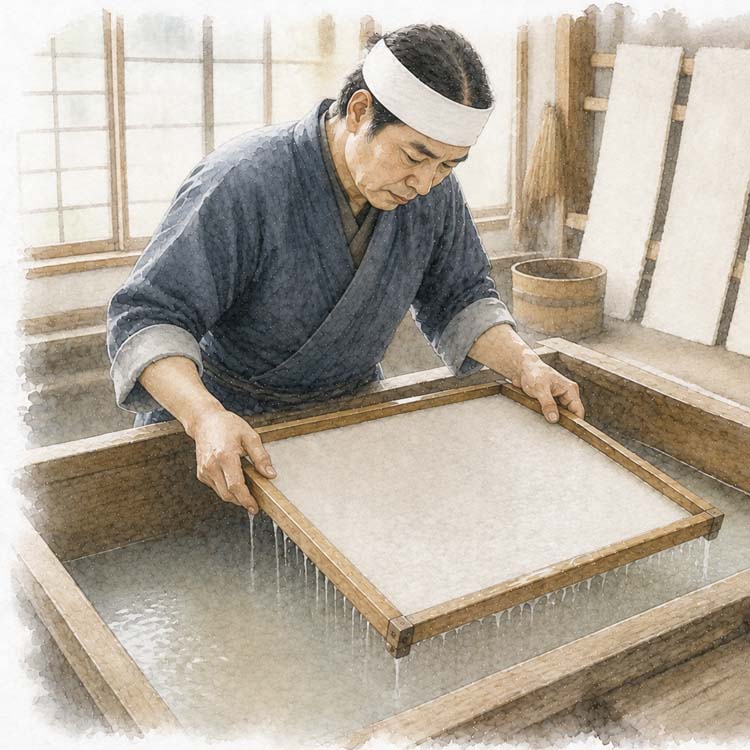
In the mountain country of Gifu, Mino produces hon-minoshi, one of the three papers inscribed by UNESCO in 2014, made from kozo alone and known for evenness and thinness. Mino paper has historically supplied shoji screens and book papers, where an even sheet with no visible variation in thickness is the whole requirement. A record naming Mino and hon-minoshi is naming an inscribed practice, which is a strong and specific claim.
Echizen, Fukui: The Paper Goddess
Echizen has been among the most important papermaking districts in Japan for well over a thousand years and is home to Okamoto Otaki, the only shrine in the country dedicated to a goddess of paper. It is not among the three papers inscribed in 2014, and that distinction should be stated rather than blurred: Echizen's standing rests on its history, its range and its scale rather than on the listing. The district makes a wider variety of papers than any of the inscribed valleys, including heavily decorated and dyed work.
Hamada, Shimane and Ogawa, Saitama: The Other Inscribed Papers
Sekishu-banshi is made at Hamada in Shimane, and hosokawa-shi in the Ogawa and Higashi-Chichibu area of Saitama. Both are kozo-only papers and both were inscribed alongside hon-minoshi in 2014. They belong on this map because the inscription is a set of three rather than a single entry, and because a collector encountering a claim about UNESCO recognition should know which three papers it can legitimately refer to.
Also on the Map
The kozo slopes, since the fibre is the craft and the plant grows where rice does not. The cold rivers, which are equipment rather than scenery in this trade. And the conservation studios of the world's museums, which now take much of the finest output. Valley, fibre, and whose hands worked the screen: washi is identified by all three together.