Deported to an Island
The decree of 1291 moved all Venetian glassmaking to Murano, a cluster of small islands a short way across the water. The stated reason was fire, and it was a real one: a glass furnace runs above fourteen hundred degrees and Venice was built of timber over water. But the second effect was the one that lasted. Concentrating the entire trade on one island made its secrets governable. Glassmakers could not leave without permission, and taking the method elsewhere was punishable by death. A craft was protected by making its practitioners into something close to prisoners of their own expertise.
Why an Island Could Be Policed
The geography did the enforcement. A quarter of a city can be left at night on foot; an island in a lagoon cannot, not without a boat and not without being seen. The 1291 decree works only because Venice is what it is, and the same water that made the city defensible made its most valuable trade containable. Glassmakers were granted real privileges in return, including standing that other artisans did not have, and their daughters could marry into patrician families. It was a gilded confinement, and it was still confinement.
Cristallo
What that concentration produced, around the middle of the fifteenth century, was a material nobody else had. Angelo Barovier worked out how to purify the soda ash and remove the impurities that had always tinted glass, and the result was clear enough to be named for rock crystal. Cristallo is the reason Murano's reputation is not merely a matter of skill or of style. For a period the island possessed a chemistry that could not be reproduced elsewhere, and the Republic's export of finished glass rather than knowledge was a deliberate industrial policy.
A Guild for Faces
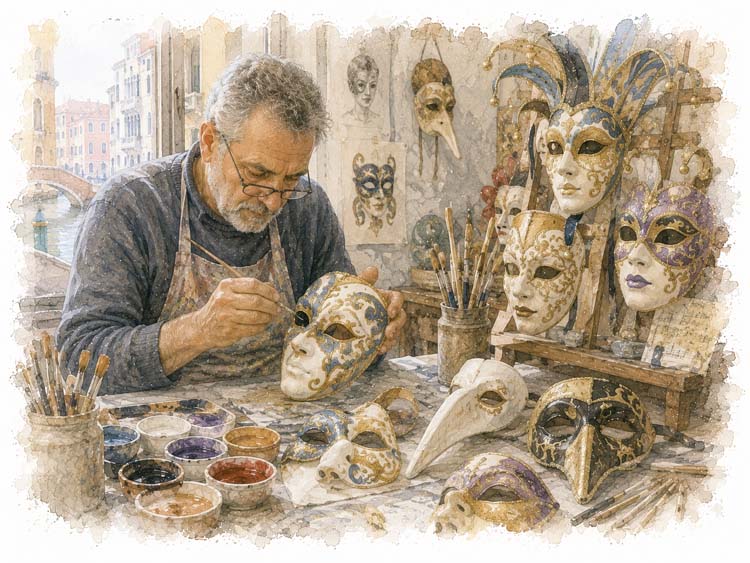
Mask-making was a recognised profession with its own rules. The mascareri adopted their guild statute on the tenth of April 1436, setting out apprenticeship, advancement, and the conditions under which masks could be made and sold. This is worth registering because it places mask-making alongside the other regulated trades of a commercial republic rather than treating it as folk costume. Somebody was inspected. Somebody could be fined.
When a Face Could Be Covered
The wearing was regulated as tightly as the making. Masking was confined at first to Carnival, and by the eighteenth century was permitted across a long season from October to June. There were days when it was forbidden outright, including St Mark's Day, Ascension, and the day the doge and the procurators were elected, and on some of those the bauta was exempted. A society that legislates the calendar of anonymity is telling you that anonymity mattered enough to be dangerous.
The Mask That Silenced You
The moretta is the object that explains the system. An oval of black velvet covering the whole face, it had no strap. It was held in place by a small button gripped between the wearer's teeth, which meant that a woman wearing one could not speak. That was the trade: it gave her the freedom to move through the city unrecognised, and it took her voice for the duration. No other mask in this collection states its own social terms so precisely, and it is worth thinking about before it is hung on a wall as decoration.
What Happened When the Republic Ended
Venice fell to Napoleon in 1797 and both crafts lost their framework at once. The glass monopoly had depended on a state willing to enforce it, and the mask trade had depended on a society that used masks; occupying powers banned the carnival and the mascareri largely disappeared. Murano's furnaces contracted severely through the nineteenth century before a deliberate revival restored the techniques from historic pieces and archives. Modern Venetian masking dates from a revival in the nineteen seventies. Neither craft is a simple survival, and describing either as unbroken would be wrong.
The Patron Institution
The patron here is the state itself, which is unusual. Venice did not simply buy glass and masks; it decided where they could be made, by whom, under what conditions, and when they could be used. The Republic's interest was commercial and political rather than devotional, and both crafts served that interest: glass was an export monopoly and the mask was a social technology that let a small, densely packed and rigidly ranked city function. When the Republic fell in 1797 both crafts collapsed, and both were revived later on different terms.