The Naval Base That Made a Craft Town
Tongyeong sits on the south coast among islands, and its craft standing comes from the navy. After the sixteenth-century Japanese invasions, the headquarters of the Korean naval command was established here, and with it a set of official workshops supplying the fleet and the administration with the goods they required, lacquerware among them. A garrison town with state workshops became a centre of skilled making, and it stayed one long after the fleet had gone.
What Ottchil Actually Is
The material is sap tapped from the lacquer tree, filtered and refined, and it is not a varnish in any Western sense. It cures into a plastic that is extraordinarily hard, waterproof, resistant to acid, alkali and alcohol, and stable for centuries; lacquered objects survive from archaeological contexts in conditions that destroy everything else organic. The sap is also strongly allergenic while raw, and lacquer workers either build tolerance over years or leave the trade.
Many Coats, Slowly
A serious lacquer object receives a great many thin applications, each cured in the humid cabinet and then ground back before the next. Cloth is sometimes laid over the wooden core to control movement, and layers of a lacquer-and-powder paste build a smooth ground. Dozens of coats over months is ordinary. The depth of a good lacquer surface is real depth, built physically, and it cannot be simulated by a thick single coat of anything.
The Core Underneath
What the lacquer sits on matters more than it appears to. Thin wood moves with humidity and will crack a hard lacquer skin, so cores are built carefully from seasoned timber, sometimes with hemp or ramie cloth laid over the joints and the whole covered in a lacquer paste ground before any finish coats. Some pieces are built over woven bamboo or over cloth alone. A lacquer object that has survived four centuries did so because somebody solved the wood problem first.
The Patron Institution
The state, through those naval workshops, and later the court. Korean lacquer with shell inlay was a high-status ware, and the Goryeo-period work is among the most refined lacquer made anywhere; very few pieces survive, scattered across a handful of museums, and they are among the rarest East Asian objects in existence. The Joseon period produced a bolder, more robust version for a wider elite.
Why Shell and Not Paint
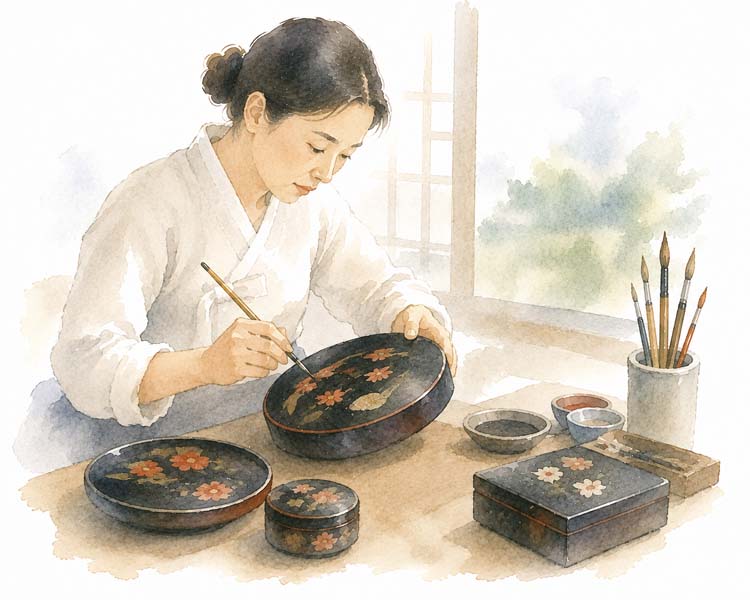
The Korean name for the ware, najeon chilgi, states the method: najeon is the mother-of-pearl, chilgi the lacquered object. Lacquer takes very few pigments. It can be blacked, reddened with cinnabar, and not much else in the traditional palette, and it has no white at all. A tradition that wants light, pattern and colour on a black ground therefore has to inlay rather than paint, and mother-of-pearl answers perfectly: it is hard, thin, iridescent, and it can be cut. The technique follows from a limitation in the material.
Two Ways to Cut Shell
The distinction is the core of the craft. In one method, shell is cut or fractured into shaped pieces and set as flat areas, which suits broad forms, flowers, birds and landscape masses. In the other, shell is drawn out into extremely fine threads, almost wire, which are then cut into short lengths and laid to build lines, scrolls and fields of tiny elements. The second is slower, finer and is where Korean work is most distinctive and least imitable.
What the Motifs Are
The repertoire is Confucian and auspicious rather than religious: the ten symbols of longevity including crane, deer, pine, tortoise and the fungus of immortality; the four gentlemanly plants of plum, orchid, chrysanthemum and bamboo; peonies, grapevines and cranes among clouds. On Joseon furniture these are laid out generously across a lid or a front, and on the finest work the shell threads build whole scrolling fields rather than isolated motifs.
Where It Stands
Tongyeong remains the recognised centre, with masters designated under the national intangible heritage system and a craft school, and the work is genuinely continuous rather than reconstructed. The pressures are cost and time: a properly built lacquer surface takes months, and the market is full of objects finished in synthetic lacquer or polyurethane with printed or plastic imitation shell, sold under the same name and at a fraction of the price, which is a difference of substance rather than grade.