A Town With No Fields
Arimatsu, now within Nagoya, was founded in 1608 on a stretch of the Tokaido between the post stations at Chiryu and Narumi. The land was poor and there was not enough of it to farm, which in most cases would have meant a settlement that failed. What this one had instead was the road, and on it a continuous stream of people walking between the two capitals with money in their sleeves and a long way still to go. In a tying workshop the sound is thread being pulled tight, over and over, thousands of times. What follows is not the story of a dyeing technique. It is the record of a town that had nothing to sell and worked out what a traveller would buy.
The Man Who Started Selling Towels
Takeda Shokuro, who lived in Arimatsu, began producing tie-dyed hand towels from Mikawa cotton and selling them to people on the road. The product was well chosen. It was cheap, light, useful, distinctive to a specific place, and it required no explanation to a buyer who had a day's walk ahead of them. Within a generation this was the town's industry. The craft did not descend from a court tradition or a temple requirement; it was invented as a commercial answer to a geographical problem, by someone who could see who was walking past his house.
The Domain Takes an Interest
The Owari domain, one of the senior branches of the Tokugawa house, recognised what Arimatsu had built and protected it, designating shibori a domain speciality and giving Takeda Shokuro formal credit for it. Protection of that kind meant a monopoly, and a monopoly meant the town could invest in technique rather than compete on price. That is the mechanism by which a roadside trade in hand towels became a body of over 150 named tying methods. Without the domain's protection there would have been no reason to develop any of them.
A Hundred and Fifty Ways to Tie
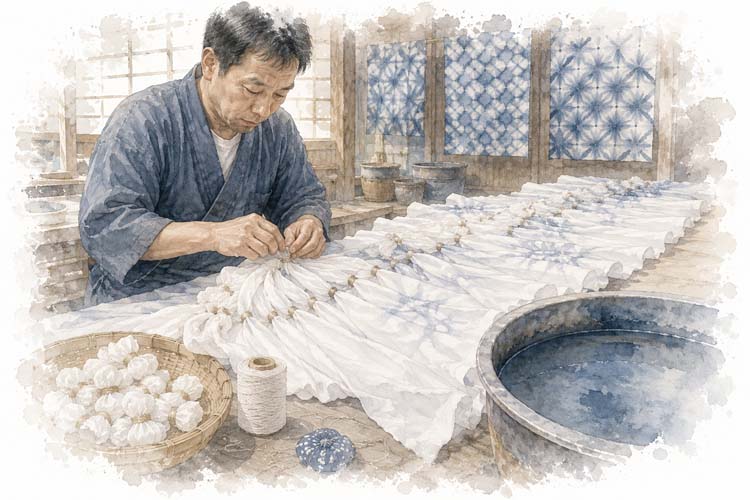
Shibori works by preventing dye from reaching parts of the cloth, and every different way of doing that produces a different result. Cloth can be bound, stitched and gathered, wrapped around a pole, folded and clamped, pinched and bound at thousands of individual points, or capped to protect whole areas. At its height Arimatsu held more than 150 distinct techniques, each with a name, each producing a recognisable pattern, and many of them requiring a lifetime to master. That proliferation is what a protected market buys. Techniques multiply when a town has no need to undercut anyone.
Where the Road Went
The Tokaido was the busiest road in Japan and Arimatsu sat on it, which was the town's entire advantage until the road ceased to be walked. The nineteenth and twentieth centuries removed the traffic, the hand towel gave way to other goods, and the industry contracted hard. What survived did so by moving upmarket, into kimono and fine dress goods where hand tying could still be justified, and by holding the techniques rather than the volume. A craft born from passing trade now depends on customers who seek it out.
The Patron Institution
The patron is a road, and the domain that policed it. There was no temple here and no court; the engine was traffic, and the Owari domain's protection is what converted traffic into a technical tradition. That combination produced a very specific commercial character which the craft has never lost. Arimatsu shibori was always made for someone who was passing through, which meant it had to be immediately impressive, portable, and unmistakably from one place. Those three requirements are still legible in the work.
Tying That Cannot Be Simulated
Technique here outlived the market that created it. All the work is still done by hand, and the reason is not sentiment. A hand-tied shibori carries irregularities in spacing, tension and dye penetration that no printed or mechanically produced imitation reproduces, because each of the thousands of bindings is made by a person and none of them is identical. That variability is the whole inheritance. In an Arimatsu workshop someone is binding a point of cloth with thread for the four thousandth time this week.