

Craft Map
The Craft Map
Regong is a valley rather than a province, and its villages lie within a few kilometres of one another along one river. The Regong arts were inscribed on the UNESCO Representative List in 2009, and that inscription covers the painting, the sculpture and the appliqué together, because in this valley they are practised by the same families.
Tongren and the Longwu Valley: The Regong Arts
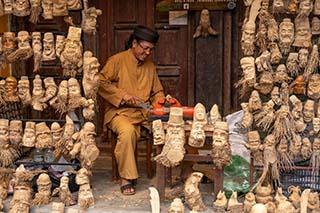
In the Huangnan Tibetan autonomous prefecture of Qinghai, on the Longwu river, Tongren is the centre of the tradition and the reason it has a name. Roughly ten thousand people here, about one in nine of the population, work in the Regong trades, which makes this the most craft-dense place in this entire collection. Painting, sculpture and barbola are carried in households rather than in institutions, and a workshop is usually a family. A Regong work's record should name the village and the household, because both are meaningful here.
Longwu Monastery: The Commission
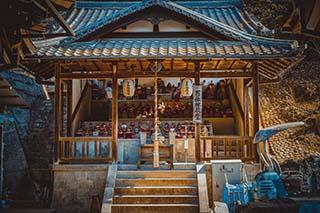
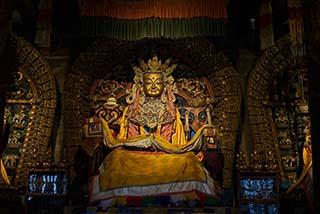
The monastery whose growth the tradition developed alongside from the thirteenth century remains the institutional anchor of the valley. It is not a workshop, but it belongs on this map because it is the reason there are workshops: the halls, their images and their cycle of repair and replacement are the demand that the whole valley answers. Any account of Regong that treats the monastery as background has inverted the relationship.
The Painting Villages: Where the Households Are
The settlements along the valley divide loosely by specialism, with concentrations of painters, of sculptors and of appliqué workers, and with both Tibetan and Tu communities practising. The distinctions matter to anyone commissioning work, because a household known for barbola is not the household to approach for a painted thangka. The valley is small enough to visit several in a day and various enough that doing so is worthwhile.
Lhasa and the Central Tibetan Style
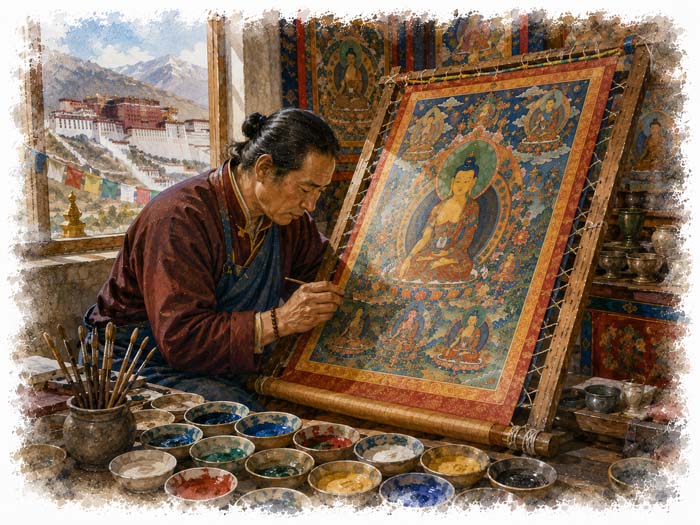
The other pole of Tibetan thangka painting is Lhasa and the great monasteries around it, where the central Tibetan manner developed under the patronage of the Dalai Lamas and the large monastic foundations. Its schools are distinct from the Amdo work of the Tongren valley in palette, in the handling of landscape and in the proportion systems taught, and a practised eye separates them readily. A record should state which tradition a painting belongs to, since Tibetan thangka covers several regional styles that are not interchangeable.
Also on the Map
The Longwu river itself, which gives the valley its shape and its name. The wider plateau monasteries of Qinghai and beyond, which are the destination for much of what is made here. And Lhasa, whose doctrine governs the iconography of every image in this valley. Which household painted a Regong image, and which hall it was made for, are the two things worth establishing.