Arts, Crafts and Living Ateliers
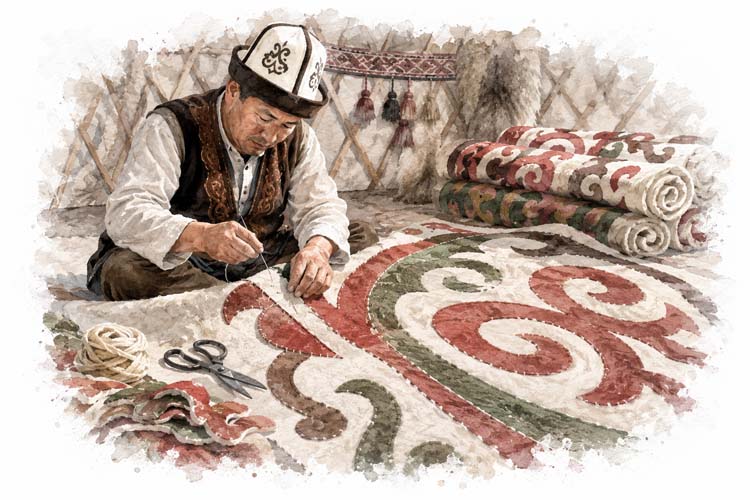
Felting is communal and physical. Wool is washed, beaten, dyed, laid out in even layers, wetted with hot water, rolled into a mat and then worked for a long stretch by several women pushing and dragging it, until the fibres bind. The cutting and stitching that follow are quieter and are done seated, frequently in groups. A large piece is beyond one person at the felting stage regardless of skill.
Reading a Shyrdak
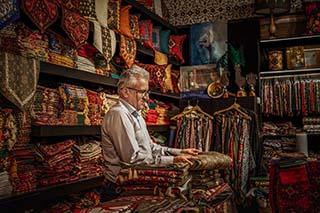
Look at the seams. Every join between two colours should be hand-stitched and then corded, and the cord should be even in tension with no puckering along the line. Turn it over: the pattern must appear on both faces, because the colours are inlaid through the thickness, and a piece with a plain or backed reverse is appliqué sold under the wrong name. Then look for the mirror twin, since the method produces two, and a seller who has both is telling you the truth about how it was made. The twin is frequently sold separately and neither piece is ever recorded as having one.
Wool, Dye and Age
Handmade felt from local mountain wool is dense, slightly uneven in thickness, and has a distinct springiness under the hand; factory felt is uniform and flat. Natural dyes give a narrower and softer range and fade gently, while synthetics are brighter and can bleed. Neither disqualifies a piece, but they should be described accurately, and a very bright multicoloured carpet presented as antique is worth questioning on the dyes alone.
The Cording, and Why It Matters
The stitched cord along every seam is not decoration added at the end; it is what holds a mosaic of separately cut pieces together and it takes a great deal of the total working time. It also draws the outline that makes the pattern legible, so a piece where the cording is thin, loose or machine-applied fails structurally and visually at once. This is the single most useful place to judge quality and it is visible in a photograph, which is more than can be said for most of the checks in this collection.
How Long One Takes
The felting is a day's communal work for the sheets. The cutting is quick. The stitching and cording are what consume the time, since every seam in the design has to be joined and then corded by hand, and a densely patterned carpet has an enormous total length of seam. A large piece is weeks of work after the felt exists, which is why simple bold patterns are cheaper than intricate ones in a way that has nothing to do with taste.
Ateliers, Villages and Artisan Encounters
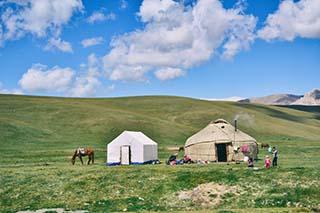
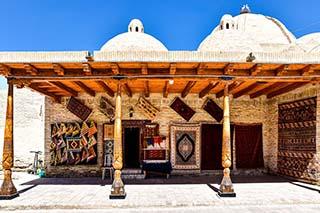
Naryn province, high in the interior, is the heartland of the craft and the place where the summer pasture tradition is most intact. Workshops and women's cooperatives operate there and around Issyk-Kul, and the high lake and the surrounding valleys are the practical route in. Yurts are still raised and used in the summer months rather than only for display, which makes this one of the few places the objects can be seen doing their actual job.
Tourwit Editions and Provenance
Tourwit commissions directly from felt-makers and cooperatives in Naryn and the surrounding provinces, paying before work begins and leaving the major share of what a piece realizes with the makers, which for a felted carpet means the group who worked it rather than one name. The record lists them, the province, the wool, the dye class, and states whether the piece is the cut-and-swap mosaic or the surface-laid type, because the market uses one word for both.
Why These Works Matter
A technique that turns one act of cutting into two finished carpets, wastes nothing, and produces an object with no reverse is a genuinely elegant solution and it was arrived at by herders working with the only material they had in quantity. It is also on a UNESCO list precisely because nothing institutional protects it. Recording who made a piece, in which province, by which of the two methods, is the least that can be done for a craft in that position, and it costs nothing at the point of purchase.