


Craft Map
The Craft Map
Kyoto's crafts are distributed by district rather than by village, and in this city the district name is frequently the product name. Yuzen dyeing, a technique closely associated with this city and with Kanazawa, was designated an Important Intangible Cultural Property in 1955, and that designation is one of the few formal marks available anywhere in this collection.
Nishijin: The Figured Silks
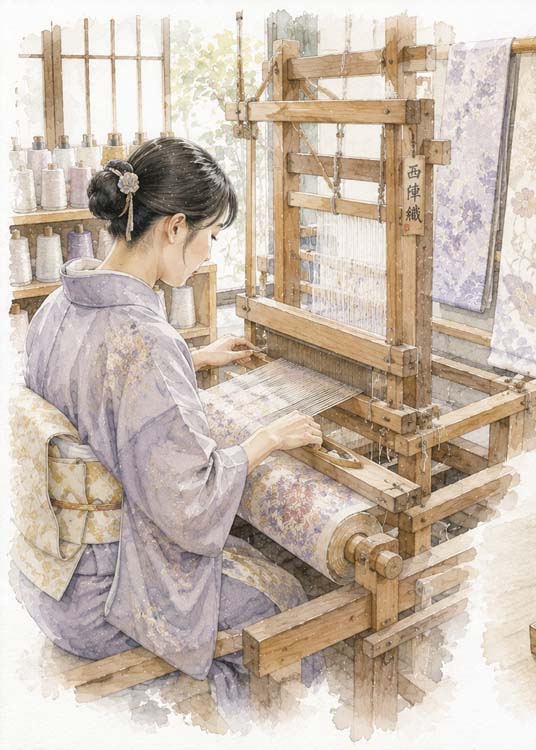
The cloth is Nishijin-ori. In the northwest of the old city, the district named for the western army's camp in the Onin War has produced Japan's most technically demanding woven silks since the late fifteenth century. The workshops are houses, the looms are inside them, and the industry has contracted sharply while retaining its top end. A record naming Nishijin should be treated as a claim about where a cloth was woven, and it is a claim worth checking, because the name is also used loosely for designs woven elsewhere.
The Lacquer and Repair Workshops: Kintsugi
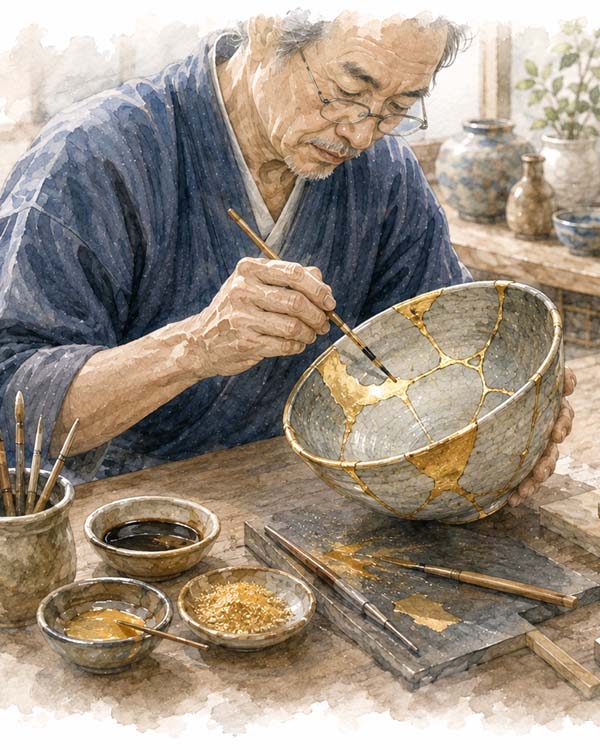
Kintsugi has no single district, because it follows the lacquer trade and the tea trade rather than occupying a quarter of its own. Its practitioners are found across the city, frequently working on objects that belong to tea schools, temples and collectors rather than making anything new. That is worth stating plainly: this is a service craft as much as a producing one, and much of the finest work in it is done on other people's property and never enters a market at all.
The Braiding Houses: Kumihimo
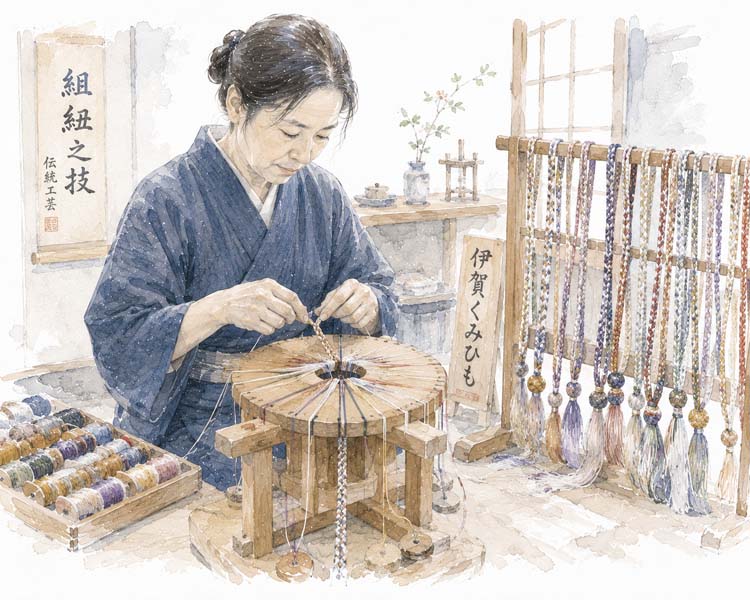
Braiding is likewise a craft of individual houses rather than a quarter, historically attached to the temple trade, then to armourers, and now largely to the kimono trade for obijime and to the mounting of scrolls. The long-established braiding houses of the city hold pattern archives running to thousands of structures, and a cord's record should name the house, because in this craft the structure is the identity.
Iga: The Other Braiding Town
Kumihimo is not only a Kyoto craft. Iga, in Mie prefecture, is the second great braiding centre and is a designated traditional craft in its own right, historically associated with the cords and lacing that armour and swords required rather than with court and temple work. That different customer produced different braids: harder, denser, made to bear load. A record should name the town, because Kyoto and Iga are separate traditions with separate reputations.
Also on the Map
The great temples and their treasuries, which are the largest holders of historic Kyoto textile and lacquer work. The tea schools, less a place than the standard against which this city's objects have been judged for four hundred years. And Kanazawa, the other yuzen centre, which shares a designation with Kyoto and should not be confused with it. Which house, and after that, for whom. Kyoto rewards a record that answers both.