




Craft Map
The Craft Map
Swordmaking geography works differently from every other craft here, because for the nihonto the historic map is a system of attributions and the modern map is a system of licences. The five traditions, the gokaden, are Yamato, Yamashiro, Bizen, Soshu and Mino, and a school attribution is a technical statement about steel, forging and hardening rather than a postal address.
Osafune, Bizen: The Old Tradition
In Okayama, the Osafune area was the most productive swordmaking district in Japanese history, home to the Osafune and Fukuoka Ichimonji schools, and its work is identified by a flamboyant clove-shaped temper line and a distinctive grained surface. It remains a centre for the study and appraisal of blades. A record naming Bizen or Osafune is placing a blade within the most heavily documented body of work in the field, which is an advantage and also a warning, because it is correspondingly the most imitated.
Seki, Mino: The Working Trade
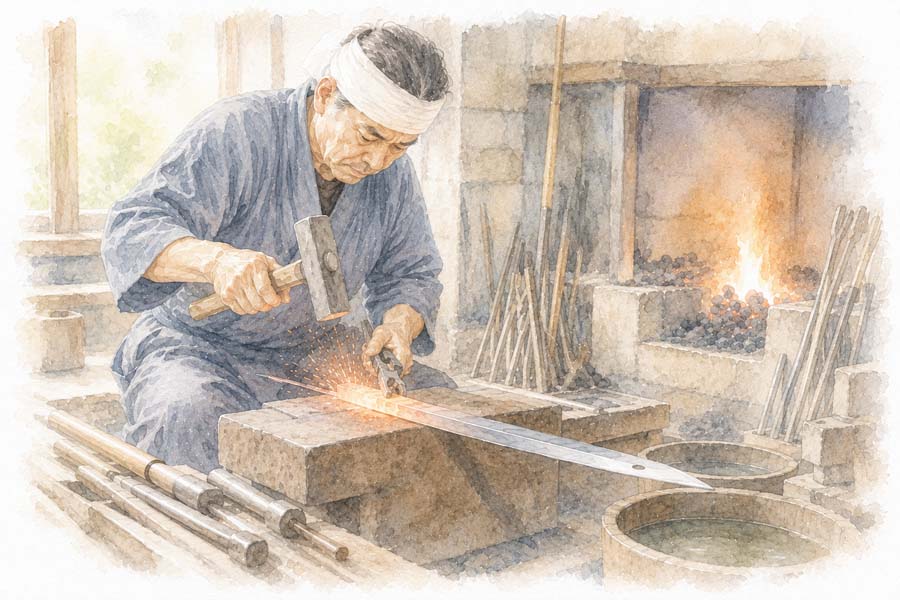
In Gifu, Seki was the centre of the Mino tradition, whose founding figures include Shizu Saburo Kaneuji, with Kaneshige named as the founder of smithing in the town itself. Mino work was made in quantity and had a practical reputation, and Seki has remained a cutting-edge town into the present, with an industry in knives and blades alongside its licensed sword smiths. It is the most continuously working of the old sword towns.
The Nittoho Tatara, Shimane: The Steel
In the old iron-sand country of Shimane, a single furnace operated by the sword preservation society produces the tamahagane that licensed smiths use, firing three times a year in runs of around seventy two hours. This is not a sword town and no blades are made there. It belongs on the map because it is the sole source of the material, and because any account of the modern craft that omits it has left out the constraint that governs everything else.
Also on the Map
The polishing studios, which are dispersed rather than concentrated and which determine what is visible of any smith's work. The fitting makers, scabbard makers and hilt wrappers, whose trades are separate and whose work is frequently of a different date from the blade it accompanies. And the shrines and museums holding designated blades, which set the reference standard. A Japanese sword carries three provenances that happen to travel together: the blade, its polish and its mounting.