Who the Peranakans Are
Chinese traders settled in the Malay ports over centuries and married local women, and their descendants formed a distinct community with its own culture: Chinese ancestral religion and family structure, a Malay-based creole language, a cuisine that fuses both, and from the nineteenth century an English-language education and a prominent role under British administration. The men are baba, the women nyonya. They were mercantile, wealthy and self-consciously distinct from the later waves of Chinese immigration, whom they regarded as quite different people.
The Three Ports
The Straits Settlements were Penang, Malacca and Singapore, British-held ports on the trade route between India and China, and the Peranakan communities of Penang and Malacca are the oldest and most distinct. Malacca's goes back furthest, to the Malay sultanate and then Portuguese and Dutch rule; Penang's grew under the British from the late eighteenth century. Both towns are UNESCO-inscribed for their surviving shophouse architecture, and Singapore, the third of the settlements, has its own Peranakan collections.
Beads a Millimetre Across
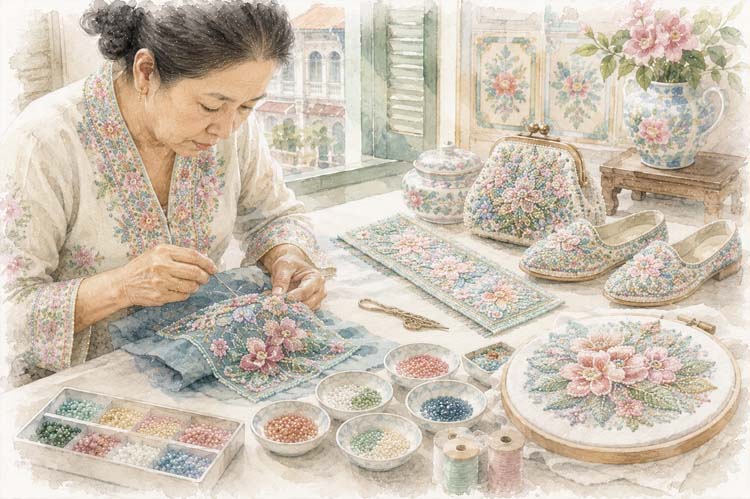
The material is the point. The finest nyonya work uses cut beads of roughly one millimetre, faceted rather than round, so that each one throws a spark of light, and a slipper front can carry many thousands of them. They came from the European glass industry, principally Bohemia, and reached the Straits through the same trade that carried everything else. The craft is entirely dependent on an imported industrial product made four thousand miles away.
Shading With Glass
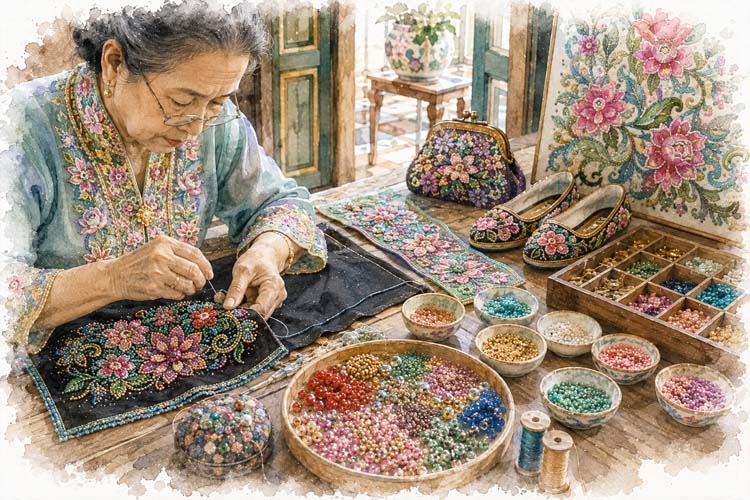
What distinguishes this from most beadwork is the ambition. Rather than geometric fields, nyonya panels attempt pictorial rendering: peonies and roses with graded petals, phoenixes, butterflies, birds among foliage, worked in beads of many closely related tones so that colour shifts smoothly across a form. Achieving a gradient in a medium of discrete units, one bead at a time, is the technical achievement, and it requires an enormous sorted palette held in advance.
Sourcing the Palette
The dependency on imported beads had a consequence that shaped the whole craft: a beadworker was limited to the colours a shipment happened to carry, and a shaded flower needs many closely spaced tones of one hue. Households therefore accumulated and hoarded beads over years, traded and inherited them, and a large sorted collection was itself a form of capital. Running out of one tone mid-panel could halt a piece indefinitely.
The Patron Institution
The family, and specifically the marriage market. Beadwork was a demonstration of a young woman's patience, eyesight and skill, produced before marriage and assessed by prospective in-laws alongside her cooking. It was not a trade and it was not sold. Slippers were the principal object: the beaded panel was worked at home and then sent to a cobbler to be made up into footwear, so even the finished item passed through two pairs of hands, only one of them credited.
A Hybrid Vocabulary
The motifs come from everywhere the community did. Chinese auspicious symbols sit beside European naturalistic flowers rendered with Victorian shading conventions, Malay colour preferences and occasional Art Nouveau and Art Deco borrowings as fashions reached the ports. It is a genuinely creole visual language rather than Chinese work made abroad, and reading it as merely Chinese work made abroad misses what the community actually was and how deliberately it held itself apart.
Why the Slipper
The dominant object is footwear, which takes some explaining. Peranakan women wore beaded slippers with the sarong kebaya, and the beaded panel was the visible upper, so it was a piece of personal display worn daily rather than an heirloom put away. Working the front of a shoe also sets a convenient scale: small enough to finish, large enough to show ambition, and curved, which makes the beading harder than a flat panel.
Decline and Revival
The tradition faded through the twentieth century as the social system that produced it changed: girls went to school and then to work, marriages stopped being arranged on those terms, and nobody had months to spend proving a point in glass. What exists now is a revival, supported by museums, heritage designation in both towns and a small number of practitioners and collectors, alongside a substantial trade in machine-made and imported imitations sold to visitors in both towns.