Designed Around a Departure
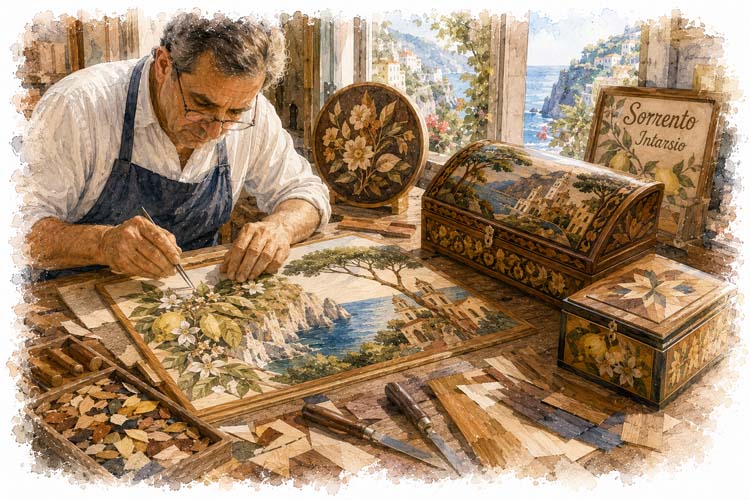
Intarsia is the working of pictures in wood, using veneers of different species cut and fitted so the image is made of the material rather than applied to it. Sorrento has practised it since the eighteenth century, and the craft grew in the eighteenth and nineteenth as the town became a regular stop for European travellers on the Grand Tour. That is the fact that shapes everything else. A trade selling to people who are about to board a ship makes portable things, and it makes them to be understood immediately by somebody who has no local knowledge and a week to decide. Every constraint that shaped this craft follows from that sentence: the size, the subjects, the finish, and the fact that a piece had to survive being packed.
The View, Sold Back
What those buyers wanted was the place itself, which is why so much Sorrentine inlay depicts the bay, Vesuvius, dancing figures, ruins and coastal scenes. This is worth registering without sneering at it. The craft was not debased by working to that demand; it was defined by it, and the technical standard it reached was extremely high precisely because the competition for those buyers was fierce. The pictorial subject matter is the mark of the market, and the quality of the cutting is the mark of the workshop.
A School, in 1886
The formalisation came late and deliberately. The Sorrento school of art was established in 1886 to teach and preserve the techniques the workshops had developed, which places this craft in the same nineteenth-century movement that produced design schools across Europe: a response to industrial competition and to the fear that a hand trade would be undercut. Its students and masters, among them names still attached to surviving furniture, are the reason the tradition has a documented line rather than an anecdotal one.
Colour Without Paint
The discipline of the craft is that every tone must be a wood. Light comes from maple or holly, darkness from walnut or ebony, warmth from olive, cherry and orange, and the greens and greys from staining or from species chosen for it. A shaded curve is achieved by scorching the veneer in hot sand, which browns the edge in a gradient. Nothing is painted. Once that constraint is understood the achievement of a good panel becomes visible: the maker was drawing with a timber merchant's inventory, and every tonal decision had to be available in stock before it could be made.
The Older Tradition Underneath
Italian intarsia is much older than Sorrento's version of it. From the fifteenth century onward it was used for the great choir stalls and study rooms of central and northern Italy, where inlayers constructed illusions of depth, open cupboards, instruments on shelves, cities in perspective, in wood alone. That is the tradition the Sorrentine workshops inherited a technique from and put to a different purpose. Knowing it exists changes how a Sorrentine box looks: the same method that once demonstrated the new science of perspective was later used to show a visitor the view from their hotel.
The Patron Institution
The patron is the visitor, which is rare in this collection and worth naming plainly rather than dressing up. There was no court here and no temple commissioning inlaid work at scale. The trade answered to a stream of foreign buyers with money and limited time, and later to an export market that followed the same taste. The consequence is a craft with no ritual function whatsoever, which makes it unusually honest about what it is: skilled decorative work made to be sold.
What Survives of It
The nineteenth-century workshops are largely gone and the trade contracted severely, but the craft did not end. A museum in the town holds the historic range, both Sorrentine work of the eighteen hundreds and Italian intarsia from the fifteenth to the eighteenth century, which lets a visitor place the local tradition inside the larger one. A small number of workshops continue, and the distinction that matters in the current market is between hand-cut inlay and machine-cut or printed imitation, which is considerable and is not always volunteered. The gap between the two is the largest of any craft on this map, because a printed panel costs almost nothing and can be made to photograph identically.