







Craft Map
The Craft Map
The northern stitching traditions divide by territory, and the divisions are old domain boundaries rather than modern administrative ones. Three traditions are recognised as the major northern types, and a record that says only sashiko has failed to distinguish between them.
Tsugaru, Aomori: Kogin-zashi
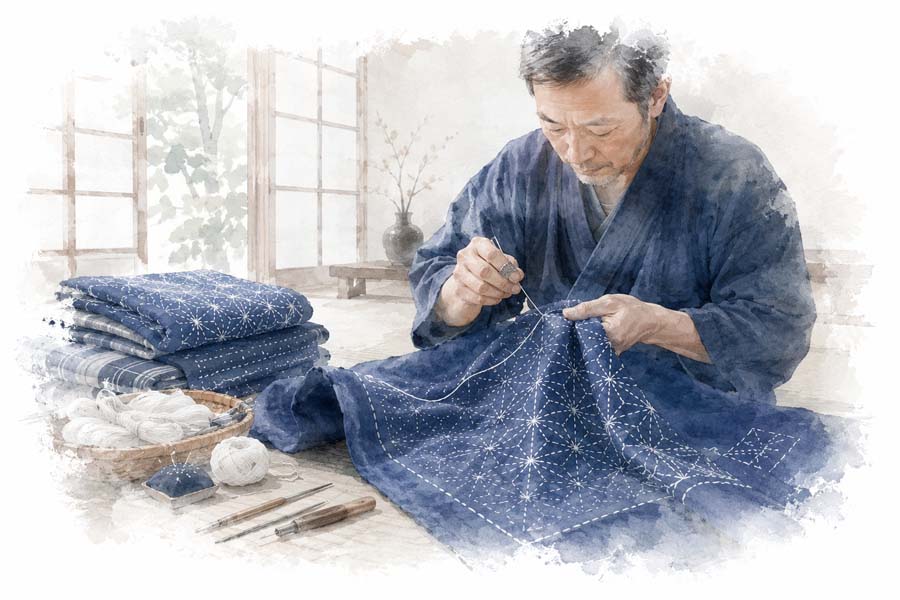
The western part of Aomori, the old Tsugaru domain, is where the cotton prohibition applied and where kogin-zashi developed in response. The work is white cotton on indigo hemp, built from diamond units in counted-thread geometry, and it is the most formally elaborate of the three traditions. It was worked by rural women from the late Edo period onward. A record naming Tsugaru is naming both a technique and the specific legal circumstance that produced it.
Nanbu, Aomori: Hishi-zashi
The eastern part of the same prefecture, the old Nanbu country, developed hishi-zashi on the same counted-thread principle with its own geometry and its own conventions of colour, which run richer than Tsugaru's austerity. The two traditions are neighbours, they are frequently confused, and the difference is legible to anyone who has looked at both. Where a record can specify Nanbu rather than Aomori, it should.
Shonai, Yamagata: The Fishermen's Coats
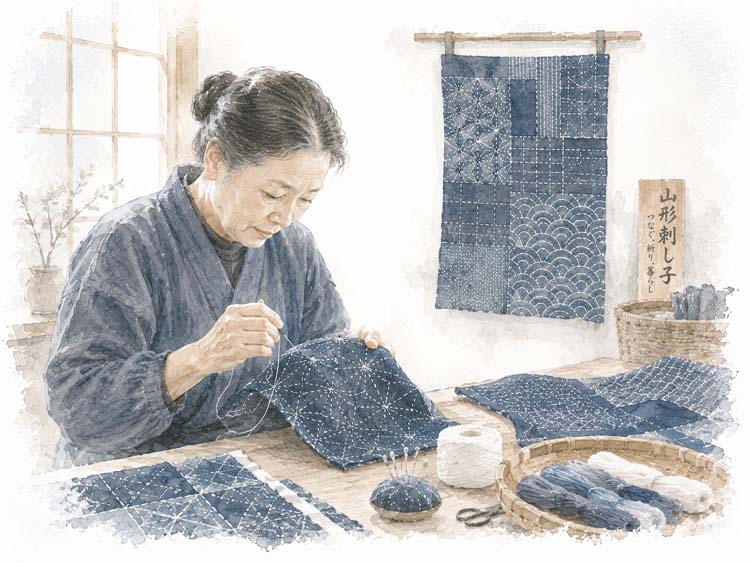
South along the coast, the Shonai region of Yamagata produced the third of the major traditions, characterised by stripe patterns and closely associated with fishermen's working coats. Its purpose is the most nakedly practical of the three, since a working coat at sea has to be warm, strong and quickly mended. Shonai work is plainer than the Aomori traditions and should be judged by durability and evenness rather than by complexity.
Also on the Map
The indigo dyers who supplied the grounds, without whom the characteristic appearance does not exist. The hemp fields, since the whole tradition is premised on hemp rather than cotton cloth. And the regional museums, which hold most of the surviving historic garments, because these were working clothes and very few families kept them once they were no longer needed. The region is the identity in northern stitching, and the general term hides it.