Arts, Crafts and Living Ateliers
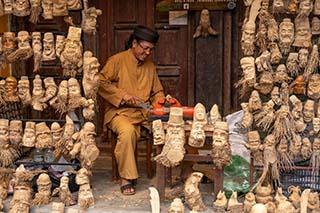
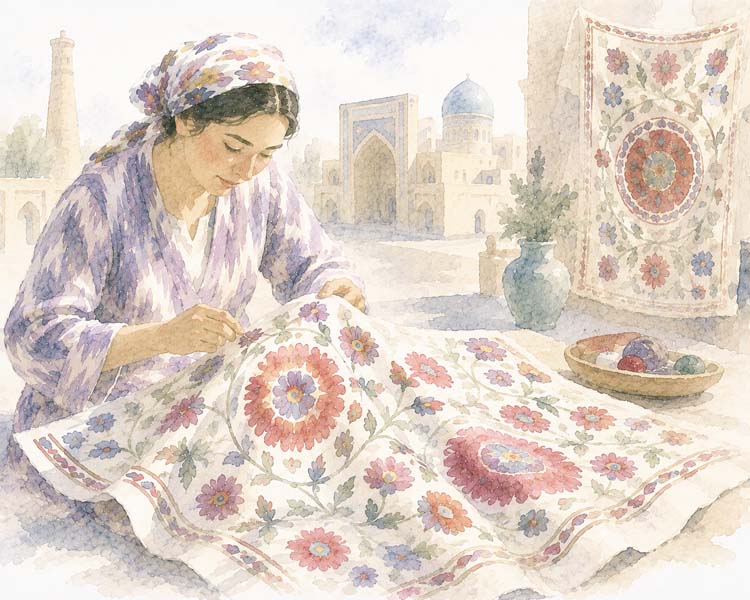
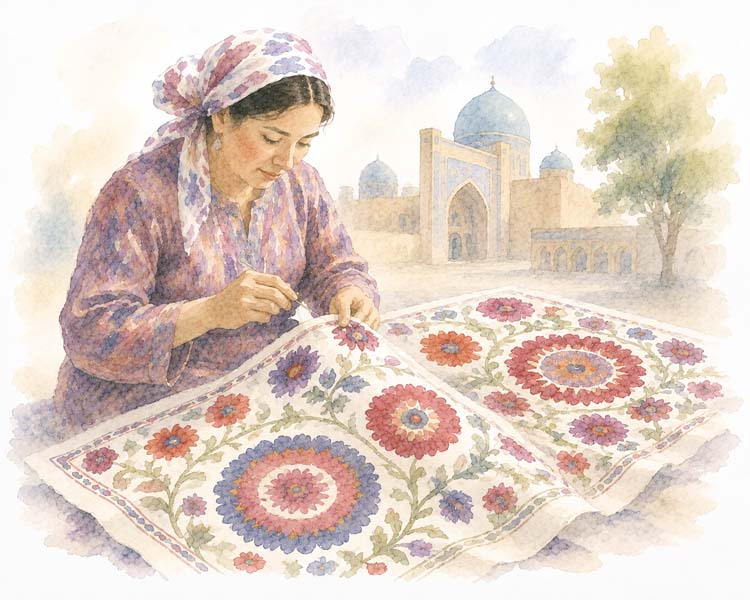
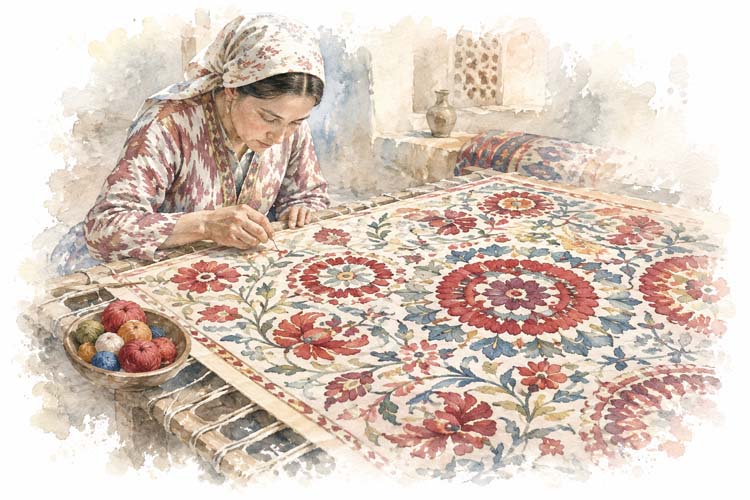
The work is done seated, with the cloth stretched on a small frame or held over the knee, in courtyards and rooms rather than in workshops. Where a household is working traditionally, several women embroider at once on different strips of the same piece, which makes the process social in a way that solitary needlework is not. The dyeing, where it is still done naturally, happens separately and usually by specialists.
Reading a Suzani
Go to the seams first. Lay the piece flat and follow a motif across each join: in authentic strip-built work the alignment slips, the scale shifts slightly, and the silk changes tone where one woman's dye lot met another's. Then look at the reverse, which on hand work is neat but clearly hand-worked, with visible thread paths and no machine backing. Check whether the silk has the soft irregular sheen of floss or the flat uniformity of rayon, which is common in modern commercial pieces.
Dye, Fading and Age
Natural dyes here were madder and cochineal for reds, indigo for blue, pomegranate rind and onion skin for yellows, and they fade unevenly and beautifully, with reds moving toward soft rose and greens shifting as the yellow component goes. Synthetic dyes arrived at the end of the nineteenth century, so their presence is a dating tool: they tend to fade flatly or to bleed when damp. Turn a piece over and compare the colour on the reverse with the face, since the difference tells you how much light it has seen.
The Deliberate Flaw
There is a tradition here, as in several Islamic craft cultures, of leaving an intentional irregularity in the work on the grounds that perfection belongs to God alone. A reversed motif, an interrupted border, a single element in the wrong colour. It is worth knowing about because it is real, and also worth holding loosely, because it is the readiest explanation available to a seller for any mistake at all.
How Long a Dowry Took
The timescale explains the quality. A girl's embroideries were begun years before her marriage and accumulated steadily, with the largest pieces representing many months of several women's intermittent work. Nobody was paid and nobody was in a hurry, and the result is a density of labour that no commercial production can reproduce at any plausible price. When people say old suzanis are better, this is the actual mechanism rather than nostalgia.
Ateliers, Villages and Artisan Encounters
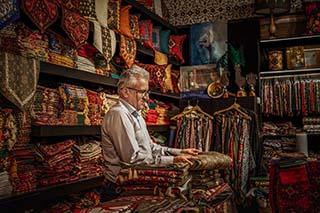
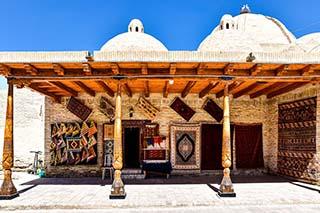
Bukhara and Samarkand are the two great destinations and both old cities are World Heritage sites, so the architecture and the textiles can be seen in a single visit. Embroidery is sold in the covered bazaars and the converted trading domes of Bukhara, and workshops and cooperatives operate in both cities and in the villages around Nurata and Urgut. The Fergana Valley to the east is a separate journey and a separate craft.
What the Ground Cloth Tells You
Turn the piece over and look at the cloth itself, not the embroidery. Handwoven cotton is narrow, so an old suzani's ground is built from strips of a consistent width with a visible slubby irregularity in the weave. Machine-woven cotton is wide, even, and needs no piecing at all, so a large modern ground may have no seams whatever. This is independent evidence from the stitching and it is harder to fake, because it means sourcing handwoven cloth before any needle is picked up.
Tourwit Editions and Provenance
Tourwit commissions directly from embroiderers in Bukhara, Samarkand and the Nurata villages, paying before work begins and leaving the major share of what a piece realizes with the makers, which for a strip-built suzani means more than one name. The record lists every woman who worked a strip, the town, the ground cloth, the stitch, and whether the dyes are natural or synthetic. Old dowry pieces sold out of households under economic pressure are not handled.
Why These Works Matter
Most textile traditions concentrate a piece in one pair of hands and then lose the name. This one distributes a piece across several pairs of hands and then loses all of them at once. The seam that does not quite line up is the record the object kept of its own making, and it is the only record that survived. Writing down who worked which strip is a small thing, and no one has ever done it.