Arts, Crafts and Living Ateliers
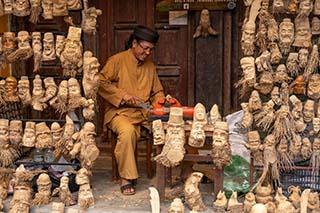
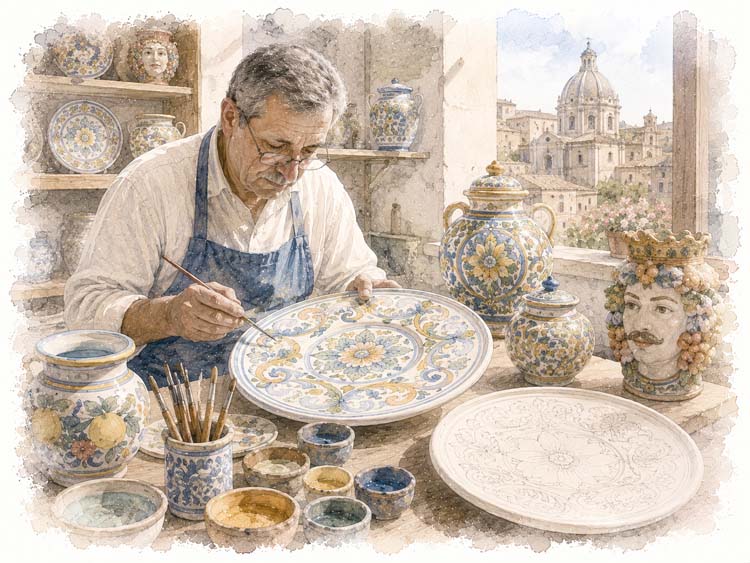
Caltagirone is a working ceramics town rather than a preserved one. Workshops run along the streets below and around the staircase, kilns are in use, and the trade is visible in the ordinary way that a trade is visible when a place actually lives on it. The scale ranges from single potters to established studios, and the same workshop will often be producing both traditional forms and pieces designed for a contemporary market, frequently by the same hands on the same day.
How a Tin-Glazed Piece Is Made
The body is thrown or moulded from local clay and fired once to biscuit. It is then dipped in a tin-opacified glaze, which dries to a chalky white surface, and painted directly onto that with metallic oxides. The second firing fuses glaze and colour into a single glassy layer. The consequence a buyer should know is that the painting happens in one pass with no correction possible, and that the colours change substantially in the kiln, so the painter is working from experience rather than from what they can see. Oxides that look brown and dull on the raw glaze come out of the kiln as blue, green or yellow, which means the decoration is executed almost blind.
Reading Caltagirone Work
Look at the back and the foot, where a hand-thrown piece shows throwing rings and a slightly uneven glaze line and a slip-cast piece does not. Look at the brushwork under the glaze rather than on it: painted-over-glaze decoration sits on the surface and wears, and it is the commonest shortcut. Ask for the workshop's name and mark. And treat the classic motifs, the heads, the pine cones, the blue and yellow vocabulary, as the beginning of the enquiry rather than the end, since they are what imitation copies first and what a genuine workshop will discuss most readily, because they know exactly how widely they are reproduced.
The Staircase as a Reference Collection
The most useful hour a collector can spend here is on the steps. Because the 1954 panels were each made by a different workshop and arranged to trace the town's stylistic development, the staircase functions as a free and permanent reference collection of Caltagirone's own repertoire. Walking up it in sequence is a course in what the local vocabulary actually consists of, and it makes the difference between a local piece and a generic Italian one much easier to see afterwards. No museum in this collection offers the same thing for free and in the open air.
Tile Is Not Tableware
The town produces two quite different bodies of work and they are often conflated. Architectural tile is made flat, in series, to cover a surface and be seen from a distance, and its drawing is bold because it has to read at three metres. Vessels and figures are made in the round, judged in the hand, and carry finer painting. A workshop that excels at one does not automatically excel at the other, and the staircase is architectural work rather than a display of the town's finest brushes. Knowing which of the two traditions a piece belongs to is the first step in judging it.
Ateliers, Villages and Artisan Encounters
The town is inland and takes deliberate effort to reach from the coast, which has kept it a working place rather than a stop on a circuit. The ceramics museum holds the historical range, and the workshops are approachable. The other Val di Noto towns are within reach and are worth seeing as the architectural half of the same story, since the tile and the buildings were produced by the same post-earthquake economy.
Tourwit Editions and Provenance
Tourwit works directly with ceramic workshops in Caltagirone rather than through intermediaries. Artisans are paid before the work begins and retain the major share of what a piece realizes. Editions are limited by what a kiln can hold and a painter can decorate, and each work is documented at source with its workshop, its painter and its firing, so that the record travels with the object and can be distinguished from the very large volume of Sicilian-styled ceramics made elsewhere.
Why These Works Matter
This is a craft that survived an earthquake by rebuilding the town, and then, three centuries later, was deliberately memorialised by the town it had rebuilt. The staircase is the only object of its kind in this collection: a commission whose purpose was to display a local craft's entire history in public, permanently, underfoot. Owning a piece from here connects to that, and the workshop name is what connects it. Without the name the object is simply Sicilian-styled ceramic, of which the world holds a great deal.