A Civilisation That Valued Cloth Above Gold
Europeans arriving in the Andes looked for metal and misread what they found. In the Inca system the supreme luxury, the supreme gift and the supreme sacrifice were all textile. Cloth was accumulated in state warehouses, given to secure loyalty, and destroyed ceremonially in quantities that made the point unmistakable. Understanding that single inversion is the key to everything else about Andean weaving: a society organised around cloth develops fibre standards, a fibre hierarchy, and a legal apparatus for controlling access to the top of it. Everything technical about Andean weaving follows from a society that treated cloth the way others treated bullion, and none of it is explicable without that.
The Fibre Hierarchy
Three camelids supply the fleece and they are not equivalent. Llama is coarse and is a pack animal's coat. Alpaca is the working luxury, soft, warm and available in a wide natural colour range. Vicuña is the extreme: a wild animal, shorn rarely, producing a fibre of roughly twelve microns, around seven finer than the best cashmere. Under the Inca only the ruler held vicuña herds and only he wore the cloth made from them, a restriction enforced with the seriousness a state monopoly on its most valuable commodity tends to attract.
Cumbi
The name for the finest grade of Inca cloth is cumbi, and its specification was extraordinary: a tapestry structure in vicuña and the finest cotton, worked at thread counts that have been recorded above six hundred to the inch. It was made by dedicated specialists rather than by households, and it was reserved. For a collector the number is worth holding onto because it sets a standard that modern hand weaving does not attempt: what survives from that tradition today is descended from it rather than equal to it, and honest sellers say so.
The Loom That Did Not Change
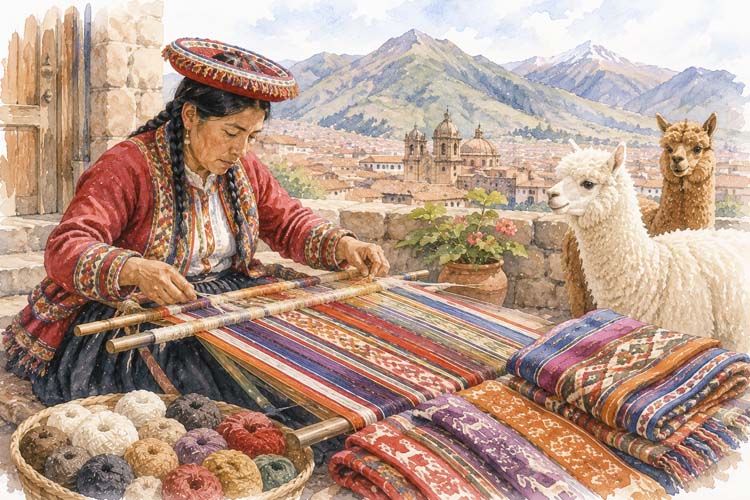
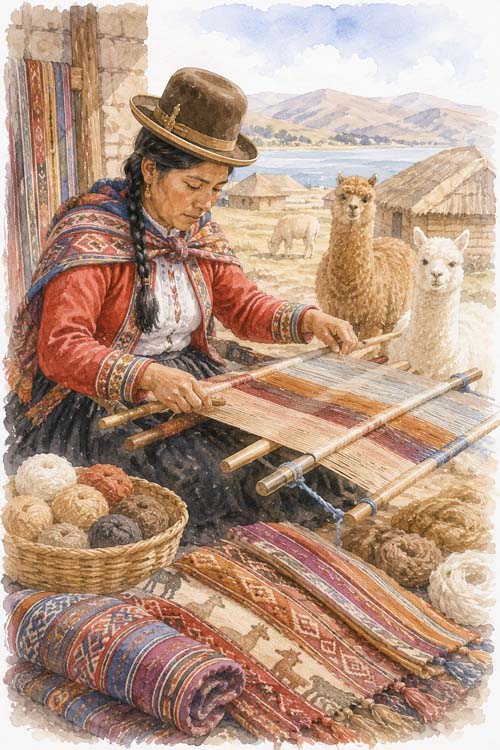
Andean weaving is done on the backstrap loom, in which the warp is tensioned between a fixed point and the weaver's own body, so that tension is controlled by leaning. It is portable, it costs almost nothing, and it produces warp-faced cloth of a density that a frame loom struggles to match. The Spanish introduced treadle looms and sheep, and both took hold, but the backstrap loom was not displaced. It remains the equipment on which the finest work in this region is still made, which is unusual: in most places the older technology became the folk one and the newer took the top of the market.
Colour Before the Conquest
The dye tradition is as old as the weaving and was equally systematic. Cochineal, the insect that lives on the nopal, gives a red of a saturation Europe could not match and became one of the most valuable commodities crossing the Atlantic. Indigo supplies the blues, and a long list of highland plants, barks, nuts and lichens the rest. The camelids themselves supply a natural palette from white through fawn and grey to near black, so a substantial part of Andean colour is not dye at all but the animal, sorted by fleece before spinning begins.
The Patron Institution
The patron was the state, and then it was nobody. The Inca system maintained specialists, supplied fibre, and consumed the output at scale; the conquest removed all three at once. What followed was four centuries in which weaving continued as household production for household use, without a market that valued fineness, and the technical peak was not maintained. That is the honest shape of this tradition: an extraordinary summit, a long descent, and a deliberate modern effort to recover ground. Saying that plainly is more useful to a buyer than implying an unbroken descent from the imperial workshops.
Recovering What Was Nearly Lost
The recovery is recent and documented. Organisations working out of Cusco have spent decades locating surviving knowledge in highland communities, reviving natural dyeing from plants, nuts and bark, and putting complex structures back into production by paying properly for them. This matters commercially as well as culturally, because it means the difference between a piece woven to a recovered traditional structure and one woven quickly for a market is now a real and identifiable distinction rather than a romantic one.