












Craft Map
The Craft Map
Sèvres is a single institution with a documented address and an unusually complete archive, so its map is short and its provenance questions are more answerable than anywhere else in this collection. There is no Geographical Indication; instead there are factory marks, painters' and gilders' marks and date letters, which together allow attributions of a precision other crafts cannot approach.
Sèvres: The Manufactory
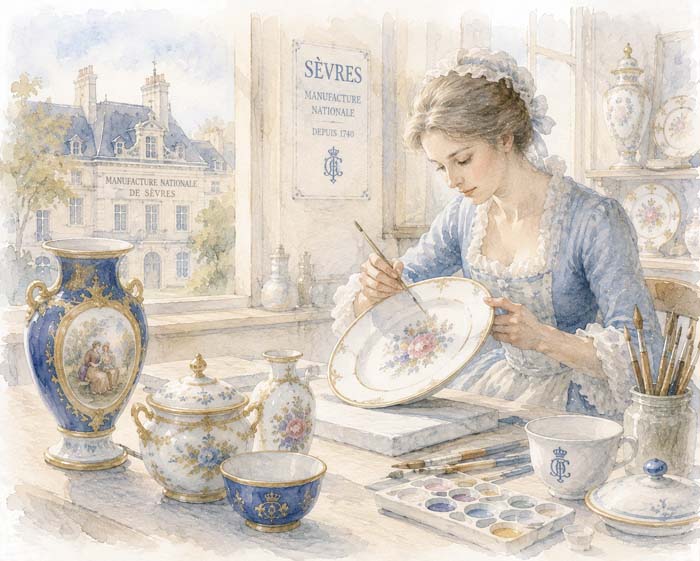
On the Seine between Paris and Versailles, the town has held the works since 1756, when it moved from Vincennes at Madame de Pompadour's urging to be nearer her estate at Bellevue. The manufactory still operates on the site and still makes both soft and hard paste. A record naming Sèvres is naming a specific institution rather than a region, which is why the marks matter so much: they identify not only the factory but frequently the individual painter and gilder and the year.
Vincennes: Where It Started
The enterprise was founded at Vincennes before the move, and Vincennes-period work is a distinct and highly regarded body of material that predates the royal designation of 1759. It should not be described as Sèvres. Where a piece is early enough to belong to that period, saying so is both more accurate and, generally, more valuable than the broader name.
Limoges: The Missing Ingredient
The kaolin found near Limoges in the later 1760s is what allowed Sèvres to make true hard-paste porcelain from around 1769, having worked in soft paste until then. This belongs on the map because the single most important material fact about Sèvres for its first two decades is an absence, and this is where the absence was finally remedied. The same city holds an entirely separate enamel tradition that should not be confused with either.
Also on the Map
Versailles, where the annual exhibition was held and where much of the output went. Meissen, the Saxon manufactory that had hard paste first and against which Sèvres was implicitly measured. And the foreign courts and national collections that received Sèvres as diplomatic gifts, and hold a substantial share of the finest work. Paste, year, and hands: the Sevres archive can usually answer all three, which is rare enough to be worth using.