Two Traditions, One Metal
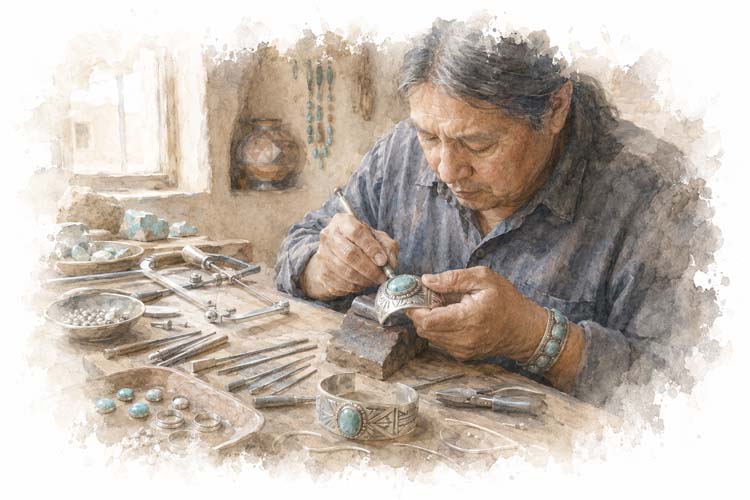
Silversmithing reached the Southwest from Mexico in the middle of the nineteenth century, passed to the Diné first and from a Diné smith to the Zuni around 1872. Within two generations the two had diverged completely. Diné work is heavy silver with a single large stone and stamped or sandcast surfaces, where the metal carries the piece. Zuni work reduced the silver to a framework and gave the whole surface to stone. Hopi work, later again, abandoned stone almost entirely for cut overlay.
Why Zuni Went to Stone
Because the lapidary was already there. Zuni had worked shell, turquoise and jet into beads, inlay and fetish carvings long before any silver arrived, in a tradition running back through the ancestral Pueblo world and its long-distance trade in shell from the Pacific coast and macaw feathers from Mesoamerica. Silver gave that existing skill a new armature. It did not create the skill, which is why the work looked finished from almost the beginning.
The Techniques
Four families of work account for most of it. Needlepoint sets many small stones cut to elongated points. Petit point sets small ovals and teardrops. Cluster work arranges larger stones radiating from a centre. Channel inlay sets flat stone into silver compartments and grinds the whole surface flat so metal and stone are level. Beyond those sits mosaic inlay, which uses turquoise, coral, jet, spiny oyster and mother of pearl to build figurative images.
The Stones
Turquoise from the Southwest mines carries recognisable character: the blue of Sleeping Beauty with almost no matrix, the greens of Royston, the spiderweb matrix of Lander Blue. Most of those mines are worked out or closed, which has pushed prices for natural American turquoise to levels that make treatment and imitation commercially attractive. Coral comes from the Mediterranean, jet is local, and the reds frequently come from spiny oyster shell rather than coral at all.
The Patron Institution
The pueblo and its household workshops, mediated by the trader. Zuni Pueblo has been continuously occupied for centuries and the work is made within it, family by family, with techniques and stone sources passing between generations. Traders shaped what was made from the 1920s onward, commissioning for the eastern market and introducing the cluster and needlepoint formats that are now read as traditional. The tribal arts and crafts enterprise and direct sales now sit alongside the posts.
Fetish Carving
The other Zuni tradition, and the older one. Small animal figures are carved from turquoise, serpentine, jet, shell, alabaster and picture stone, each species carrying an association, and they are made both for use within the pueblo and for sale. Carvers are individually known and their work is identifiable. A carving made for sale is a different object from one that is kept and fed within a household, and the distinction is not one a buyer should try to collapse.
The Hallmark
Signing was not the original practice. Early work moved through traders anonymously and is attributed today by style, by family and by the recollection of the pueblo rather than by any mark. Hallmarks became general from the middle of the twentieth century, and a contemporary piece without one invites a question rather than settling it. Registries of Zuni hallmarks exist and are consultable, which makes attribution here more tractable than in most crafts.
Santa Fe
Santa Fe is the market rather than the source. The Palace of the Governors portal, where Native artists sell directly under a juried programme that verifies tribal membership, is the one place in the city where the maker is guaranteed to be the person handing the piece over. Indian Market each August is the largest gathering of Native artists anywhere and is judged competitively. Around both sits a much larger retail trade of very mixed reliability.
What the Market Did
The volume of imitation is the defining commercial fact. Zuni-style work is produced abroad in quantity, block turquoise and reconstituted composite are sold as natural stone, and stabilised turquoise, which is genuine stone treated with resin, sits legitimately in between and should be declared. The Indian Arts and Crafts Act makes false claims of Native manufacture a federal offence, and prosecutions happen rarely enough that the burden stays with the buyer.