










Craft Map
The Craft Map
Jingdezhen is unusual among craft places in that the whole town is the unit, and the meaningful distinctions are between quarters, kiln sites and material sources rather than between villages. The town has been the largest porcelain centre in China since the fourteenth century, and its name has been imperial property since 1004, which is a longer written provenance than most crafts possess.
Zhushan: The Imperial Kiln
Pearl Hill, in the centre of the town, held the Imperial Kiln Factory from 1369 under the Hongwu reign until the end of the imperial system. This is where court-standard ware was made and, as importantly, where court-standard failures were smashed and buried rather than released, which is why the site has yielded imperial shards in quantity. Anything described as imperial-quality Jingdezhen is being measured against what was made on this hill. The site sits in the middle of a living town rather than apart from it.
The Old Kiln Quarter: The Wood Firing
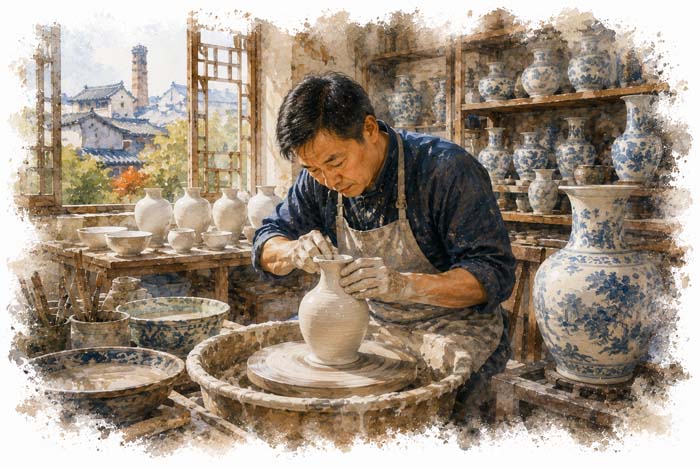
Around the imperial site lie the lanes where the private kilns worked, walled in stacked saggers and still holding wood-fired kilns of the traditional egg shape. The division of labour that the imperial factory imposed survives here as separate trades: throwers, turners, outline painters, wash painters, glazers, kiln men. A collector who wants to understand why Jingdezhen pieces look consistent rather than personal should watch one bowl pass through four sets of hands in a morning.
Gaoling and the Clay Hills: The Material
The valley's advantage begins in its hills, in the pottery stone and white clay that together make a body capable of translucency. The material is the reason the industry sits here and not somewhere better connected. Any account of Jingdezhen that starts with emperors has started too late; the geology chose the site, and the court merely arrived to claim it.
Also on the Map
The river, which carried clay down and finished ware out and is the reason a hill valley could supply an empire. The export waterway to Canton, along which the Dutch East India Company's thirty million pieces travelled between 1602 and 1682. And the shard grounds throughout the old town, which are the closest thing this craft has to a written archive. Nobody asks who made a Jingdezhen piece. Where in the system it was made is the question that has an answer.