Arts, Crafts and Living Ateliers
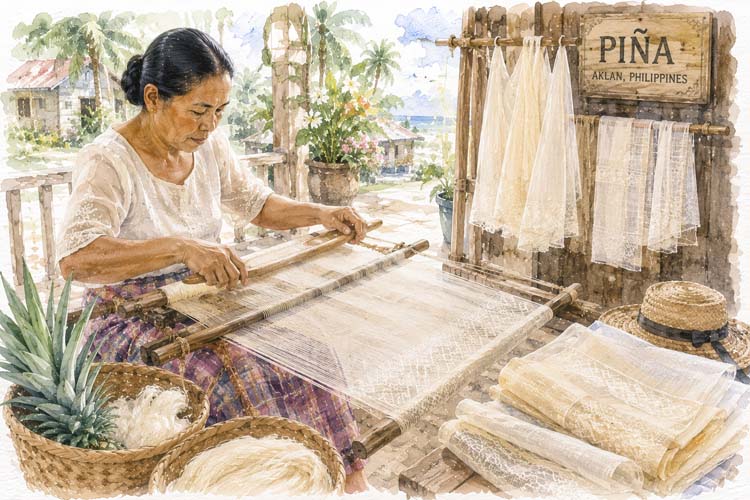
The work divides across households. One person scrapes leaves, another knots thread, another weaves on a wooden handloom, another embroiders, and a garment passes through all of them. The scraping is done outdoors with a shard or shell drawn along the leaf; the knotting is done sitting down, endlessly; the weaving is slow because the thread is fragile and the shed must be opened gently.
Reading Piña
Hold it to the light. Genuine piña is translucent with an uneven, slightly stiff hand and a faint ivory cast rather than pure white, and the yarn shows tiny knots at intervals, visible under magnification and occasionally to the naked eye. Polyester imitations are perfectly even, brighter white, limper, and have no knots at all. Piña also creases sharply and does not spring back, which synthetic does.
Blend Identification
Burn a thread if the seller allows. Pure plant fibre burns to a fine ash and smells of burning paper; silk self-extinguishes with the smell of burnt hair; polyester melts to a hard bead. A piña-silk blend gives a mixed result. Weight and drape help too: pure piña is crisp and holds its shape, silk blends drape more softly, and synthetics feel slippery and hang wrong for the cut.
The Embroidery
On the best work, examine the openwork. Hand-drawn thread work shows slightly irregular spacing where threads were withdrawn and bound, and the reverse is worked and tidy rather than backed. Machine embroidery on piña exists and is common, and shows regular tension, a bobbin thread of different character, and frequently a stabiliser residue. Hand embroidery on a cloth this fine is a genuinely rare skill.
Why the Loom Is Slow
Piña thread has almost no elasticity and breaks under tension that any other fibre would take, so the weaver works gently and stops constantly to repair breaks, tying each one with a knot as small as the ones in the original thread. Humidity helps and the weaving is often done early or late when the air is damp, because dry thread snaps. A weaver may produce a very small length in a day.
Sorting Before Anything Else
Before knotting begins the scraped fibre is combed and graded by fineness, because a thread assembled from mismatched filaments weaves unevenly and shows as streaks in a translucent cloth. That sorting is unglamorous, unpaid attention that never appears in any description of the craft, and it is the difference between a piece that hangs evenly against the light and one that does not. Households that skip it produce visibly poorer cloth.
Ateliers, Villages and Artisan Encounters
Kalibo in Aklan province, on the island of Panay, is the centre, and it is the same town whose January festival is among the country's largest. Weaving households can be visited and cloth commissioned directly. Aklan is a short hop from Boracay, which means it is easy to reach and almost always driven straight through by people on their way to the beach.
Caring for It
Piña is strong along the thread and fragile at a crease, so a garment should be hung rather than folded on a line, and never pressed with a hot dry iron directly, which scorches and flattens the characteristic crispness. It is traditionally washed by hand in cool water and air dried in shade, and yellows slowly with age in a way that is generally considered attractive rather than a fault.
Tourwit Editions and Provenance
Tourwit commissions directly from Aklan weavers and embroiderers, paying before work begins and leaving the major share of what a piece realizes with them, which for a finished garment means several named people. The record identifies the scraper, knotter, weaver and embroiderer where they can be established, states the fibre content and any blend explicitly, and names the embroidery technique.
Why These Works Matter
A cloth assembled from tens of thousands of hand-tied knots, in a fibre extracted from a leaf by hand, woven so fine it is transparent, and then embroidered on a ground that punishes any pressure. It is worn to weddings and to work by people who mostly do not know how it is made. Recording the four separate pairs of hands behind one shirt is the correction this collection keeps making, and here it is four sets of hands rather than one.