



Craft Map
The Craft Map
Ebru is an atelier craft rather than a regional one, and it travelled with the book trade rather than with a material, so its map is a short list of cities and a set of workshop lineages. UNESCO inscribed Ebru, the Turkish art of marbling, on the Representative List in 2014, and that inscription attaches to the practice and its transmission rather than to a place.
Istanbul: The Ateliers
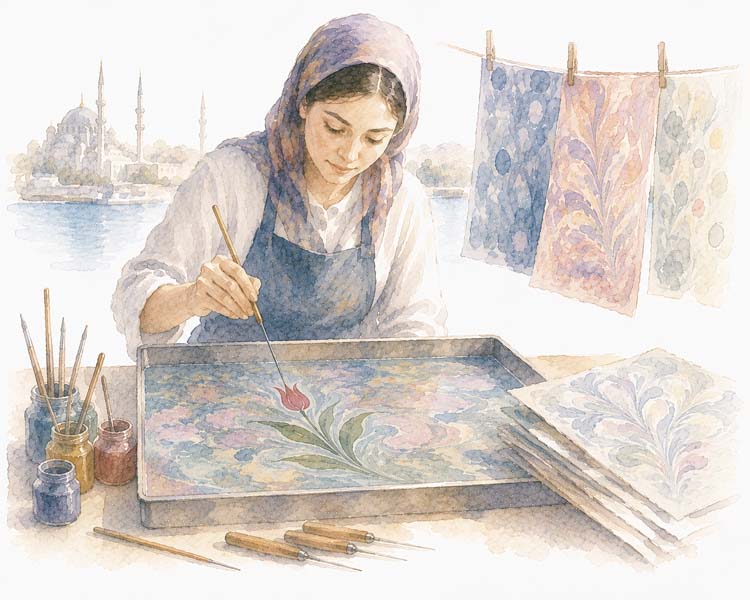
The city was the centre of Ottoman book production, calligraphy, binding and chancery work, and marbling belonged to that complex. The ateliers were and are here, teaching runs through named master and student lineages, and the craft's modern revival has been led from the city. A record naming Istanbul should also name the atelier and the marbler, because in a craft with no repeatable output the individual hand is the only stable identity.
The Tray: Where the Work Exists
In this craft the meaningful location is a rectangle of thickened liquid, and everything that distinguishes one sheet from another happens on it in a few minutes. Nothing survives there afterwards. This belongs on the map because it is the only place an ebru pattern ever exists as itself, and because understanding that is the difference between reading these sheets as decorated paper and reading them correctly.
The Binderies and Calligraphy Workshops
Marbling's historic clients sat next to it. Bookbinders needed endpapers and cover papers, calligraphers needed mounts and grounds, and chanceries needed papers that resisted alteration. These trades shared quarters and personnel with the marblers and are the reason the craft existed at all. Any account that treats ebru as a standalone art has described its present rather than its history.
Also on the Map
The Central Asian and Persian marbling traditions from which the Ottoman practice descends and with which it shares technique. The European papers of the same period, which took the method up for bookbinding and developed it differently. And the manuscript collections of Istanbul, where the craft's original purpose can still be seen in use. Whose hand, which pattern, and what the sheet was made to sit behind: ebru answers all three or none.