





Craft Map
The Craft Map
Two villages in two states, two crafts separated by roughly two thousand years, and one shared problem: neither is protected, and both are widely reproduced by people who name neither village.
San Pablito, Puebla: Amate
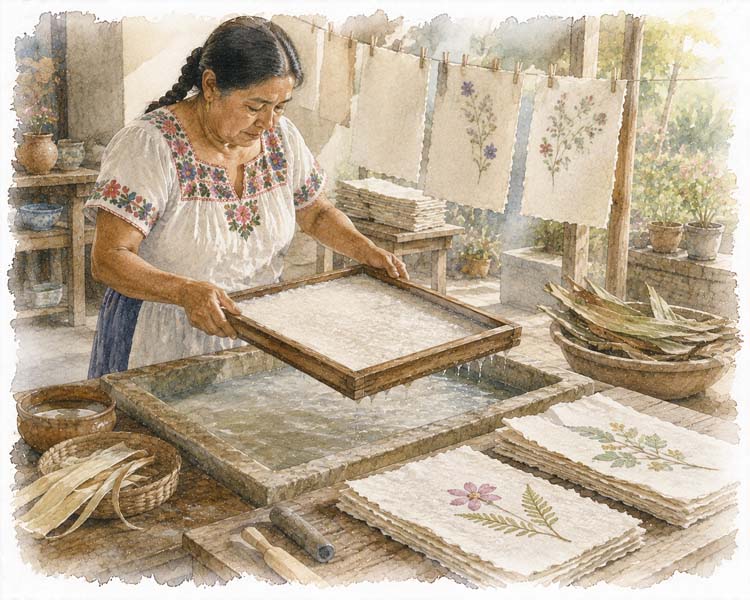
High in the Otomí sierra of northern Puebla, San Pablito has made bark paper for close to two thousand years and is the centre of the craft. Inner bark is boiled with lime and ash, rinsed, laid in a grid and beaten with a flat stone until the fibres fuse. Until the 1960s only shamans made it and the process was secret; the paper is sacred only once a shaman has cut it in a rite. Most sheets sold today become supports for Nahua painting from Guerrero, so a full record names two places, not one.
Tenango de Doria, Hidalgo: The Embroidery
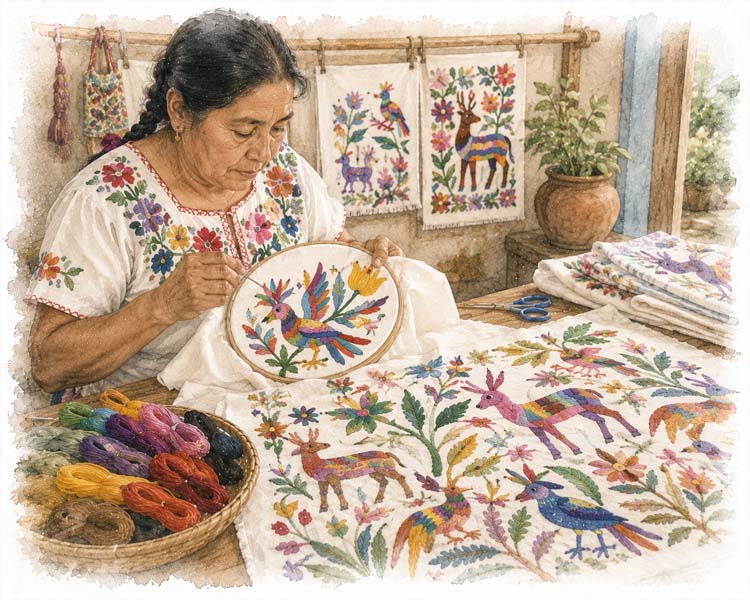
In the neighbouring state of Hidalgo, Tenango de Doria and its surrounding villages produce the embroidery that carries the town's name. It dates from 1960 and is credited to Josefina José Tavera of San Nicolás, who began it during a drought. Designs are drawn freehand and filled in flat blocks of colour with the outline left bare. It has never been trademarked, is classified as folk art under Mexican law, and has been used without credit by international fashion houses. The maker's name is the only provenance that exists.
Guerrero
Several hundred kilometres south, and on this map because most San Pablito paper does not stay in Puebla. Nahua painters in the Alto Balsas villages of Guerrero buy the sheets and paint them, and the result is what the market calls amate: a painting on Otomí paper by a Nahua hand. Two states, two peoples, two crafts in one object, and a label that usually names neither.
Pahuatlán
The larger town below San Pablito, on the road in, and the place the first tenangos were sold before the embroidery had a market of its own. It is the commercial hinge for both crafts, the point where paper and cloth leave the sierra, and the reason a piece can carry a town name that is not the village it was actually made in.
Also on the Map
The jonote and fig trees the paper is stripped from, whose bark is the limiting material and whose harvesting is now a live question in the villages. Which village, and then whose hands: on this map the second question has an answer and is almost never printed on the label.