Arts, Crafts and Living Ateliers
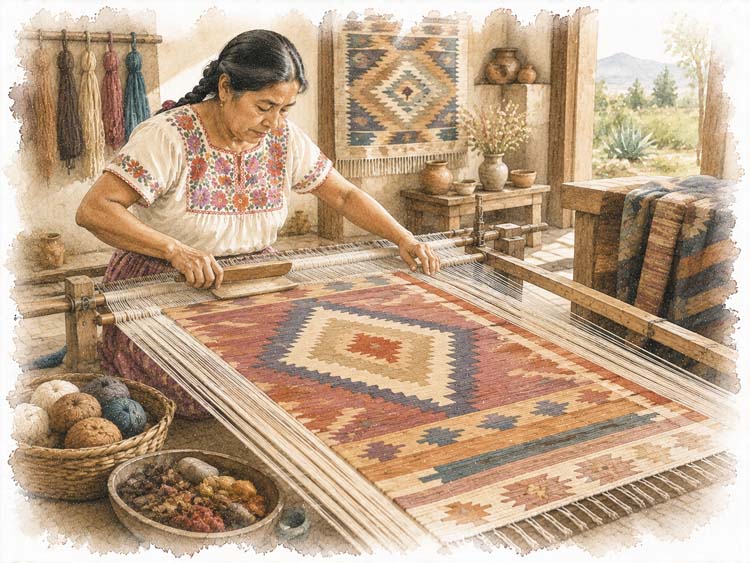
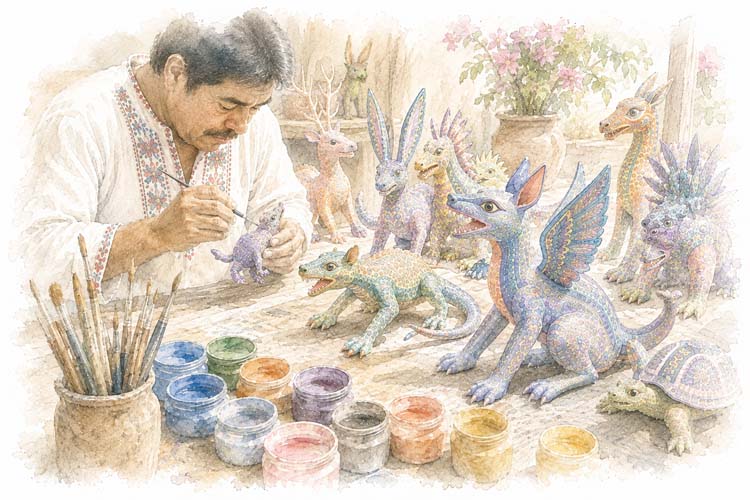
Teotitlán is a weaving village in the plainest sense: looms in courtyards and front rooms, wool in the yard, dye pots outside, and the whole sequence from raw fleece to finished rug visible within a few streets. Arrazola and San Martín Tilcajete are carving villages, quieter and dustier, where copal is cut green, shaped, dried, and then painted in stages by other members of the same household, frequently the women.
The Wood Decides the Creature
Copal is a soft wood and it is carved wet, which is why alebrije forms curve and twist the way they do: the carver follows the branch. Drying afterwards is the dangerous stage, and cracks are common, which is one reason cheaper pieces are made from several parts glued together while better ones are cut from a single piece where the form allows. Check the joins, check for filler, and ask whether the piece is one wood or several. The painting is a separate skill and often a separate person, so both names are worth asking for.
Reading a Teotitlán Rug
Ask what the dye is, and expect a specific answer: cochineal, indigo, pericón, moss and pomegranate are named materials rather than a general claim about being natural. Natural dye varies subtly across a field and synthetic dye does not, so absolute evenness across a large red is informative. Look at the ends and the selvedges for the finish quality, and ask which loom it was made on. And ask about the design's origin: some are Zapotec in derivation, some are Saltillo-derived colonial patterns, and a number are twentieth-century adaptations of Navajo and modernist sources, which is legitimate and should simply be stated.
Two Villages, Two Manners
Arrazola and San Martín Tilcajete are twenty minutes apart and their carving reads differently: broadly, one favours smoother, more rounded animal forms and the other a busier, more finely patterned surface, though individual workshops vary more than the generalisation allows. Acquiring a piece in Oaxaca city means working at one remove from both. Going to the villages means meeting the carver, and in a craft this young and this well documented, that is the whole provenance. There is no older claim available and none is needed.
What a Rug Costs in Time
The arithmetic is worth doing before discussing price. Wool is carded and spun, dyed in batches over days, and then woven at a rate that depends entirely on the density of the weave and the complexity of the design. A finely woven rug of any size is months rather than weeks, and the dyeing alone can occupy a fortnight if several colours are being developed from raw materials. When a piece is offered at a price that cannot cover that, the explanation is usually synthetic dye, a coarser weave, or a rug woven somewhere else entirely and finished here.
Ateliers, Villages and Artisan Encounters
All three villages are within an hour of Oaxaca city and all three receive visitors constantly, which has produced the usual split between workshops set up for arriving groups and workshops doing serious work. The difference is easy to detect: ask a technical question about dye recipe or about drying time and see whether the answer is specific. The city's markets carry everything from all three villages and rather a lot from neither, including a substantial volume of carved and painted work made outside Oaxaca entirely.
Tourwit Editions and Provenance
Tourwit works directly with weaving households in Teotitlán del Valle and carving families in Arrazola and San Martín Tilcajete rather than through intermediaries. Artisans are paid before the work begins and retain the major share of what a piece realizes. Editions are limited by what a loom and a hand can produce, and each work is documented at source with its village, its maker, its painter where these differ, and its dyes by name, so that the record travels with the object.
Why These Works Matter
Put together, these two make an argument about what tradition actually is. One craft is two and a half thousand years old and uses a European loom and European sheep. The other is younger than most of the people reading this and is already unmistakably of its place. Neither fact diminishes either object. What they demonstrate is that a craft belongs somewhere because of who makes it and how, not because of how far back a brochure can push the date.