A People Defined by Dispossession
The southern Ndebele are an Nguni-speaking people long settled on the highveld northeast of Pretoria. Their nineteenth century ended in catastrophe: defeat by the South African Republic in 1883, the breaking up of the polity, and the distribution of the population across white-owned farms as tenant labour. In the twentieth century apartheid removals moved them again into the KwaNdebele homeland. It is against that history that the visual culture has to be read, because what looks like decorative exuberance was produced by a community that had lost its land and retained its identity in the one medium nobody could confiscate.
Beads Are an Import
The glass seed bead is not indigenous to southern Africa. It arrived through European trade, in quantity from the nineteenth century, and it displaced older ornament in shell, seed, metal and bone. The intense flat colour that defines this work therefore depends on an imported industrial product, mostly Czech and Venetian in origin, and the palettes available to a woman in any given decade were set by what the traders were carrying. Older pieces can sometimes be dated by their colours for exactly that reason, and the shift from a restrained white-ground palette to dense saturated colour tracks the changing supply as much as changing taste.
What the Garments Are
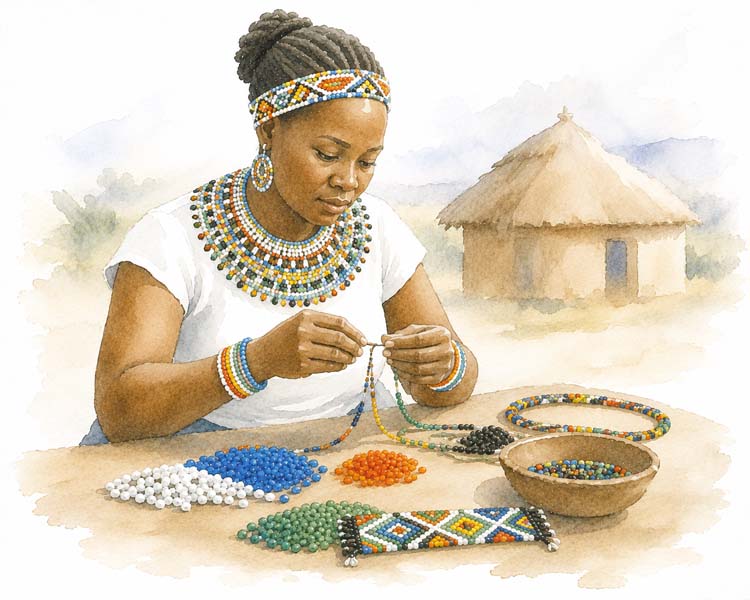
The repertoire is specific and each item belongs to a stage of life. There are beaded aprons for girls, for initiates and for married women, each a different shape and construction; there are long beaded strips worn down the back by a married woman on ceremonial occasions; there are neck, arm and leg rings. Nothing is generic. A garment is made for a person at a moment, frequently by her mother or her mother-in-law, and it is worn to announce exactly what that moment is.
Techniques, Plainly
Three constructions cover most of the repertoire. Beads can be threaded into a self-supporting fabric worked row on row, which is how the flexible panels and the long trailing pieces are made. They can be sewn onto a ground of hide or, later, canvas, which is how the stiff aprons are built and why their geometry stays rigid. And they can be wound over a grass or fibre core to make the solid rings worn at neck, arm and leg. Each technique has a different failure mode with age, and knowing which one a piece uses is the first step in assessing its condition.
The Patron Institution
There is no court and no workshop. The institution here is the household and the female line within it, and the transmission is from older women to younger ones as part of raising them. That is why the work is unsigned, why it was never a trade in origin, and why the twentieth-century shift toward selling it altered the craft's character more than any change of technique. Some of the most celebrated practitioners of the painting became known internationally by name, which is a genuine departure from how the tradition worked and has had the side effect of drawing attention to a body of work that museums had previously catalogued as anonymous craft.
Wall Painting as the Same Grammar
The painted compound is the other half. Women paint the exterior walls of the homestead in bold outlined geometry, historically in earth pigments and lime and later in commercial paint, working freehand without stencils or measuring. The forms are architectural, not floral: gables, steps, chevrons, and from the mid-twentieth century recognisable references to razor blades, aeroplanes and electric lights. The relationship between the painting and the beadwork is direct, and a woman who does one generally does the other.
Continuity and Its Costs
Full traditional dress is now worn by fewer women and mostly on occasions rather than daily, and much beadwork made today is made for sale. That is not automatically a loss of authenticity, since the technique and the vocabulary are unchanged and the makers are the same women, but it does mean the market carries two different classes of object: garments made for a person and objects made for a buyer. The difference is usually visible in the finish and always relevant to the price. A garment made for a daughter is finished on the reverse; an object made for a stall frequently is not.