A Country of Herders
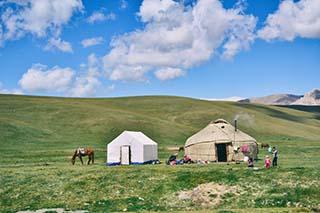
Mongolia is enormous, high, dry and cold, with a small population and an economy that rested for millennia on five animals: horse, cattle, camel, sheep and goat. Households moved with the seasons between pastures, and a material culture developed in which every object had to be portable, repairable and made from what the herd produced. Arkhangai in the central provinces is classic herding country, grassland, river valleys and volcanic country.
Why Felt and Not Weaving
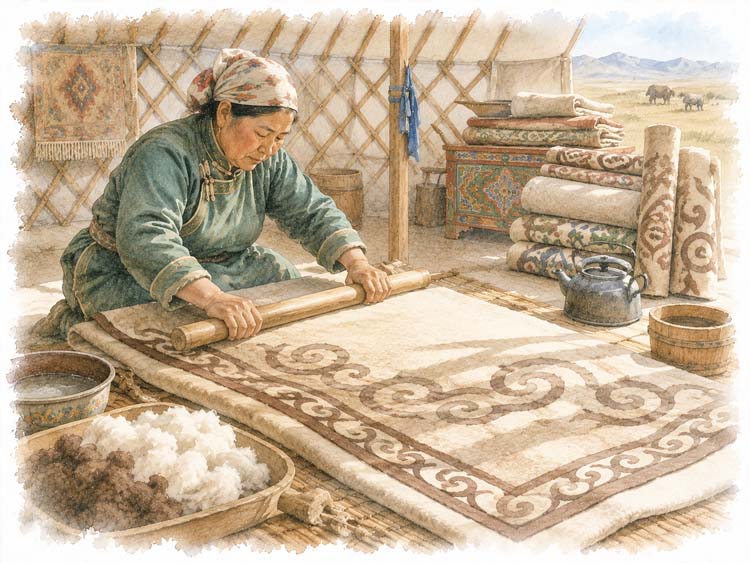
Felt requires no loom, no warp, no fixed installation and no settled workshop, which is precisely why a mobile society perfected it. Wool is beaten to open the fibres, laid out in crossed layers, sprinkled with hot water, rolled around a core and then dragged, traditionally behind a horse across the steppe for kilometres, until the scales on the fibres interlock permanently. It is cloth made by pressure and friction rather than by any structure of interlacing threads, which is why it has no grain and cannot fray.
The Ger Itself
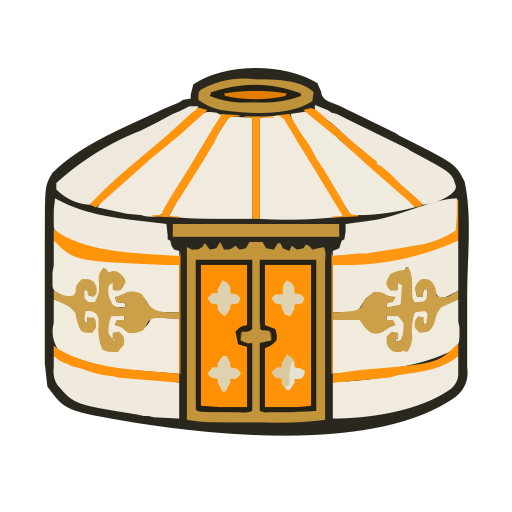
The dwelling is a designed object and a good one. A collapsible lattice wall, a set of roof poles, a compression ring at the apex that needs no fixings, felt covers, an outer canvas, and woven bands that hold the whole under tension. It goes up in an hour or two, comes down as fast, and packs onto a few animals or a small truck. Nothing in it is nailed. The Mongolian ger and its associated craft are recognised by UNESCO.
The Patron Institution
None, and none needed. This was the universal domestic technology of an entire society, made by households for themselves, and its standard was survival rather than approval. There was no guild, no court commission and no market, because everyone had one and everyone knew how. The imperial period produced luxury versions and enormous ceremonial gers, but the ordinary object required no patron at all, which is rare enough in this collection to note.
What Else the Herd Gives
Around the felt sits everything else. Leather for harness, boots and vessels; horsehair for rope and for the strings and bow of the horsehead fiddle; sinew for thread; bone and horn for fittings; dung for fuel in a country with almost no wood; and hides tanned with milk products. A single household's material world comes almost entirely off its own animals, which is true of very few places left.
Ornament With a Job
Felt is decorated by quilting and appliqué, and the vocabulary is the shared Turkic and Mongol repertoire: the endless knot, the curling horn form, the ulzii and the meander, worked in couched cord or contrasting felt. Much of it is structural, since stitching that holds two layers together is also the pattern. The ornament is where the maker's hand shows in an object otherwise made by pressure.
What the Twentieth Century Did
The socialist period collectivised herding, settled a large part of the population, and pushed manufactured goods into households that had made their own. Nomadic practice survived it and expanded again after 1990 under a different pressure: a market economy, mining, harsh winters that kill livestock in the millions, and a steady migration toward the capital, where a large proportion of the country now lives, many of them in gers on the city's edge.
How Many Layers a Winter Needs
The covering is not one thickness. A ger is dressed for its season: a single layer through summer, with the wall felts rolled up at the base to let air through, and two, three or more layers added for winter along with an inner lining and an outer canvas. Households adjust it through the year rather than living under a fixed envelope, and the ability to tune the building to the weather is a large part of why the design works at these temperatures.
Where It Stands
Ger-making continues as a real trade because gers are still lived in, in the countryside and in the districts around Ulaanbaatar, and workshops build frames and press felt commercially. Alongside that sits a decorative trade in small felt goods for visitors. The distinction between a felt made to keep a family alive through winter and a felt slipper is worth keeping firmly in view.