Arts, Crafts and Living Ateliers
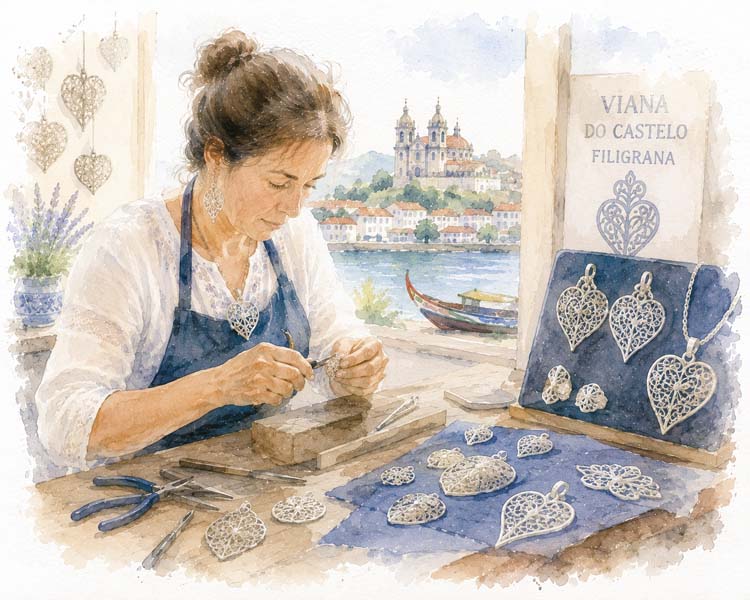
A filigree bench is small and the tools are few: a drawplate, rollers, fine pliers, tweezers, a soldering torch and a great deal of patience. The smith works under magnification, laying curl against curl inside an outline, holding the assembly together with nothing but friction until the solder flows. The workshops in the Minho villages are family operations, frequently a single room, and the skill is transmitted by sitting next to someone for years.
Reading Portuguese Filigree
Look at the wire under magnification. Genuine filigree is built from twisted and flattened wire, so the surface of every scroll shows a fine regular serration along its edge, and the individual curls are separate elements touching each other. Cast imitation reproduces the appearance in solid metal: the pattern is there but the wires are fused into one mass, the serration is soft or absent, and the reverse shows a flat casting surface rather than open work you can see through.
The Back and the Solder
Turn the piece over. Real filigree is open, and light passes through the gaps between the scrolls from front to back. The solder joins should be minimal and localised, barely visible, because a smith who floods the work with solder has drowned the delicacy that justifies the technique. Excess solder pooling in the corners of the frame is the commonest sign of hurried or inexpert work.
The Hallmark
Portugal requires assay marking on precious metal, so a genuine piece carries a punched hallmark indicating the metal and its purity, along with a maker's mark. This is checkable and it is the first thing to look for. Traditional work is high-carat gold, which is soft, warm in colour and heavier than it looks; silver filigree is also traditional and much less expensive. A piece with no mark at all should prompt the question of where it was actually made.
How Long a Heart Takes
A substantial filigree pendant is days of work, most of it invisible: drawing and twisting the wire before anything is shaped, then bending each individual scroll, then positioning perhaps several hundred of them inside the frame, and only then the single soldering operation that either succeeds or destroys everything preceding it. The material cost of the gold is real but it is frequently the smaller half of the price, and buyers who price these by weight have misunderstood what they are looking at.
Ateliers, Villages and Artisan Encounters
Viana do Castelo is the coastal town at the centre of it, with the trade concentrated there and in nearby villages, above all Gondomar near Porto, which is the other great filigree centre and produces a large share of the country's output. Both are within easy reach of Porto, so the tile and the gold can be seen on one trip. Workshops receive visitors and take commissions directly.
Silver, and the Everyday Version
Not all of it is gold. Silver filigree is a genuine part of the same tradition, worked by the same smiths in the same forms at a fraction of the cost, and historically it was what a household bought when gold was out of reach. It is worth taking seriously rather than treating as a lesser substitute: the technique is identical and the difficulty is the same, so a fine silver piece demonstrates the craft just as completely as a gold one does.
Tourwit Editions and Provenance
Tourwit commissions directly from filigree workshops in the Minho and around Gondomar, paying before work begins and leaving the major share of what a piece realizes with the smith. The record names him or her, the town, the metal and carat, the hallmark, and the form, and states the working hours where the workshop will give them, since with this craft the hours are the object.
Why These Works Matter
This is a gold tradition that belonged to farming families rather than to a court, in which a woman's ornament was also her family's reserve, and in which the technique is one of the few that genuinely cannot be mechanised without becoming something else. The hallmark already certifies the metal. What no mark records is which pair of hands spent those hours laying curls inside a frame without letting the whole thing melt.