Arts, Crafts and Living Ateliers
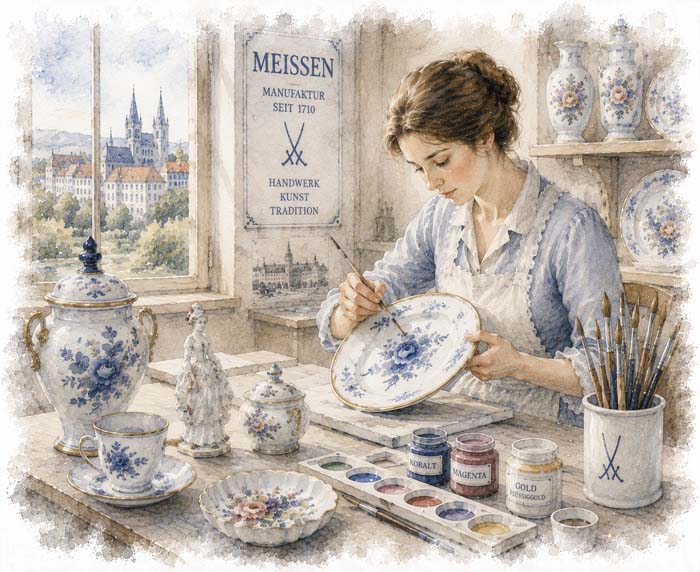
The manufactory still operates in Meissen and the division of labour is deep: throwers and mould-makers, repairers who assemble cast components into a figure, underglaze painters, overglaze enamellers, gilders. A complex figure passes through many hands and its moulds may be eighteenth-century originals still in the archive. The painting studios work with brushes to a standard set by pattern books that have been maintained for three centuries and are still the reference for what a pattern should look like.
Underglaze and Overglaze
The distinction governs colour. Cobalt blue can be painted onto the raw body and survive the full firing, which is why blue-and-white patterns are underglaze and effectively indestructible. Most other colours burn away at that heat, so they are applied on top of the fired glaze and fixed in a cooler second firing, which leaves them very slightly raised and vulnerable to wear. Run a finger across a polychrome piece: if the colour has texture, it is overglaze enamel.
Reading the Body
Hold a thin part to a strong light. True hard-paste porcelain is translucent, showing a warm glow and sometimes the shadow of your fingers, where earthenware and most soft-paste are opaque. Tap the rim and it rings clearly rather than thudding. Look at any unglazed edge, where the body should be dense, white and glassy rather than porous. These checks separate porcelain from everything imitating it before any mark is considered.
The Crossed Swords
The mark is applied in underglaze blue beneath the glaze, so it cannot be added later without detection: a mark sitting on top of the glaze, or one that can be scratched, is wrong. The form of the swords changed across periods and is documented in detail, which allows close dating. Because it is the most forged ceramic mark in existence, treat it as evidence to be weighed alongside body, painting and modelling rather than as proof on its own.
Cancellation Marks
One detail rewards knowing. Pieces that failed the manufactory's inspection were sold as seconds with the mark deliberately cut through by grinding lines across it, and the number of strokes indicates the grade of fault. These are genuine Meissen and are honestly cheaper. A dealer who does not mention visible cancellation strokes, or who explains them away, is either uninformed or hoping you are. Either way the piece is worth less than an uncancelled equivalent.
Why Figures Are Difficult
A porcelain figure is not modelled and fired as one thing. It is cast in many separate moulds, a head, arms, drapery, flowers, base, and assembled wet by a specialist whose whole job is joining them so the seams disappear. Then it shrinks by around a sixth in the firing, unevenly, while soft enough to slump under its own weight. Losses are high and always have been, and a complex figure with fine extended fingers or applied flowers is an argument with physics.
Ateliers, Villages and Artisan Encounters
Meissen is a small town on the Elbe upstream of Dresden, with the fortress where it all began still standing above the river. The manufactory runs a visitor workshop and a museum holding the reference collection. Dresden itself is the essential companion: the royal porcelain collection there holds Augustus's Asian pieces alongside the early Meissen, so the imitation and its model can be compared in one room.
Tourwit Editions and Provenance
Tourwit works with Meissen-trained painters and modellers on contemporary commissions, paying before work begins and leaving the major share of what a piece realizes with the maker. The record names the painter, the modeller where a figure is involved, the pattern, and whether decoration is underglaze or overglaze. Antique Meissen is not offered, because the mark is the most forged in ceramics and attribution belongs to specialist auction houses with the archives to support it.
Why These Works Matter
This is the point where Europe stopped copying and started making, and it happened because a king imprisoned an alchemist and got something better than gold. The manufactory has run continuously for three centuries with its moulds and pattern books intact, which almost nothing else in this collection can claim. The irony worth holding onto is that the tradition founded on protecting a secret became the most imitated ceramic in the world.