Younger Than It Looks
This is not an ancient folk art and saying so matters. Paper cutting appeared in the Polish countryside around the middle of the nineteenth century, once industrially produced coloured paper became cheap enough for a village household to buy, and it spread quickly through the central regions. Before that, cottage walls were decorated with cut cloth, straw and whitewash patterns. A tradition frequently presented as immemorial is barely older than photography, and depended on an industrial product reaching the countryside.
The Tool Decides the Style
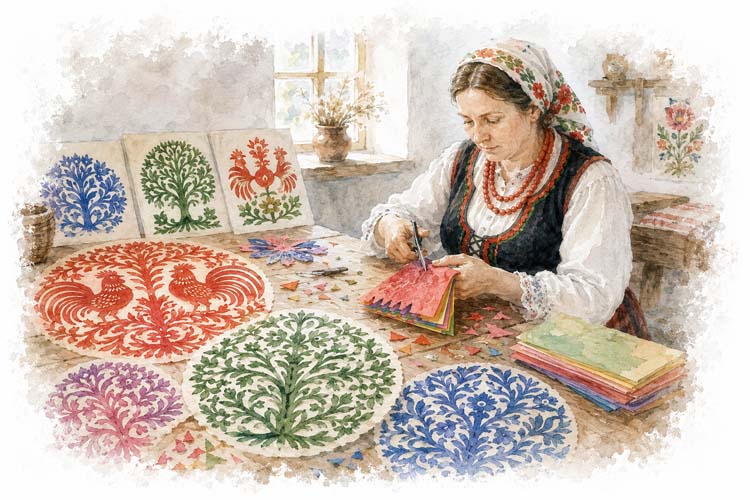
The defining fact is the shears. Sheep shears are a single piece of sprung steel with two blades, gripped in the palm, and they are powerful, blunt and awkward for detail. They cut through many folded layers at once, which produces symmetry automatically, and they cannot manage the delicate tracery that fine scissors or a knife allow. Everything characteristic about wycinanki, the boldness, the strong silhouettes, the mirrored forms, follows from a tool designed for wool.
Two Regions, Two Kinds
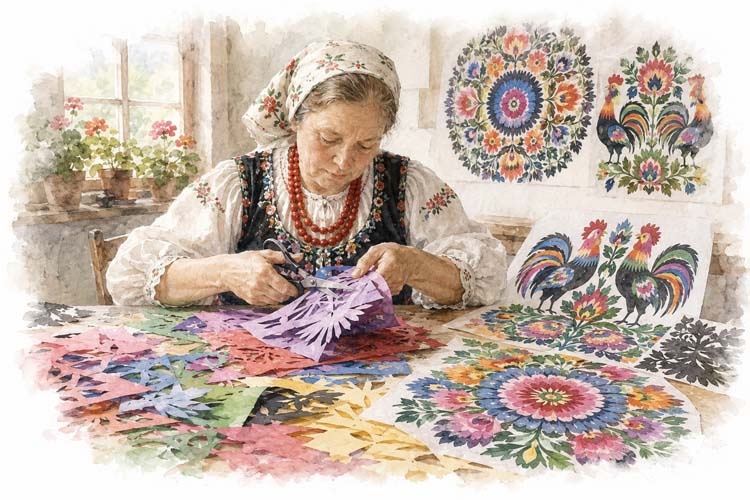
The forms differ sharply by district and the difference is the whole attribution question. Łowicz produces the multicoloured type: layered cuts in many colours pasted one on another to build up a dense composition, most famously a round form assembled from concentric coloured layers, with roosters, flowers and village scenes. Kurpie produces the opposite: single-colour cuts, usually dark, of great delicacy and precision, with the spruce-tree form and elaborate symmetrical openwork. Held up to a window a fine Kurpie cut reads as lace made of paper.
Folding, and Why Everything Mirrors
The symmetry is not a stylistic choice, it is a consequence of method. A sheet folded once and cut produces a mirrored pair; folded twice, four-fold symmetry; folded into a radial wedge and cut, a rosette. The cutter is working on a wedge of paper and imagining the whole, which is a genuine spatial skill and the hardest thing to learn in the craft. Open a piece out and the design appears complete for the first time, including to the person who made it.
The Patron Institution
None whatever. No court, no church, no guild, no market. These were made by village women to decorate their own cottages, pasted directly onto whitewashed walls and around the ceiling beams, and thrown away when the walls were rewhitewashed for Easter. The complete absence of any patron is the reason almost no nineteenth-century examples survive: nobody was collecting something that was designed to be destroyed annually.
Collected Into Existence
What preserved the craft was ethnography. Polish folklorists and museums began collecting cut-paper work in the later nineteenth and early twentieth centuries, treating it as significant precisely when it was ordinary, and the surviving historic corpus is almost entirely what those collectors took. In the interwar period and again under the postwar state, folk art was actively promoted and organised into cooperatives, which supported makers and also standardised what had been more various.
The Cooperative Century
That state promotion is a genuine double edge. It gave rural women an income and a status their grandmothers did not have, kept techniques alive, and produced a great deal of very accomplished work. It also selected for what sold and exhibited well, hardened regional styles into official types, and moved the craft from a wall decoration made for a household to a framed object made for someone else. Both halves are true and the second is rarely mentioned. A great deal of what is now called traditional is specifically the cooperative style of the middle of the last century.
What the Motifs Actually Are
The repertoire is domestic and agricultural rather than symbolic in any deep sense: roosters and peacocks, flowering trees, stars and rosettes, and on the Łowicz work small scenes of village life, weddings, harvests and processions with figures in local dress. Sellers sometimes attach elaborate meanings to individual motifs; the honest position is that this is a decorative vocabulary drawn from what was around the cutter, and its charm is that it is literal.
Where It Stands
Wycinanki is now a recognised heritage craft with competitions, museum collections and a modest market, made by a limited number of practitioners, many of them older women in the historic districts. It is neither dying nor thriving. What has definitively ended is its original function: nobody papers a whitewashed cottage wall with fresh cuts each spring, because nobody lives in that cottage. The craft continues; its purpose does not.