








Craft Map
The Craft Map
One highland region, one loom held under the weaver's own body, and a design system organised municipality by municipality so precisely that the town is legible in the blouse. The questions are the weaver, the town, brocade against embroidery, the fibre and whether the piece is old or new. A seller who answers the town question with a country is selling from a warehouse.
Antigua and Lake Atitlán
Guatemalan Huipil is woven on the backstrap loom across the highlands, with figures brocaded into the cloth as supplementary weft rather than embroidered onto it, and garments built from two or three narrow panels joined by a hand-stitched randa. Antigua is the colonial capital and the principal market. Around Lake Atitlán the villages diverge within a few kilometres: Santiago Atitlán with its deep reds and long-billed birds, San Juan La Laguna working natural dyes through named cooperatives. A record should carry the weaver, the municipality, the language community and the construction, and should name a municipality rather than a region, because the region is not the unit that means anything here.
Chichicastenango
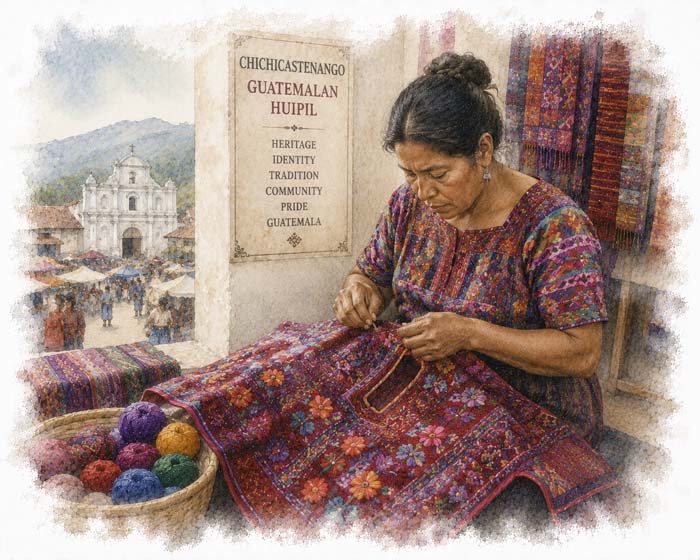
The largest market in the highlands, held twice weekly in a K'iche' town whose church of Santo Tomás carries Maya ceremony openly on its steps. Chichicastenango weaving is densely figured, and the town is also the point through which a great deal of highland cloth from elsewhere passes, which makes it the place where the question of which municipality a garment actually comes from most needs asking. A record should name the weaver's own town rather than the market she sold in.
Nebaj
In the Ixil country to the northwest, working red grounds with double-headed birds and a figured density that is immediately distinguishable from the lake towns. It is also one of the places the armed conflict fell on hardest, and the weaving there continued through the destruction of surrounding villages, which is a fact about the cloth as much as about the town.
Todos Santos Cuchumatán
High in the Cuchumatanes and one of the few towns where men's dress survives in full and is worn daily: red-and-white striped trousers, a striped jacket and a straw hat, all of it woven and made locally. Men's traje has disappeared faster than women's almost everywhere else. The town's horse race on the first of November is unlike anything else in the highlands.
Salcajá
The jaspe town, where men work treadle looms introduced by the Spanish, tie-resist dyeing the threads before weaving to produce the blurred figures that run through the wrapped corte skirt. It supplies skirt cloth across the highlands, which is why a single outfit routinely combines a pre-Columbian loom worked by a woman with a colonial one worked by a man in another town.
Also on the Map
Momostenango, where the 260-day count has been kept without a lapse. Ixcaco, the naturally brown cotton that needs no dye. And the court cases now being brought by weavers' organisations over who owns a town's design. And the dealers who cut old garments into bags and cushions, which is where a great deal of irreplaceable weaving has gone.