The Southern Coast
Ambalangoda sits on the southwest coast between Colombo and Galle, a fishing and trading town in the low country, and its mask carving is concentrated in a few families whose workshops have operated for generations. This is coastal Sinhalese country, Buddhist, but with a substrate of ritual practice that Buddhism accommodates rather than replaces, and the masks belong entirely to that substrate rather than to the temple.
Eighteen Demons
The healing ritual addresses affliction through a defined cast. Eighteen figures are each associated with a specific complaint, blindness, deafness, paralysis, madness, fevers, stomach disease, and each has its own mask, its own dance and its own verses. A ritual specialist diagnoses which is responsible, and the ceremony summons, entertains, confronts and finally dismisses it over a night. The masks are the working equipment of a medical system.
The Great Serpent Mask
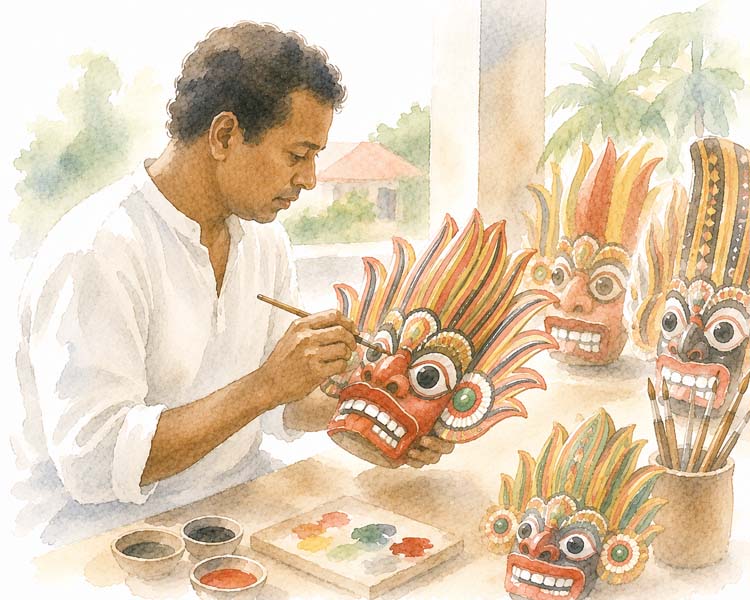
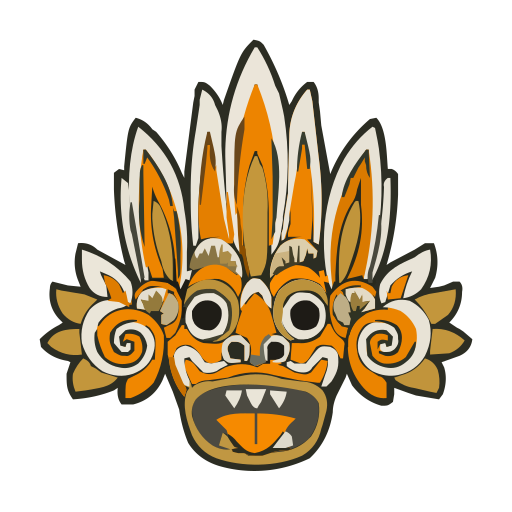
The most spectacular object in the tradition is enormous: a mask of the demon of disease surrounded by the eighteen smaller demon faces arranged in tiers, with cobras rising from it, sometimes over a metre and a half tall and worn or carried in performance. It is the ritual's whole cast assembled into one image, and it is the piece every workshop is judged by.
The Other Tradition
Kolam is a different thing altogether: a village theatre of masked characters performing comic and satirical episodes, with a cast including the king and queen, officials, policemen, villagers, animals and, pointedly, colonial figures. Where the healing masks are terrifying by design, kolam masks are exaggerated, absurd and frequently unkind about people in authority. The two are made by the same carvers and are constantly confused by outsiders.
The Patron Institution
Not a court and not a temple. The customer was the household with a sick member and the village wanting an entertainment, and the practitioners were hereditary ritual specialists and performers of particular caste communities rather than religious officers. The masks were equipment rather than art, commissioned when needed and used until they wore out, and repainted between performances rather than preserved.
Kaduru Wood
The material is specific and it matters. Masks are carved from a light, soft, close-grained local timber that can be worked thin and worn on the face for hours without exhausting the dancer, and which takes paint well. The wood is cured over a slow fire and dried for weeks before carving. A mask made from a heavier wood is a decorative object rather than a workable one, whatever it looks like from the front.
A Fixed Palette
The colours are prescribed rather than chosen, historically from natural sources, and each figure has its own combination that identifies it. Red, yellow, black, white and green recur, applied in flat areas over a prepared ground, with the modelling done by the carving rather than by shading. A mask is identified by its colour and its features together, and a carver working correctly is not free to improvise.
Who Performs, and Why That Matters
The rituals were conducted by hereditary specialists from particular communities, and the association carried social cost: the families who held this knowledge occupied a low position in the caste order precisely because of what they did, drumming, dancing and dealing with demons. The craft and the ritual belonged to people the society ranked beneath itself and called on when it was frightened, which is a common enough arrangement and rarely stated.
Sanni and Kolam, Named Properly
The two traditions have names and using them prevents most of the confusion. The healing ceremony with its eighteen figures is the sanni, and its masks are the demon masks. Kolam is the village masked theatre with its cast of social types. There is also a third body of ritual addressed to a deity rather than to demons, with its own masks and its own occasions. A seller who calls everything a devil mask is not distinguishing between three different things.
Where It Stands
The full night-long healing ritual is now rare, though it has not disappeared, and kolam performance is rarer still. What continues robustly is the carving, sustained by a museum and workshops in Ambalangoda and by a market that is largely decorative. That is an honest description: the object is in better health than the ceremony it was made for, which is the reverse of almost every other case in this collection.