A Region Named on Other People's Inventories
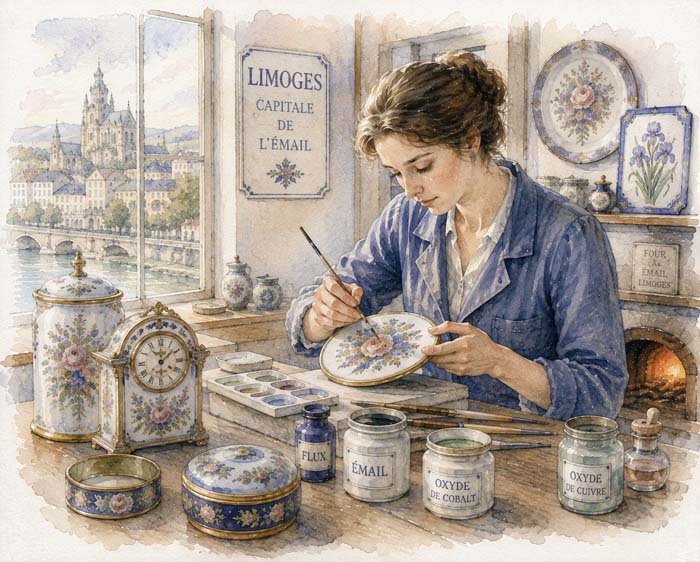
The Limousin is high, wooded, thinly populated country in central France, and it produced two of the most widely distributed luxury objects of their respective periods without either being invented for a local market. Enamelled reliquaries from here reached cathedral treasuries across Europe. Tapestries woven here hung in houses that had no connection to the Creuse at all. In an enamelling room the copper looks like nothing until it goes into the fire. What follows is not a regional history. It is the record of how a remote province came to be named in the inventories of institutions that had never sent anyone there.
Opus Lemovicense
Limoges enamel work in champlevé, in which cells are gouged out of a copper plate and filled with vitreous enamel before firing, is documented from the second quarter of the twelfth century, and by 1169 texts refer to the output of these workshops as opus Lemovicense, the work of Limoges. That phrase is the point. A craft had become a recognised category, identified by its place of origin, in the written records of people who acquired it hundreds of miles away. Very few medieval manufactures achieved that.
1215: A Council Creates a Market
The Fourth Lateran Council of 1215 authorised the use of champlevé enamel for sacred vessels, and the consequences for this region were immediate and enormous. A ruling of church law effectively certified a technique, and the workshops that had it were in the Limousin. Demand followed across the whole of Latin Christendom, and the region supplied reliquaries, crosses, croziers, book covers, pyxes and candlesticks in quantity. It is the clearest case in this collection of a craft whose market was created by an administrative decision taken somewhere else entirely.
Serial Production, Six Centuries Early
The volume this generated produced something that looks startlingly modern. Limoges workshops standardised: common formats, repeated figure types, applied heads cast separately and riveted on, and a division of labour that let output scale without every piece being individually designed. This was a medieval industry in a real sense, and it should be described as one. A collector encountering repeated elements across different Limoges pieces is not encountering copies but a production system doing what it was built to do.
The Second Life, in Painted Enamel
Champlevé work declined, and at the end of the fifteenth century Limoges re-emerged with something different: painted enamel, in which the image is built up in layers of enamel on a copper plate like a painting rather than being confined within gouged cells. This gave the workshops a second period of prosperity through the sixteenth century and produced portraits, plaques and vessels of great refinement. Two distinct traditions therefore share one place name, separated by a gap, and conflating them is the commonest error in the field.
The Cartoon and the Loom
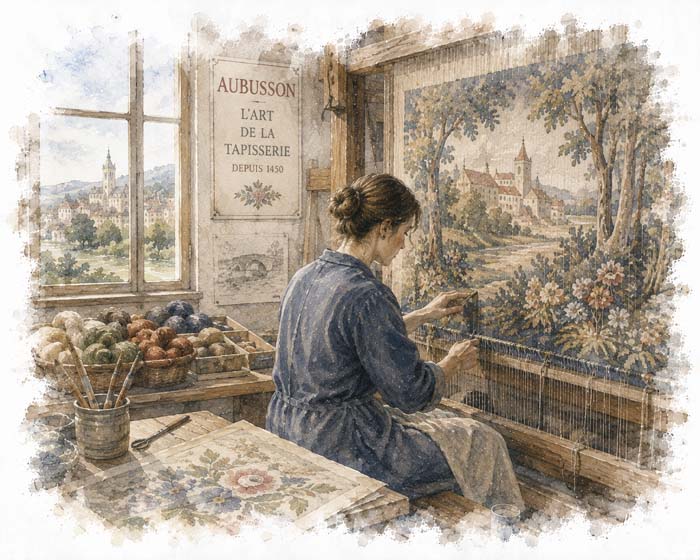
Aubusson's arrangement is a different version of the same division. A tapestry begins as a painted cartoon made by an artist, which is then interpreted by the lissier at a horizontal low-warp loom. The weaver works on the reverse of the fabric, with the cartoon beneath or behind the warp, building the image thread by thread without a direct view of it. Colour is judged by a system of hatching and by experience rather than by looking. UNESCO inscribed the craftsmanship in 2009, and what it recognises is precisely this: an interpretive skill exercised on somebody else's design, blind.
The Patron Institution
In both crafts the authority is external. For the enamel it was the church, which certified the technique in 1215 and then bought from these workshops for two centuries. For the tapestry it is the artist, who supplies the cartoon that the weaver executes. In neither case did the Limousin decide what it would make. It decided how well it could be made, and that distinction runs through everything the region produced.
Executed From the Back
The regional competence lies in realising other people's intentions. The enamellers filled cells to a scheme, the weavers work from the reverse of a design they did not draw, and both traditions are assessed on fidelity and finish rather than on invention. That subordination is the whole inheritance and it is not a diminishment: interpretation at this level is a rarer skill than invention, and it is the reason artists have kept sending cartoons to the Creuse for six hundred years. In Aubusson a lissier is matching a hatched transition she will not see properly until the loom is cut.