Two Kingdoms, Two Kiln Districts
Sukhothai emerged as a Thai kingdom in the thirteenth century in the north-central plain, and Lanna, with Chiang Mai as its capital, was a separate northern kingdom founded at much the same period and independent for centuries afterwards. They are frequently collapsed into one Thai story and they were distinct polities with distinct histories, which matters because the ceramics associated with each have different characters and different dates, and the trade routinely labels everything Thai.
The Origin Story and the Evidence
The tradition holds that King Ramkhamhaeng brought potters from China after a visit, and it appears in later chronicles rather than contemporary sources. Excavation of the kiln sites shows a sequence of local development, with earlier Mon and regional stoneware traditions, and technical borrowing from Chinese practice through the trade that was already flowing. The Chinese-potters story is a tidy explanation for something that happened untidily over a longer period.
Sawankhalok and the Export Trade
The kilns at Si Satchanalai, known in the trade by the name Sawankhalok, produced on an industrial scale. Their output moved through the maritime networks of Southeast Asia and turns up in graves, shipwrecks and settlement sites across Indonesia, Borneo, the Philippines and beyond, in quantities that make it one of the region's great ceramic export industries. Whole sunken cargoes have been recovered from the Gulf of Thailand and the Java Sea, some carrying tens of thousands of pieces from these kilns.
Underglaze Iron and the Other Ware
Celadon was not the only output. The same kilns produced a painted ware decorated in iron-brown under a clear glaze, with fish, flowers and bold linear designs, and it travelled the same routes. It is generally less prized than the celadon and it is technically the more revealing of the two, because brushwork survives on it and the hand of an individual painter can be seen where a monochrome glaze conceals everything.
The Patron Institution
Not primarily a court. Unlike Goryeo celadon, which was made for a palace, the Thai kilns were a commercial export industry serving overseas markets, and their scale reflects that. The courts of Sukhothai and Lanna consumed ceramics and Buddhist institutions commissioned architectural and ritual pieces, but the volume was driven by ships. That difference in patronage shows in the ware itself, which is robust, repeatable and made in quantity.
What Thai Celadon Looks Like
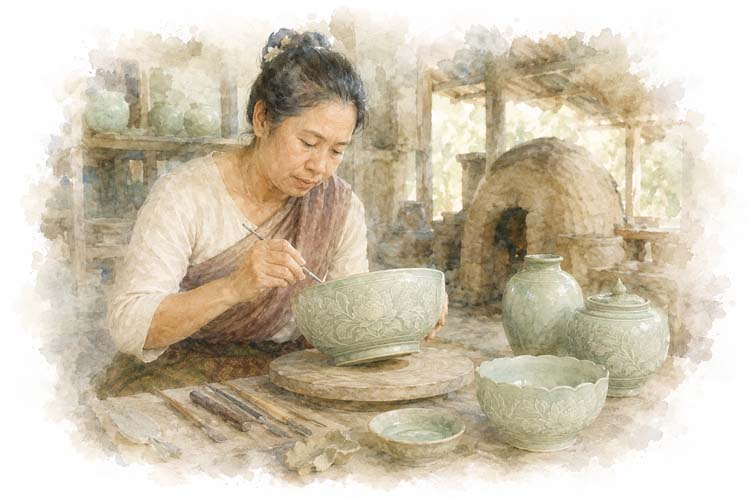
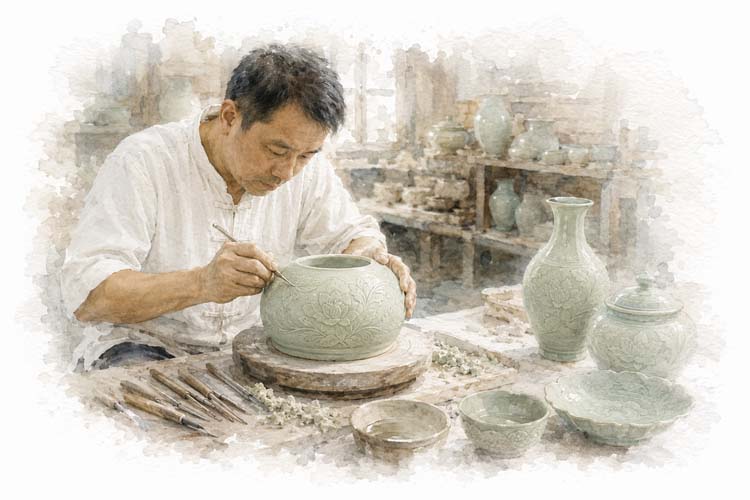
The classic Sawankhalok celadon is a grey-green or olive glaze over a greyish stoneware body, frequently with a deep crackle, and decoration is typically incised or carved under the glaze rather than inlaid: fish in the bottoms of dishes, floral scrolls, combed lines. The forms are plates, bowls, jars, bottles and covered boxes, and the bases usually show an unglazed foot with the marks of the stacking supports used in the kiln.
The Kilns Themselves
The kilns are worth understanding because they explain the volume. These were cross-draught brick structures built into slopes, large enough to fire hundreds of pieces at once, and the sites at Si Satchanalai contain them in numbers, along with the waste mounds of failed and broken ware. Excavation has recovered kilns preserved well enough to walk into. An industry of that scale in a pre-industrial economy required organised clay supply, fuel, labour and shipping, all of which had to be coordinated.
The Long Gap
Production declined and effectively ceased by the sixteenth or seventeenth century, as warfare disrupted the region and Chinese and later Vietnamese wares recaptured the export markets. What is made in Chiang Mai today is a twentieth-century revival, established in the modern period and drawing on the excavated material, and it is a genuine and skilled industry rather than an unbroken descent. The parallel with Korea is close and worth stating: two celadon traditions, two long silences, two reconstructions from excavated fragments.
Chiang Mai Now
The northern city has become the centre of contemporary Thai celadon, with workshops producing tableware, lamps and decorative pieces in the characteristic crackled green glaze for domestic and export markets. It is also the centre of a much wider craft economy in lacquer, silver, umbrellas, woodcarving and textiles, much of it concentrated in specific villages around the city, and the celadon sits inside that rather than standing alone.