Arts, Crafts and Living Ateliers
Embroidery is done seated, on a frame or in the lap, by several women of a family working over months. Felt is the other great medium and it is heavy communal work: wool is laid out, wetted, rolled in a mat and dragged, sometimes behind a horse, until the fibres bind. Nothing in felting is delicate until the decoration stage. Silversmithing and woodwork are men's crafts and are done separately.
Reading a Tush Kiyiz
Look at the density and the ground. Older pieces are worked in silk on a handwoven or velvet ground with the embroidery covering a substantial part of the field, and the stitching is even but visibly hand-worked, with slight variation where different women joined the work. Modern production pieces use synthetic thread on machine cloth and read flat and glossy. Check the border, which is where the most demanding work sits and where quick pieces simplify first. A narrow or sparsely worked border on an otherwise dense field usually means the piece was finished against a deadline.
The Felt Carpets
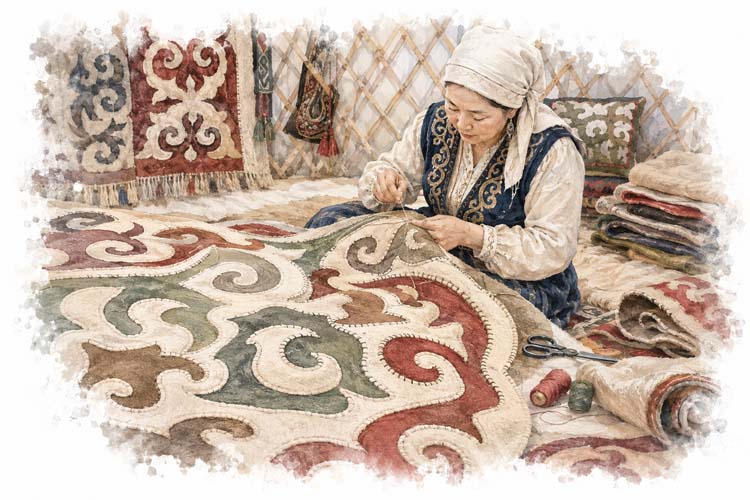
The other major domestic textile is the felt floor covering, and there are two distinct techniques worth telling apart. In one, coloured felt shapes are cut and inlaid into each other so the pattern goes right through the thickness and there is no front or back. In the other, the design is laid on the surface in coloured wool before the felting, so it fuses in as the piece is made. Both are genuine, and the inlaid kind is the more demanding.
Silver, and the Weight of It
Kazakh silver is substantial: heavy bracelets, large ring forms, pectorals and hair ornaments, frequently set with carnelian or coloured glass, worked with granulation, filigree and niello. As in the Atlas, it was a woman's own property and a way of holding value, and as there, a great deal of it was melted when families needed money. Weight, tool marks and honest wear are the checks, and modern cast reproductions are soft in detail.
The Woven Bands
The narrow patterned bands that bind the yurt's frame and decorate its interior are a craft in themselves and the most overlooked one. They are woven on small portable looms, carry the same ornament as everything else, and are structural: they hold the lattice under tension and secure the felt covers against the wind. An object that is simultaneously load-bearing and decorated is rare in any culture, and here it is routine.
Ateliers, Villages and Artisan Encounters
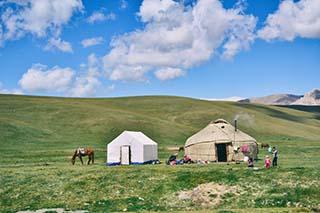
Almaty is the country's cultural centre and its museums hold the reference collections of yurt furnishing, embroidery and silver, which is where the standard should be learned before anything is acquired. Craft workshops and cooperatives operate in and around the city and in the regions. Yurts are raised for festivals rather than lived in, so seeing a fully furnished one usually means timing a visit to an occasion.
Wood, Bone and Inlay
The chests, low tables, cradles and the yurt frame itself are worked by men in wood, frequently inlaid with bone, horn or silver in the same ornamental vocabulary the women embroider. A decorated chest was part of a bride's equipment and travelled with her. Because the pieces are small, portable and structurally simple, the quality sits entirely in the joinery and the inlay, and a chest whose inlay is glued rather than let into cut recesses is modern work.
Tourwit Editions and Provenance
Tourwit commissions directly from Kazakh embroiderers, felt-makers and silversmiths, paying before work begins and leaving the major share of what a piece realizes with the maker. The record names her, the region, the materials and the technique, and for a tush kiyiz it names each woman who worked on it where more than one did. It also states plainly whether a piece continues an unbroken practice or belongs to the post-independence revival.
Why These Works Matter
This is the material culture of a people who solved the problem of how to live well while moving, and every object in it is an answer to that problem: light, foldable, structural, and decorated because the decoration was the architecture. The life it was built for has gone. What remains is unusually worth documenting precisely because the function that explained it is no longer visible in the object.