Arts, Crafts and Living Ateliers
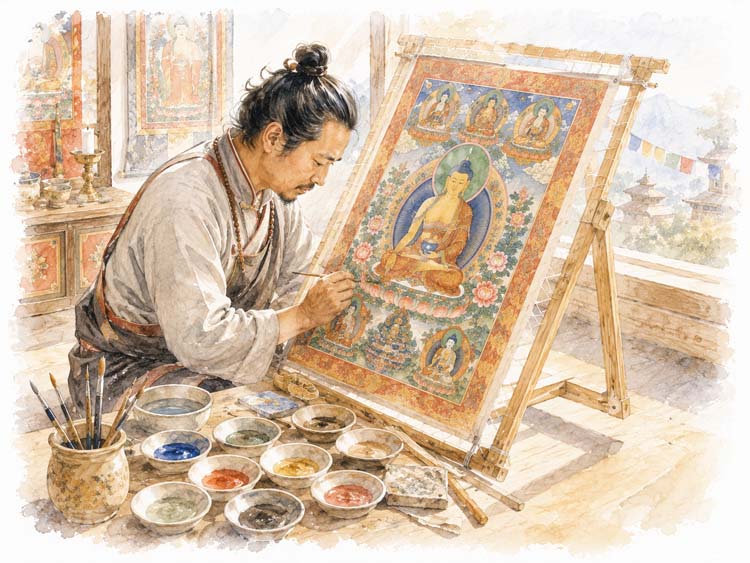
A painter works seated with the framed canvas propped nearly upright, brushes made of a few animal hairs set in a quill, and pigment in small dishes mixed fresh with glue. The order is fixed: grid, drawing, sky and ground, then the figures from background to foreground, flat colour first, then shading, then outlining, then gold, then the eyes. Nothing is worked out of sequence, and a painter who has been trained properly will not attempt it.
Reading a Thangka
Examine the outlines under magnification. Hand painting shows a line that varies in width and pressure and occasionally wavers; a printed thangka, which is common and cheap, shows a dot screen and perfectly even edges. Then look at the gold: real burnished gold has a mirror sheen at a raking angle and sits with slight relief, while gold-coloured paint is flat and dull. Then look at the back for the cloth and the stitching.
Mineral Against Synthetic
Ground mineral pigment is granular under a lens, with visible particles and slight variation in density across a flat area, and it has a matte depth. Modern synthetic paint is even, smooth and frequently brighter than anything a mineral can produce, particularly in the greens and purples. Neither is dishonest but the price difference is large, and a piece sold as traditionally made should be traditionally pigmented.
Judging the Drawing
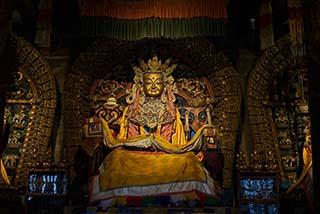
Quality shows in the face and hands before anywhere else. On good work the features are placed exactly, the expression is composed rather than approximate, the fingers are individually considered, and the fine gold linework on robes is unbroken and even. On quick work the face is the first thing to go soft. Compare two thangkas of the same deity side by side and the difference is unmistakable within seconds even to an untrained eye.
The Mount
A thangka is not a stretched canvas. The painted cloth is trimmed and sewn into a brocade surround with an inner border, an outer border and a panel of contrasting silk at the base, then attached to a wooden roller at the bottom and a stave at the top, with a silk cover that hangs down over the face when it is not in use. The mounting is a separate trade, and on serious work the silks are chosen deliberately rather than by what is on the shelf.
Ateliers, Villages and Artisan Encounters
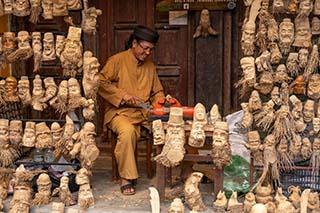
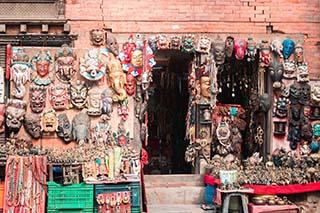
Patan is the valley's metalworking and painting centre and has been for centuries, with workshops throughout the old city and a museum in a restored palace that is among the best in South Asia. Bhaktapur is the most intact of the three cities. Boudhanath, around its great stupa, is the centre of the Tibetan exile community and its painting workshops, which are a distinct tradition from the Newar one and worth visiting separately.
Condition and Restoration
Old thangkas suffer in specific ways: smoke from butter lamps darkens them, the ground cracks where the cloth has been rolled and unrolled, and the brocade mount perishes long before the painting does. Overpainting is extremely common and is frequently presented as original. Look at the cracks: genuine age produces a fine craquelure following the weave, while repainting sits over the cracks and fills them, which is visible under a lens at a raking angle.
Tourwit Editions and Provenance
Tourwit commissions directly from painters in Patan, Bhaktapur and the valley workshops, paying before work begins and leaving the major share of what a piece realizes with the painter. The record names the artist and the school he trained in, states the pigments as mineral or synthetic, confirms real gold where used, identifies the deity and the iconographic tradition, and states whether the piece has been consecrated.
Why These Works Matter
This is a tradition where invention is constrained by doctrine, the patron is recorded and the painter frequently is not, and the object only becomes itself after a ritual the painter does not perform. It is also the workshop that supplied the whole Himalaya and gets credited for almost none of it, because the paintings have always left under the name of the region they were sent to rather than the one they were made in.