Arts, Crafts and Living Ateliers
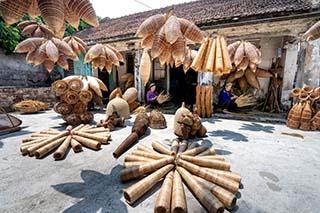
The work happens in the courtyard and the doorway of the house. A woman sits on the ground with a mass of prepared clay, building the vessel upward, turning it by hand rather than by any mechanism, with a stone or a piece of leather for smoothing. The pots dry in the shade for days, are painted when leather-hard or dry, and are fired in a batch when enough have accumulated. Nothing about the process requires equipment that could not be made at home.
Reading a Kabyle Pot
Look inside and at the base. Hand-built work shows the traces of construction: faint horizontal ridges where coils were joined and smoothed, finger pressure marks, and a base that is not perfectly round. Wheel-thrown pottery shows concentric throwing rings and a mechanically true profile, and any vessel offered as Kabyle that has them is not what it is claimed to be. The wall thickness should vary slightly when the pot is turned in the hands, and the rim should be very slightly out of true. Set the pot down and look at it from eye level: it will lean, fractionally, and it is meant to.
The Painting and the Firing
The decoration is freehand, so the bands are not exactly parallel, motifs differ slightly from repeat to repeat, and the brush loading varies visibly along a line. Painted-on decoration applied over a fired body, or transfer-printed pattern, will be flat and perfectly even. Look for fire clouds, the irregular grey and brown blooms left by direct contact with fuel in an open firing, since a uniformly coloured body indicates a controlled kiln. Both firing methods produce usable pots; only one of them is this tradition.
Forms and Their Uses
The repertoire is functional and worth learning: large narrow-necked jars for storing oil and grain, water vessels with two handles designed to be carried on the shoulder or the head, shallow dishes, lamps, and the flat unglazed griddle plate on which flatbread is cooked over a fire. Each form is shaped by its job, and the proportions of a water jar in particular are the product of a long working out of how much weight a woman can carry uphill from a spring.
What Survives, and What Does Not
Low-fired porous earthenware is fragile, and that has consequences for anyone thinking about older pieces. Vessels in daily use broke and were replaced, so the tradition leaves comparatively little behind it: what exists in collections is mostly late nineteenth and twentieth century, gathered by colonial-era collectors and by museums. There is no deep stratum of surviving antiques here to compete with, which means the honest object in the market is a recent one, and there is no reason to pretend otherwise.
Ateliers, Villages and Artisan Encounters
The pottery villages are in the Kabylia massif east of Algiers, in the districts around Tizi Ouzou and in the Soummam valley, with certain villages long known specifically for ceramics. Access is straightforward by Algerian standards but the country as a whole receives few visitors, and arrangements are best made through local contacts rather than assumed. The region's silver jewellery, made in enamelled cloisonné with coral, is a separate and equally serious tradition of the same mountains, made by men, and it uses the identical geometric vocabulary in an entirely different material.
Tourwit Editions and Provenance
Tourwit works directly with potters in the Kabyle villages, with payment made before the work is begun and the major share of what a piece realizes retained by the maker. Since this tradition has no guild and no signature and its makers have never been recorded, the record here does the work no institution ever did: it names the potter and her village, states that the piece is hand-built and open-fired, and describes the painted vocabulary used.
Why These Works Matter
A craft with no patron, no wheel, no kiln, no workshop and no signature is about as institutionally undefended as an object can be, and this one has nonetheless been made continuously in the same mountains for a very long time by women who were never named. What is at risk is not the technique but the reason for it. The moment the household stops needing the pot, everything else about the tradition depends on somebody deciding it is worth keeping.