



Craft Map
The Craft Map
Jiangnan's crafts sit in named cities rather than villages, and the distances between them are short, which is why the region reads as one workshop with several departments. One mark applies across the region and it is international: the craftsmanship of Nanjing Yunjin brocade was inscribed on the UNESCO Representative List in 2009.
Suzhou: Su Embroidery and the Silk Fan
On the canal network west of Shanghai, Suzhou has been the delta's centre of fine silk work for centuries, and its embroidery is counted among the four great schools of China. The city's specialisms are the ones that reward looking closely rather than from a distance: split-thread embroidery worked to the appearance of painting, double-sided pieces finished on both faces, and folding silk fans that belong to the same taste. Workshops still cluster in and around the city rather than dispersing. A Su piece's record should name its workshop and, where possible, its embroiderer.
Nanjing: Yun Brocade
Upriver on the Yangtze, Nanjing was an imperial capital and held an official silk manufactory, which is the reason the most technically demanding brocade in China is woven here. Yun brocade requires the great drawloom and two operators working in coordination, with gold and peacock feather yarn introduced by hand. UNESCO inscribed the craftsmanship in 2009. Because output is measured in centimetres a day, quantity is itself a provenance signal, and any large piece offered cheaply should be questioned on that basis alone.
Dingshu, Yixing: Zisha Teaware
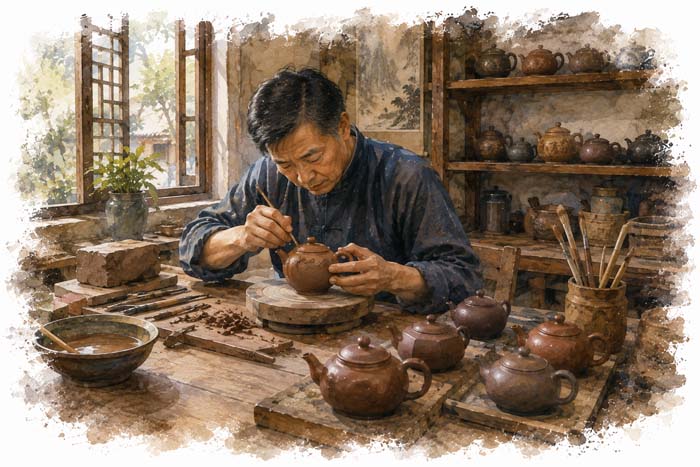
South of Lake Tai, the town of Dingshu in Yixing sits on the purple clay deposits that give the ware its name and its properties. Production dates to the Zhengde period of the Ming, and tradition places its beginning with Gongchun and the monks of the Jinsha monastery. Pots are built from beaten sheets rather than thrown, and left unglazed by principle. The tie to place is strict here: the clay, the makers and the technique are all local, and a pot from elsewhere in the same clay is not the same thing.
Shaoxing: Chinese Calligraphy
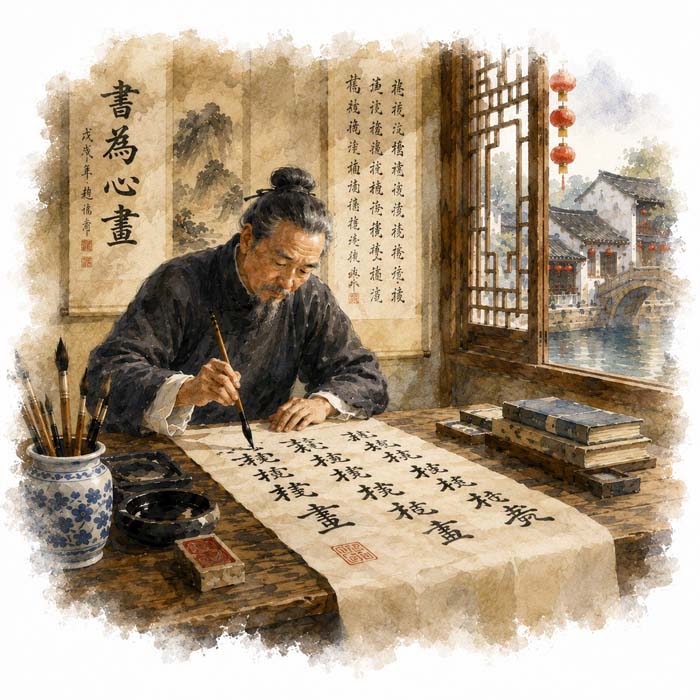
South across the bay, at the foot of Mount Kuaiji, Shaoxing holds the most consequential address in Chinese calligraphy. Wang Xizhi was governor of Kuaiji here, and in 353 he gathered forty one guests at the Orchid Pavilion for a spring purification, wine cups floating down a winding stream. The preface he wrote that day, three hundred and twenty four characters of running script, became the work every later calligrapher was measured against. The original is lost, believed buried with Emperor Taizong of Tang; the closest thing to it is a traced copy attributed to Feng Chengsu in Beijing. An entire tradition descends from a document nobody alive has seen.
Zhuanzhu Lane, Suzhou: Jade Carving
Jade is worked a few streets from the embroidery workshops, and has been since the Ming, when the lane became the principal carving centre outside Beijing. Under the Qing, carving was heard from nearly every house along it. The Suzhou preference is for small pieces finished to a delicacy that rewards holding rather than display. The name attached to that reputation is Lu Zigang, working in the later sixteenth century and unusual for marking his pieces, though objects carrying his mark appear far more often than one lifetime can explain, so the mark opens a question rather than settling one. It is national intangible heritage.
Shanghai: Jade Carving in the Haipai Manner
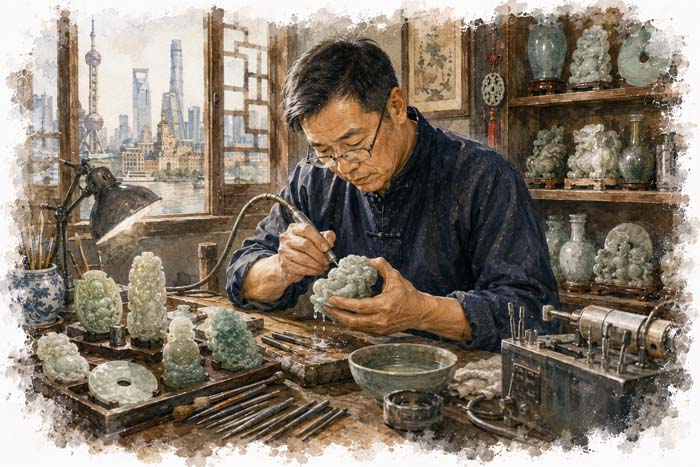
Downriver at the mouth of the delta, Shanghai is not an old carving town, which is the point. The craft was assembled here in the nineteen sixties, when a single factory brought roughly twelve hundred carvers together and a distinct manner formed. Where Suzhou favours the small and the delicate, the Shanghai speciality is vessels, censers and bottles whose shapes and ornament come from archaic bronze rather than flowers or figures. For a collector the distinction does real work: the two cities carve the same material into different categories of object, and a record naming only China discards that. Also national intangible heritage.
Also on the Map
Lake Tai, the water that connects these towns and moved their goods. The canal system that made the delta rich enough to be particular. And the classical gardens of Suzhou, which state most clearly the taste all of these crafts were made to satisfy. Who made an object matters here, but so does which city's idea of restraint it was made to satisfy.