A Kiln Town That Took Instructions
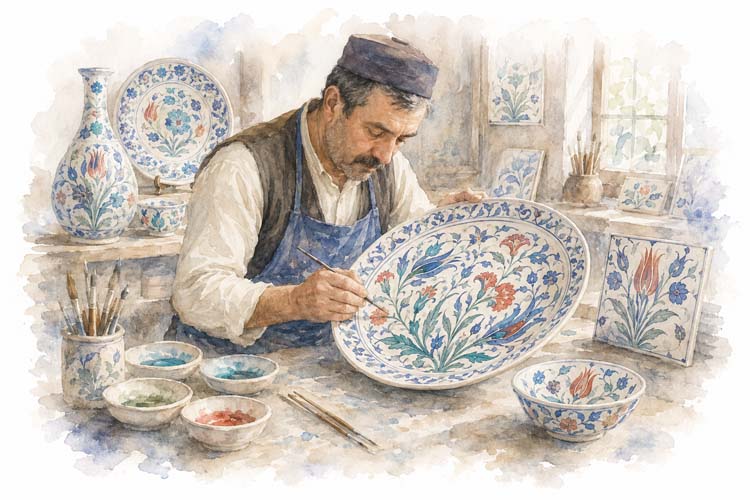
Iznik is a small place on a lake in northwestern Anatolia, and for roughly two centuries it produced the finest ceramics in the Islamic world without designing very much of them. The drawings arrived from Istanbul. That division, between a court that decided what things should look like and a provincial town that worked out how to make them, is the organising fact of this tradition and it explains almost everything a collector will notice. In an Iznik workshop the pigment tray is the most interesting object in the room. What follows is not the history of a town. It is the record of a design bureaucracy and the kilns that served it.
The Body That Is Not Clay
Iznik ware is fritware, a stonepaste composed principally of ground quartz with glass and only enough clay to hold it together. The quartz content is exceptionally high, which makes the material difficult to work, prone to failure and unusually white. It also fires hard and faintly translucent, so a thin Iznik dish can approach the appearance of porcelain without being porcelain at all. The whole tradition is an answer to a problem: Chinese porcelain was admired and unobtainable, and this was the nearest approach available to potters who had no kaolin.
1514, and the Artists Who Arrived
After the Ottoman victory over the Safavids in September 1514, artists and craftsmen from the Persian world came to Istanbul in numbers and entered the imperial workshops, the nakkaşhane. That office produced the designs for the court's manuscripts, textiles, metalwork and tiles alike, which is why an Iznik dish, an Ottoman kaftan and a bookbinding of the same period share a vocabulary. The pottery is not an independent art with its own tradition of ornament. It is one output of a single design authority applied across every medium the court commissioned.
The Red That Would Not Behave
The palette developed in stages, from blue and white toward a wider range, and the difficult addition was red. An iron-rich preparation, sometimes called Armenian bole, was applied thickly and produced a colour that other potters could not match, but it had to sit in a raised layer to hold its intensity under the glaze. That thickness is visible in raking light and detectable by touch. It is also the first thing later imitators failed to reproduce, which makes it the most practical authentication test in the field.
Tiles, and What They Were For
The kilns supplied vessels, but the work that shaped the tradition was architectural. Ottoman mosque and palace interiors were faced in tile at enormous scale, and a single commission could occupy the town's entire capacity. Architectural work imposes requirements that vessels do not: colours must match across thousands of pieces made over months, patterns must align across panels, and the whole must read correctly from a distance and at height. The consistency a collector admires in Iznik ware was a structural necessity before it was an aesthetic virtue.
The Patron Institution
The court was designer and client at once, and both roles sat inside the palace in Istanbul rather than anywhere in Iznik itself. The nakkaşhane supplied the drawings, the court placed the orders, and the palace's requirements set the standards. That arrangement produced the tradition's peak and also its ending: when court patronage weakened, the kilns had neither designs of their own nor an independent market able to sustain the quality, and the work declined sharply. A craft that never had to find its own customers is a craft with no defence when its customer stops ordering.
Executed, Not Invented
What continued was not a preserved tradition but a technical achievement in service of somebody else's drawing. Modern Iznik work is a revival rather than an unbroken line, and it is honest to say so. What survives from the historic kilns rewards a specific kind of attention: not to the invention of the pattern, which happened in Istanbul, but to the execution, which happened here and which nobody has fully matched since. In an Iznik workshop today someone is laying red thickly enough to feel, and knowing that if it goes on thin it is worth nothing.