The Plateau
Isaan is the northeast of Thailand, a wide low plateau tilting toward the Mekong, drier and poorer than the rest of the country, and culturally closer to Laos than to Bangkok: the language spoken across most of it is a Lao dialect, the food is different, and the region has long been looked down on from the capital. It is also the most populous region in Thailand and the source of much of the labour that built Bangkok.
Silk From the Back of the House
Sericulture here is a household activity rather than an industry. Mulberry is grown at the edge of the rice fields, worms are raised in trays under the house, cocoons are boiled and reeled by hand onto a simple frame, and the resulting yarn is uneven, slubby and full of character because hand-reeling cannot produce the uniformity a filature does. That irregularity is what people mean by the look of Thai silk, and it is a by-product of small-scale production.
How Ikat Actually Works
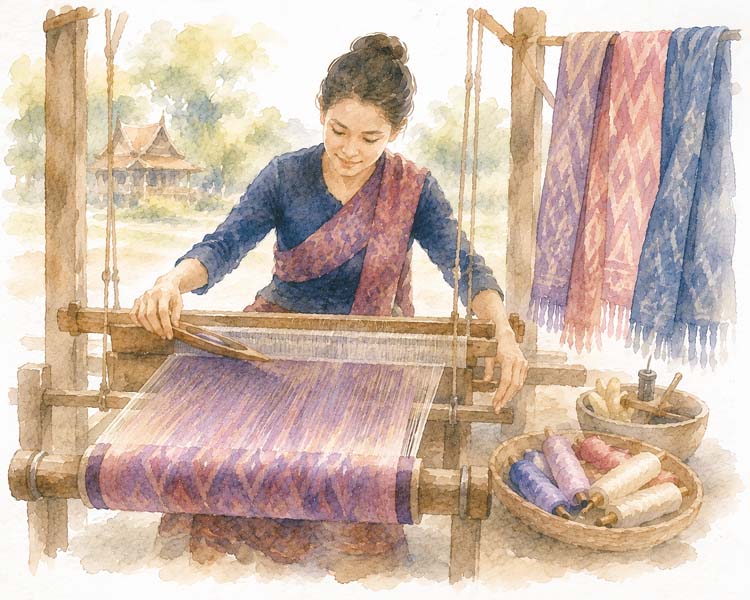
The weft threads are wound onto a frame in the order they will be woven, then bound with waterproof ties wherever the dye must not reach, and dipped. The ties are cut, new ones added, and the bundle dipped again in the next colour, and so on. When the threads finally go onto the loom in sequence, the pattern assembles itself across the cloth. Every calculation about the finished design happens while the threads are still a bundle.
Why the Edges Are Soft
The characteristic blurred outline is a physical consequence rather than a style. Dye creeps a little under the binding, and the threads shift by a fraction as they are woven, so a boundary that was sharp in the bundle arrives on the cloth slightly feathered. Sharper edges mean tighter binding and more careful alignment; perfectly crisp edges mean the pattern was printed onto finished cloth rather than dyed into the yarn.
The Patron Institution
None traditionally, and then a queen. This was household weaving for household use and local exchange, made by women in the months between rice crops. From the 1970s a royal foundation set out to develop rural craft as supplementary income across the northeast, providing training, standards and a market, and a great deal of what is woven now passes through that system. It is one of the clearest cases in this collection of deliberate state-adjacent craft development, and it succeeded on its own terms: silk income reaches households that have very little else.
Jim Thompson and the Revival
The other modern intervention was commercial. An American who settled in Bangkok after the Second World War built an export business for Thai silk, raised standards, found international buyers and made the material famous, and his disappearance in Malaysia in 1967 turned him into a story that has slightly obscured the weavers. The industry he built is real and so is the fact that the weaving long predated him.
Not Only Mudmee
The region weaves more than ikat and the distinctions matter. Khit is a supplementary weft technique producing small geometric motifs raised on the surface. Praewa, associated with the Phu Thai people, is a dense discontinuous supplementary weft in brilliant colour, worked almost like tapestry and traditionally reserved for the finest shoulder cloths. A record that says only Isaan silk has named a region and no technique.
What the Patterns Mean, and Do Not
Mudmee designs carry names drawn from the world around them: hooks, diamonds, the naga serpent of Mekong belief, flowers, and geometric fields built from small repeated units. Some carry genuine associations, particularly the naga, which belongs to a living body of river belief. Sellers extend this into elaborate symbolic readings for every element, and weavers themselves frequently describe a motif simply as one their mother used.
Where It Stands
Handwoven silk continues across the northeast in genuine volume, supported by cooperatives, royal projects and a domestic market that still wears it, and Thailand operates a certification scheme with a peacock emblem marking grades of Thai silk from fully handmade to blended. The competition is printed imitation and machine-woven cloth in ikat-like patterns, which is cheap, convincing at a distance and widely sold.