





Craft Map
The Craft Map
Beijing's craft geography is organized by proximity to the palace rather than by village, because these trades were sited where the court could supervise them. The places that matter are workshop quarters and successor institutions rather than settlements. Two of the three trades carry national intangible cultural heritage listings, Jingtailan from 2006 and Beijing jade carving from 2008, and those listings attach to the city, not to a wider region.
The Palace Workshops: The Standard
The imperial manufactories operated inside and beside the Forbidden City, drawing craftsmen from across the empire into a single establishment answerable to the household. They are the origin of everything else on this map. Nothing is made there now, but the standard set there is what every later workshop has measured itself against, and the palace collections remain the reference against which a piece is judged. A work described as court quality is being compared with objects that never left this compound.
The Beijing Enamel Works: Jingtailan
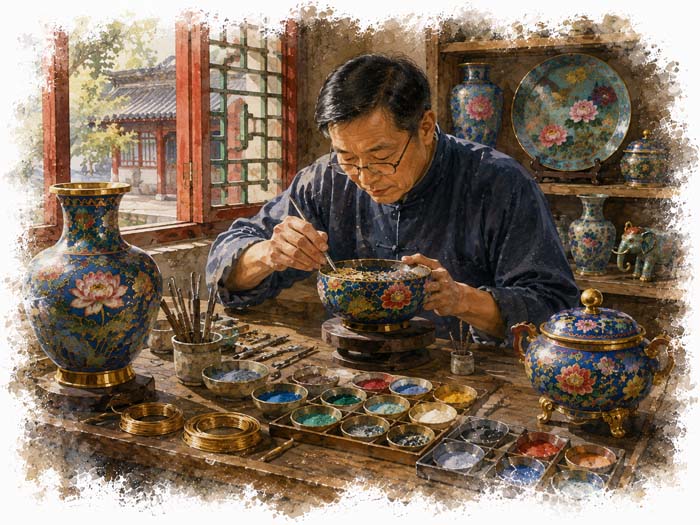
In 1956, forty two private enamel workshops were consolidated with the former Qing imperial workshop into a single enterprise, which is why the craft's continuity in this city is unusually traceable. Wire is still bent by hand here, cells are still filled with a spatula, and pieces still go through repeated firings until the enamel sits level. Jingtailan entered the national intangible cultural heritage list in 2006. This is the address where a claim to Beijing cloisonné can actually be tested.
The Jade Workshops: The Slow Trade
Beijing jade carving is counted among the city's classic court crafts and was listed nationally in 2008. It is practised in workshops rather than in one factory, and the work is individual in a way the enamel is not, because every stone is different and every design is a response to a particular boulder. A jade's record should name its carver. The enamel's record names its workshop. That difference is real and worth respecting on any document that accompanies a piece.
Also on the Map
The opera schools and troupes of the city, where painted faces are living practice rather than product. The temple fair grounds, which are where these trades met the public after the court stopped ordering. And the palace museum collections, the benchmark for every other name here. No village made these. What a record should establish is how close to the old standard the work was held.