A Town Built on Quicksilver
Mercury was found here at the end of the fifteenth century and Idrija became the second largest mercury mine on earth, working almost continuously for five hundred years. Mercury was strategically vital: it was used to extract silver from ore, so Spanish American silver production depended on European mercury, and this Slovenian valley was wired into a global economy from the sixteenth century, its output shipped to Spain and onward to the Americas. The mine is now inscribed by UNESCO alongside Almadén in Spain.
Why a Mining Town Makes Lace
Mining employed men, dangerously, and paid irregularly. Mercury poisoning was an occupational certainty rather than a risk, and a household could lose its earner suddenly or gradually. Lace answered that: it needed almost no capital, could be done at home in any spare hour, was portable, and produced something a merchant would buy for cash. It was a household's second income and, frequently, its insurance policy. The craft is a direct consequence of the mine's economics.
The Tape That Makes It
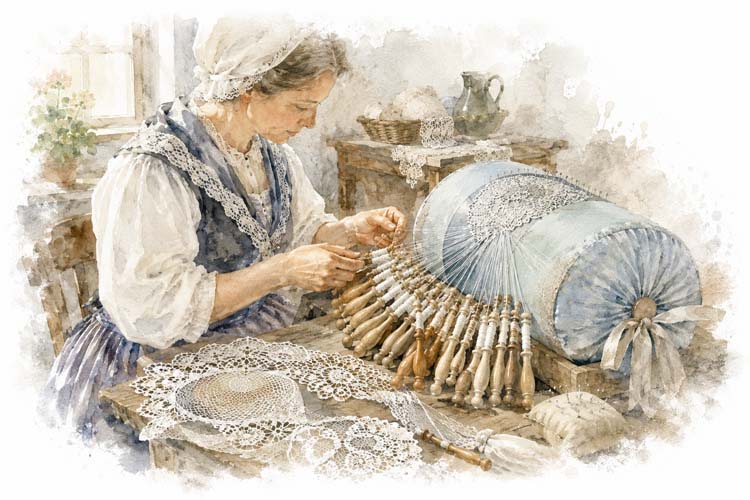
The technical signature is a continuous braid worked in cloth stitch, which travels through the design, turns back on itself, and is joined to its own earlier passes with pins. Instead of building a picture from separately made motifs as Bruges does, Idrija draws it with one moving line, like a pen that never leaves the paper. That gives the lace its flowing, ribbon-like character, and it means a piece is worked as one continuous operation from start to finish with no opportunity to set part of it aside and begin again.
What Mercury Did to People
The mine's human cost belongs in this card because the craft is a response to it. Mercury is absorbed as vapour and accumulates, and chronic poisoning produces tremors, neurological damage and early death; the shaking was common enough in Idrija to have a local name. Shifts underground were shortened over the centuries as the connection became undeniable. A household whose earner was being slowly poisoned needed a second income that did not depend on him, and that is what the lace was.
The Patron Institution
The mine, indirectly, and then the school. There was no court and no guild here. What there was, unusually, was an imperial administration running a strategic industry and taking an interest in the welfare of its workforce, and a lace school was founded in 1876 with official backing. It has operated more or less continuously ever since, which makes it one of the oldest continuously running lace schools anywhere and the institution that carries the craft.
The School as the Mechanism
This matters more than any patron. The school standardised the technique, trained generation after generation, kept a pattern archive, and gave the craft a written and teachable form. When the mercury economy declined and then ended, the lace did not go with it, because its transmission had been separated from the industry that started it. Bohemia's glass schools did the same job in the same century, and the parallel is exact enough to be worth stating: in both places an institution founded in the nineteenth century is the reason a twentieth-century collapse did not finish the craft.
Protected by Name
Idrija lace carries a protected designation and there is a certification scheme for genuine local handmade work, which is more legal protection than most crafts in this collection enjoy. It reflects a real threat: machine-made and imported lace is sold under the name, as it is everywhere. The designation covers the origin and the handwork; it does not, as usual, record the woman who made it, which leaves the same gap the Kairouan and Talavera certifications leave.
What It Is Now
The craft is genuinely alive rather than preserved. Several hundred people in and around the town make lace, the school still enrols children, and an annual festival each June brings the whole thing into the open with competitions and a market. It has also moved: contemporary designers work in the technique for fashion and interiors, and the town has been deliberate about treating that as continuation rather than dilution, which is a more confident position than most craft towns manage.