Arts, Crafts and Living Ateliers
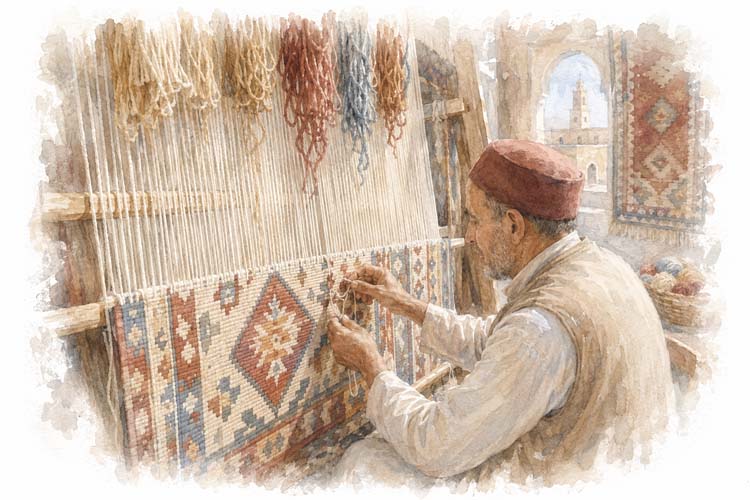
The looms are upright and stand in houses and in small workshops within the old city and its surrounding districts. A weaver works seated in front of the warp, knotting across the width and beating each row down with a heavy comb, and the carpet grows upward as the finished portion is rolled under. Large carpets are worked by two or three women side by side across the same loom, which is a different kind of collaboration from anything solitary and requires the knotting to be matched between hands closely enough that the join does not show. It rarely disappears entirely, and finding it on the reverse tells you how the carpet was made.
Reading a Kairouan Carpet
Turn it over. The knot count is visible on the reverse and can be estimated by counting across a measured span, and the back should show a clear, even, regular structure with the pattern legible. Look for the certified label sewn to the back, which records the grade. Then check the consistency of the beating, since a carpet worked by more than one weaver can show a subtle change in density where the hands met, and check the selvedges and the ends for whether they are original or reconstructed.
Reading a Flatweave
The kilim is a different assessment entirely. Here the question is the tightness of the weft packing, whether the wool covers the warp completely, and how the colour changes are managed where one block meets another. Look at the reverse for a face nearly as clean as the front. Because these were made for use in the household rather than for a graded market, they carry no certification, and they are also the pieces where individual invention shows most clearly.
The Medallion, and Its Ancestry
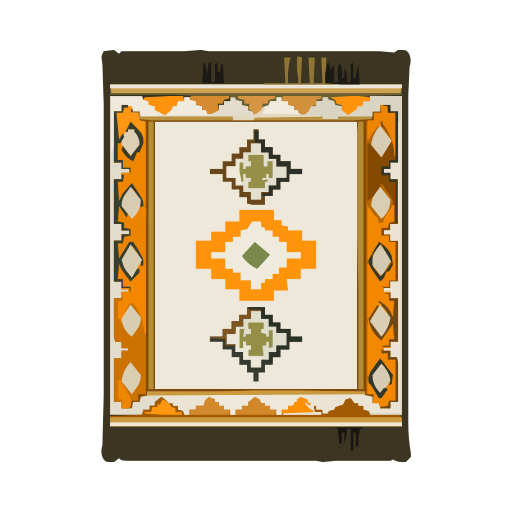
The characteristic Kairouan design is a central medallion on a field with cornerpieces and multiple borders, and its ancestry runs back through Ottoman-period Anatolian carpet design. Recognising that connection is useful, because it places the carpet in a family rather than treating it as isolated, and because the local development of the type, its particular colouring and its handling of the borders, is what makes a Kairouan carpet identifiable to somebody who knows the family.
What a High Grade Costs
Time scales with knot count, and it scales badly. Doubling the density more than doubles the work, because every row is finer and there are more of them, and a carpet at the top of the grading scale can occupy a weaver for the better part of a year. Set against the prices such carpets fetch at the end of a trading chain, that arithmetic is the argument for dealing at source, and it is also why the finest grades are becoming rarer regardless of demand.
Ateliers, Villages and Artisan Encounters
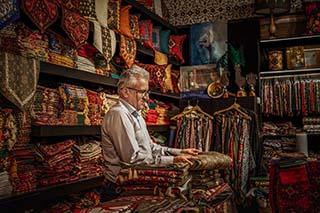
The old city of Kairouan is compact and walkable and the weaving is in and around it. The Great Mosque, the mausoleum of a companion of the Prophet, and the vast open cisterns outside the walls are the historic sites, and the carpet trade operates in the streets between them. Elsewhere in Tunisia, the flatweave traditions of the south and the island of Djerba are separate and worth knowing about before forming any view of Tunisian weaving as a whole.
Tourwit Editions and Provenance
Tourwit commissions directly from weavers in Kairouan, paying before work begins and leaving the major share of what a piece realizes with the maker. Where a carpet carries the official certified label, the record reproduces its grade; and it then adds what the label omits, which is the name of the woman who knotted it, the loom she worked on, the wool and the dye class, and the names of the others where a large carpet was worked by more than one pair of hands.
Why These Works Matter
This is the rare case where a formal system already verifies the object. Grades are recorded, labels are sewn on, densities are checked. And the system still does not say who made it. The gap between a certificate that guarantees a knot count and a record that names a weaver is the whole distance between a commodity and a work, and it is unusually visible here because the first half already exists.