Rank Made Visible
Hawaiian society was steeply stratified and featherwork was the visible property of its summit. The full-length cloak, the shorter cape, the crested helmet, the feathered god images and the kāhili standards carried before chiefs were regalia in the full sense. Scale, colour and density stated rank precisely, and a cloak reaching the ankles belonged only to the highest chiefs. A lesser chief wore a cape at the shoulder. These were not garments in any ordinary sense, and they were not decorative. They were worn into battle, exchanged between chiefs, inherited, and understood to carry the accumulated mana of everyone who had worn them before.
How They Were Made
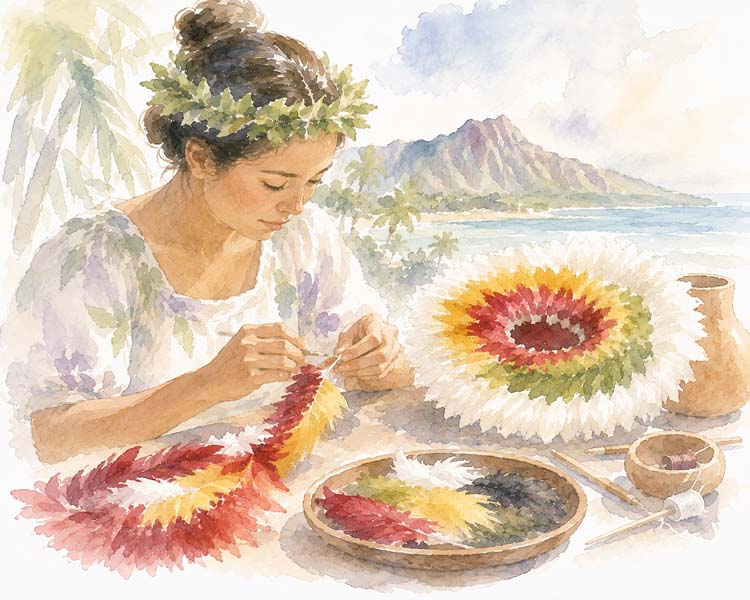
A foundation net was knotted from olonā, a plant fibre of exceptional strength and fineness, shaped to the wearer. Small bundles of a few feathers each were then tied onto the mesh in overlapping rows, each course concealing the knots of the one below, building a dense pile that behaves like fur rather than cloth. Nothing is glued and nothing is woven through. The colour blocks that give these pieces their geometry, the crescents, triangles and bands, were planned into the tying and are structural rather than applied. A large cloak represents an accumulation of individually tied bundles running into the hundreds of thousands.
The Birds
Yellow came from the ʻōʻō and the mamo, red from the ʻiʻiwi and the ʻapapane, black from several species. Yellow was the scarcest because the birds that produced it carried only a small tuft of yellow each, most of the plumage being black, which is why a predominantly yellow cloak indicated the very highest status. Bird catchers formed a specialist occupation with their own knowledge of gums, snares and the habits of the forest canopy. The accounts differ on whether birds were released after plucking, and the honest answer is that practice varied and the cumulative harvest was very large.
What Happened to Them
The ʻōʻō and the mamo are extinct. So are many other Hawaiian forest birds, and a majority of the survivors are endangered. The principal causes were not featherwork: forest clearance for cattle and cane, rats, mongooses and cats, and above all avian malaria carried by mosquitoes introduced in the nineteenth century, which pushed the surviving honeycreepers up into cold high-elevation refuges that are now warming. The materials of this craft are gone in the most final sense the word allows.
The Patron Institution
The chiefly class, and after unification the kingdom. Featherwork was made under chiefly direction by men of specialist rank, accompanied by chant, and the finished pieces were held, inherited and given between chiefs rather than traded. Through the monarchy they remained state regalia and appeared at coronations and state occasions. They are now held overwhelmingly in museums, principally the Bishop Museum in Honolulu, with significant pieces in Britain, Germany, Australia and New Zealand as a consequence of eighteenth and nineteenth century voyaging.
Why Some Are Overseas
Objects given to, traded with or removed by European voyagers from the 1770s onward reached collections across Europe, and their status is not settled. The cloak presented to a British captain in 1779 has been discussed for two centuries. In 2016 a cloak and helmet held in Wellington were returned to Hawaii on long-term loan, an arrangement widely read as a model. Repatriation here is a live negotiation between institutions and Native Hawaiian organisations, not a closed chapter.
What Exists Now
The knowledge did not vanish with the birds. Practitioners have reconstructed the tying techniques from surviving pieces and from oral transmission, and work today in feathers from farmed and non-endangered birds, producing kāhili, lei hulu and smaller pieces, teaching through halau and community programmes. That is a genuine living practice deserving support. What it is not is a continuation of the historic cloaks, which cannot be remade because the birds are not there, and treating the two as the same thing is the error worth avoiding.
The Wider Craft World
The other Hawaiian traditions are in better condition and are worth naming. Kapa, the barkcloth, was beaten with carved mallets that watermark the sheet and dyed in a palette wider than anywhere else in Polynesia, and it is under serious revival. Lauhala, the plaiting of pandanus leaf into hats, mats and baskets, is continuous. Lei making in flowers, shells, seeds and feathers is daily and universal.