











Craft Map
The Craft Map
One capital, four locations, three crafts and one documented invention. The questions are the maker, the village, the technique, and for lacquer whether the piece is son mai at all.
Hanoi
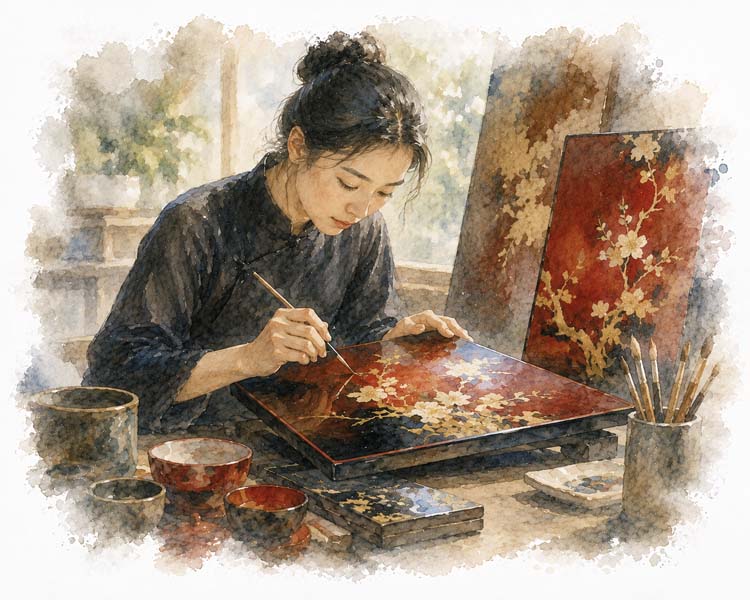
The city where lacquer painting was developed in the 1930s at the colonial fine art academy, and where the studios and the reference museum collection are. Panels are built from many layers of coloured lacquer, gold and silver leaf, crushed eggshell and shell inlay, then ground back wet so the image emerges. A record should name the painter, give the layer count and the inlay materials, and confirm the piece was ground rather than painted.
Tương Bình Hiệp
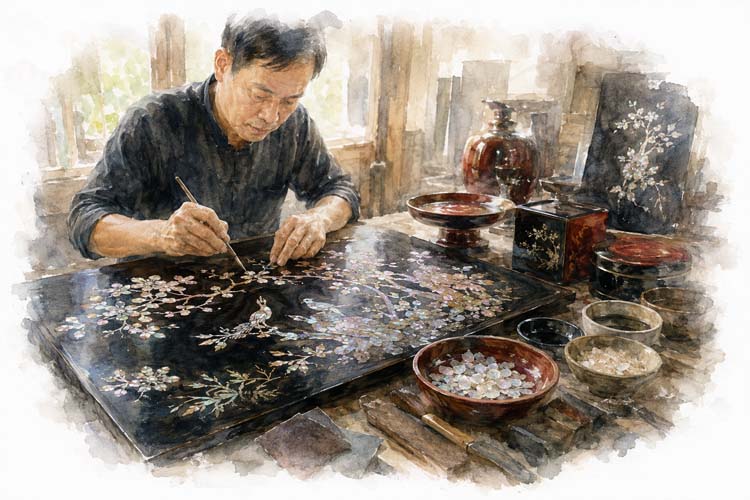
The southern lacquer village, near Thu Dau Mot in the Binh Duong region north of Ho Chi Minh City, with its own long lacquer tradition working boxes, panels, screens and furniture rather than academy painting. It is a separate centre from Hanoi with its own workshops and its own character, and the two are routinely collapsed into a single Vietnamese lacquer. A record should say which.
Hanoi (Bat Trang village)
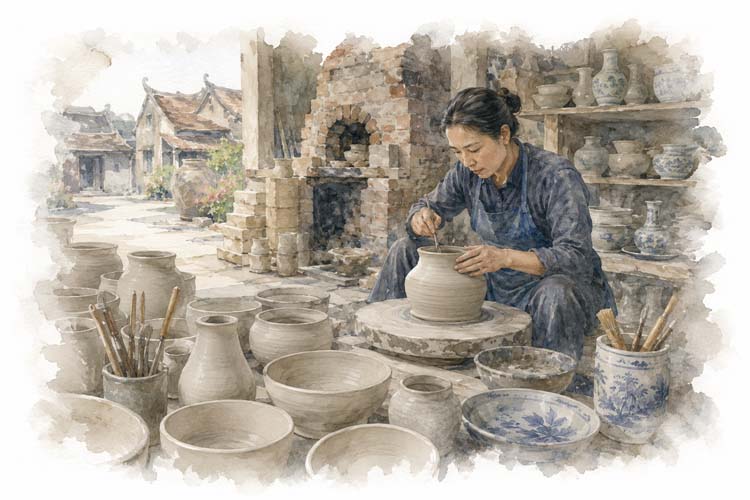
The ceramics village on the Red River a short way downstream, making pottery for some seven centuries on local clay, with historic blue-and-white and distinctive crackled and ash glazes. Now hundreds of workshops covering the full range from studio work to high-volume commercial ware. A record should name the potter and state whether the piece is thrown and hand-painted or moulded and transfer-decorated.
Van Phuc (Hanoi)
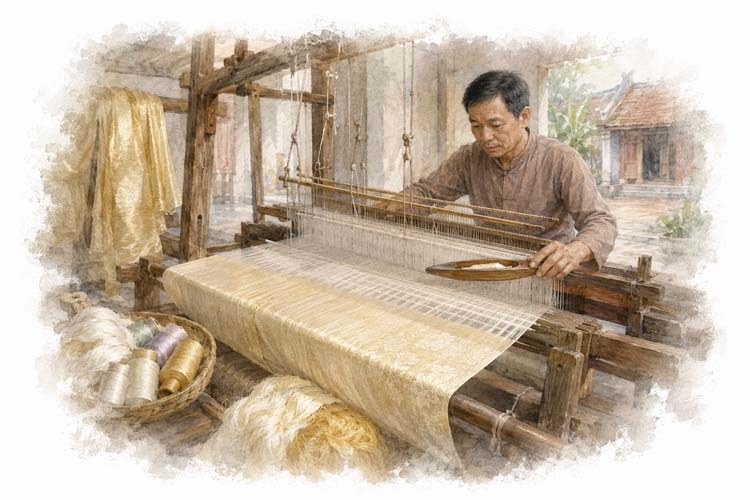
The silk village, historically Ha Dong, weaving for the capital for a comparable span and known for fine figured silk whose patterns appear as the cloth turns in the light. Genuine handloom production continues alongside a substantial trade in imported cloth sold under the village name. A record should confirm the fibre by burn test and name the weaver.
Also on the Map
The crushed duck eggshell that supplies white to a medium with no white pigment, and whose crazed texture is unmistakable once seen. The colonial art academy, whose documented 1930s experiments are the origin of son mai as painting and whose leading students became national figures. The household ancestor altar, the oldest and steadiest customer for lacquer, ceramics and incense in the country. And the craft village system itself, one trade per settlement, still legible across the delta. Maker, village, technique, materials.