The Southwest Coast
The kilns clustered on the southwestern shore of the peninsula for practical reasons: good clay, forest for fuel, and above all sea transport, since fired ceramics are heavy and fragile and the court was far away. Gangjin and Buan were the principal centres under the Goryeo dynasty, and the remains of hundreds of kiln sites survive along that coast, which is where the modern study of the ware begins and where the revival got its evidence.
The Colour and How It Happens
Celadon glaze takes its colour from a small quantity of iron reduced in a kiln starved of oxygen. Fire the same glaze in an oxygen-rich atmosphere and the iron oxidises to a yellow or brown; reduce it and the same iron yields the blue-green the tradition is named for. The colour is therefore a product of atmosphere rather than of pigment, and controlling it in a wood-fired kiln over many hours is the whole difficulty.
Sanggam Inlay
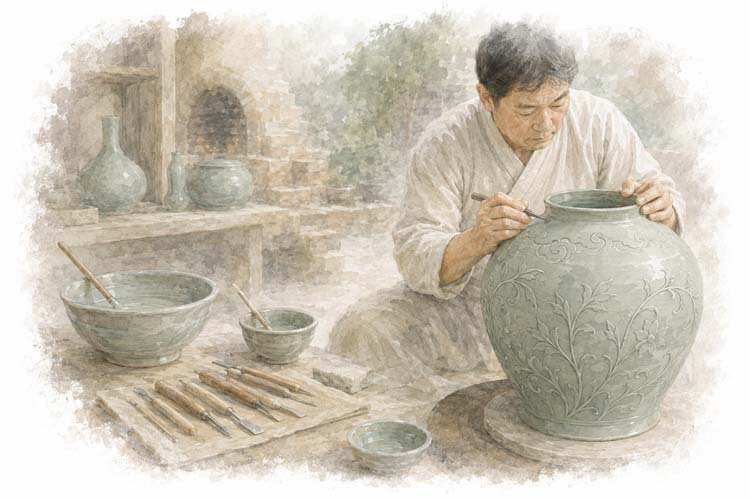
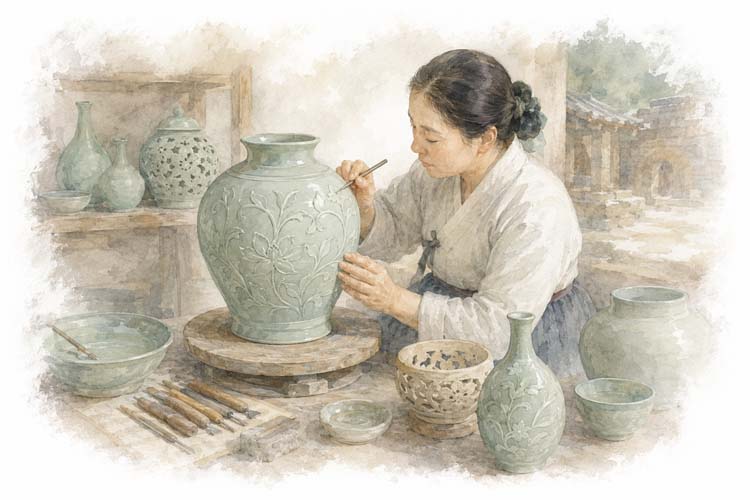
The Korean contribution is decisive and datable to the twelfth century. Designs are incised or stamped into the leather-hard clay, the recesses filled with white or iron-bearing slip that fires black, the surface scraped level, and the translucent celadon glaze applied over the whole. The result is a pattern visible through the glaze, part of the body rather than painted on the surface, with a softness no overglaze technique produces. Chinese celadon is carved or plain; this is Korean.
Kingfisher Colour
The Goryeo period produced a documented aesthetic judgement worth repeating. A Chinese envoy writing in the twelfth century listed Korean celadon among the finest things under heaven, and the colour the Koreans prized had its own name, translated as kingfisher, a particular blue-green that the best kilns achieved and that the revival has spent decades chasing. It is not a general green; it is a specific target, and potters still describe their work by how close it comes.
The Patron Institution
The Goryeo court, and the ware collapsed with it. Celadon of this quality was a court and aristocratic product, made under official supervision for the palace, temples and the elite, and it reached its height in the twelfth and thirteenth centuries. The Mongol invasions and the subsequent fall of the dynasty destroyed the conditions that sustained it, and the succeeding Joseon period turned to white porcelain and to buncheong instead. The technique was effectively lost for centuries.
What Joseon Made Instead
The succeeding dynasty did not simply stop; it changed its mind about what ceramics were for. Buncheong, a grey stoneware covered in white slip that is brushed, stamped, dipped or incised, appears in the transitional period and is loose, fast and confident where celadon is controlled. After it came Joseon white porcelain, austere and undecorated or painted sparely in cobalt, which suited a Confucian state that distrusted display. Three Korean ceramic traditions in sequence, each a rejection of the last.
Lost and Recovered
What exists now is a reconstruction. Goryeo celadon ceased to be made, and the modern revival dates from the twentieth century, built on excavation of the kiln sites, analysis of shards and sustained experiment by individual potters. Korea designates leading practitioners as holders of intangible cultural heritage. That is an honest description of the situation: a continuous place, an interrupted lineage, and a technique rebuilt from excavated fragments by people who had never seen it made.
Onggi, Which Never Stopped
The other craft on this coast is the opposite in every way. Onggi are large coarse earthenware jars for fermenting soy paste, soy sauce and kimchi, made from local clay with a simple ash glaze and fired in long climbing kilns. They are porous at a microscopic level, so they breathe: gas escapes and a slow air exchange continues, which is exactly what a long fermentation needs. This is a piece of food technology rather than an ornament, and it was engineered as one.
Coiled and Beaten
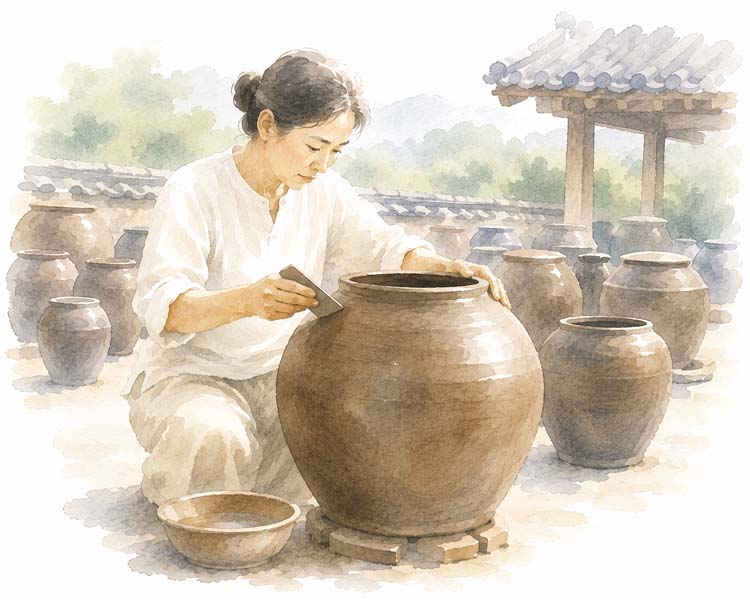
The making is distinctive. A large onggi is not thrown from a single lump but built up in coils or from a thick slab drawn upward, the wall beaten out with a paddle against an anvil held inside, thinning and expanding it. A potter walks around the piece as it grows. Jars stand taller than a person and the largest require two people, and the skill is in wall thickness that stays even as the form widens, judged entirely by sound and by hand.