Icon Painters Without Icons
Palekh was a village of icon painters for centuries, working a recognisable regional style: elongated figures, no perspective, gold on dark grounds, egg tempera on gesso. After 1917 that trade ended abruptly, because the state suppressed religious art and the market for icons disappeared. An entire village of highly trained specialists had a technique, a five-hundred-year tradition of using it, and nothing left to apply it to.
The Artel of 1924
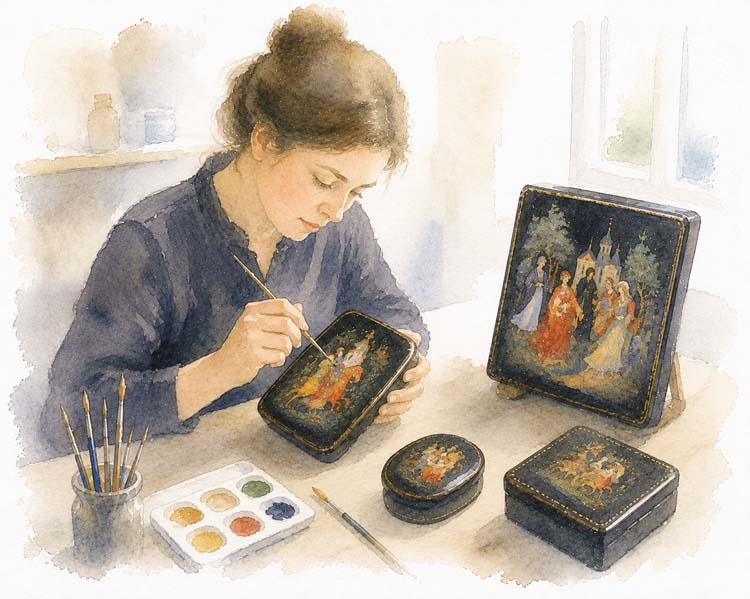
What they did next is the interesting part. A group of Palekh painters formed a cooperative and applied their icon technique to papier-mâché boxes, a format already in use at Fedoskino nearby. The technique was unchanged, the surface and the subject were entirely new: folk tales, Pushkin, troikas, battles, and in due course Soviet themes. It is one of the clearest examples anywhere of a craft surviving by transplanting itself onto a different object, and it was done deliberately and within a few years of the trade collapsing.
How a Palekh Box Is Made
Layers of cardboard are pasted, pressed, dried for weeks and soaked in linseed oil to make a hard papier-mâché body, then lacquered black outside and red within. The painting is egg tempera, mixed by the artist, built up in translucent layers over a drawn outline, with gold leaf applied and burnished for highlights and hatching. Many coats of clear lacquer follow, each polished. The whole sequence takes months and is why a genuine box costs what it does.
A Toy From Japan
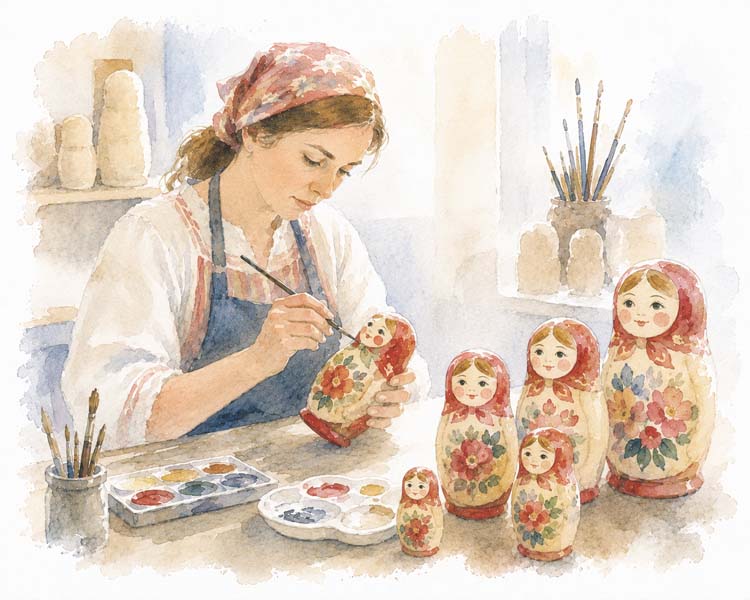
The matryoshka is not old. It was designed around 1900 in Moscow, at a workshop attached to the Abramtsevo artistic circle, by the painter Sergey Malyutin and turned by Vasily Zvyozdochkin, and the acknowledged model was a Japanese nesting figure of the Seven Lucky Gods brought back from Honshu. It won a medal at the Paris Exposition of 1900 and became an emblem of Russianness within a decade of being invented from a Japanese import. The story is not hidden; it was recorded at the time and has simply stopped being repeated.
Why Icon Technique Suits a Box
The transplant worked because the two objects have more in common than they look. An icon is a small panel prepared with gesso, drawn in outline, painted in translucent egg tempera layers from dark to light, gilded, and finished with a protective coat, and it is read at close range in poor light with gold doing the work of illumination. A lacquer box is the same problem at a smaller scale on a black ground. Nothing about the painters' training had to change; only what they depicted.
The Patron Institution
The Soviet state, more than anything else. It suppressed the icon trade that created Palekh's skills, then supported the lacquer artel that replaced it; it organised craft production into cooperatives and factories; it commissioned designers to standardise Gzhel's style in the 1940s and 1950s; and it exported all three as evidence of a flourishing folk culture. Almost nothing here reached its present form without state involvement, and that is rarely said aloud in the shops that sell them.
The Subjects They Chose
What Palekh painted after 1924 is worth noticing. The repertoire went to Russian folk tale and to Pushkin, to troikas racing through snow, to battles and hunts and harvests, and later to explicitly Soviet subjects including tractors and electrification. The visual language stayed medieval while the content became national and then political, which produces the tradition's strangest objects: collective farms rendered in the conventions of a fifteenth-century icon.
Gzhel, and the Blue That Came Late
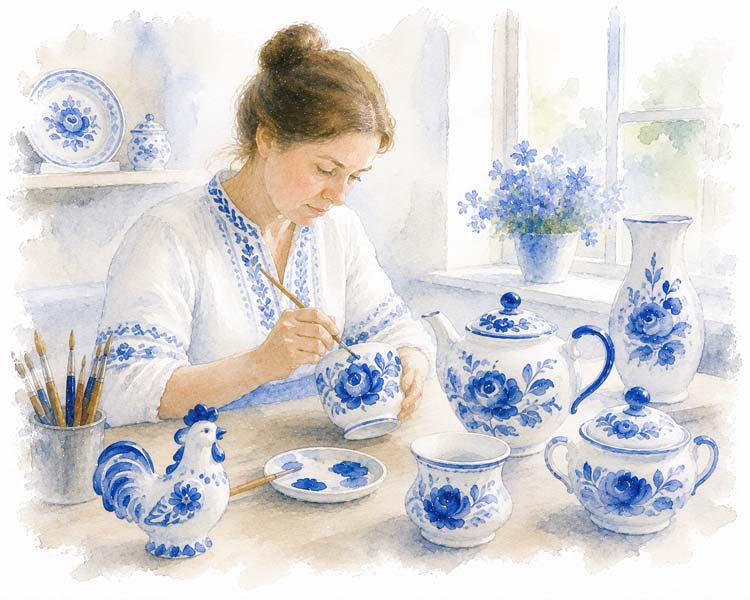
The clay around Gzhel has been worked since the fourteenth century and the district made maiolica, then semi-faience, then porcelain. The cobalt blue on white that defines it now is a nineteenth-century development, arriving with the European taste that Delft and Meissen had already shaped, and its modern form was consolidated after the Second World War by named designers who codified the palette and the brushwork. Old clay, recent look, and the two facts are usually collapsed into one claim about antiquity.
The Stroke With a Shadow
Gzhel's technical signature is a single brushstroke that carries its own gradient. The brush is loaded with cobalt on one side only and turned as it moves, so one stroke lays down a petal that is dark at one edge and pale at the other. A trained painter builds a whole flower from a handful of these. It cannot be done twice identically, which is why hand-painted Gzhel varies and transfer-printed imitation does not.