


Craft Map
The Craft Map
Ukiyo-e is a city trade rather than a regional one, and its geography is a matter of districts, publishing houses and, today, surviving workshops. There is no Geographical Indication in this field and there could not usefully be one; provenance here rests on publisher seals, censor seals, impression state and, for contemporary work, the named carver and printer.
Edo: The Trade
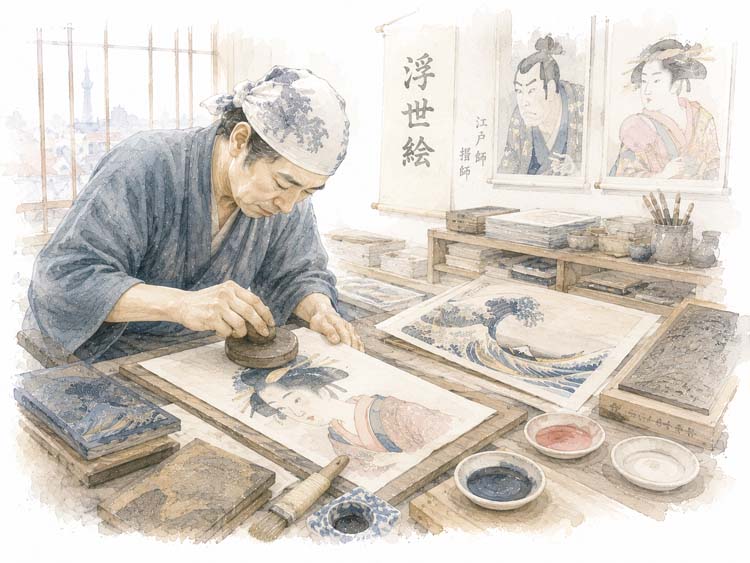
The city now called Tokyo is where the medium was invented, published and sold, and where its subject matter lived. The publishing houses clustered in the commercial districts, close to the theatres and the entertainment quarters they depicted, because the trade depended on knowing what was happening that week. A print's record should name its publisher wherever the seal allows, since the house is the closest thing this medium has to a workshop identity.
The Carving and Printing Benches: The Actual Work
In this medium the decisive places are two benches, and they were historically separate premises engaged by the publisher for each project. That structure survives: contemporary Japanese woodblock printing still separates the two trades, and the small number of workshops carrying them are the reason the technique is not extinct. Any modern print worth acquiring should name both specialists, and a record that names only a designer has repeated the medium's oldest injustice.
The Block Archives: Where Editions Were Decided
Blocks were assets. They were kept, reused, sold between publishers, recut when they wore, and printed from long after a design's first success, which is why impression state matters so much and why a design can exist in states separated by decades. Where blocks survive, they are the physical record of an edition that was never formally limited. This belongs on the map because in ukiyo-e the edition is a fact about the blocks rather than a decision made by anyone.
Also on the Map
The theatre districts, which supplied the trade's most dependable subject matter and its deadlines. The cherry wood the blocks were cut from, which is fine and dense enough to hold a hairline. And the Western collections assembled from the 1860s onward, which are why so much of this material left Japan. Who designed an ukiyo-e print is never the whole answer. Which printing, from which blocks, in what state: that is.