Arts, Crafts and Living Ateliers
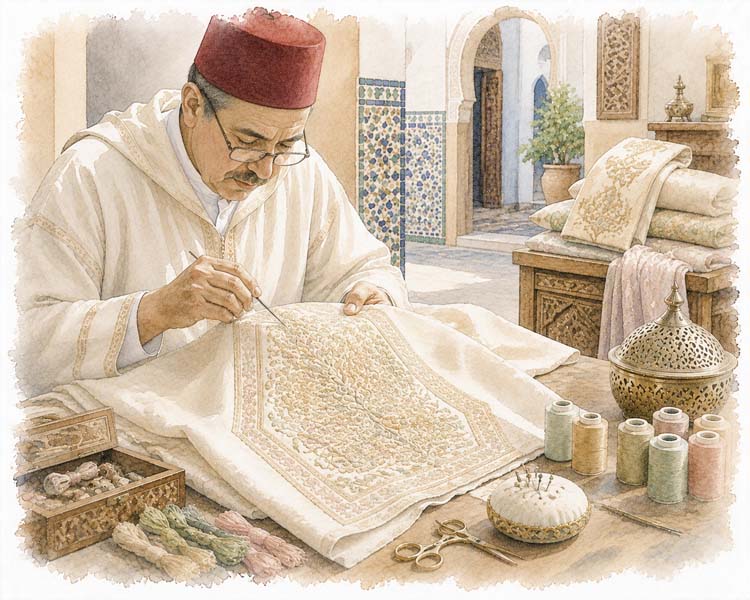
The zellige workshops sit outside the old city near the kilns, and the sound of them is unmistakable: rows of men seated on the ground, each with a small anvil, striking tile with a hammer whose edge has been ground to a chisel. Shaped pieces accumulate in sorted heaps by form and colour. In another part of the yard the setters work face-down in frames. The embroidery is domestic and quiet by comparison, worked in the house on a small frame in good light.
Reading Zellige
Look at the joints. Hand-cut pieces meet in fine irregular lines because each was struck individually, and the slight variation from piece to piece is what gives an old panel its life. Machine-cut tile is dimensionally perfect and reads as dead. Look at the glaze, which on traditional work is uneven in depth, pooling slightly and varying in tone across a single colour, and at the edges, where a hand-struck piece shows the chipped bevel on the reverse. A modern printed tile imitating the pattern has no joints at all.
The Colours and Their Order
The classic restricted palette is not a limitation to be apologised for. White, with black and shades of blue, green and yellow, is what the mature Marinid work uses, and the geometry is legible precisely because the colour count is low. Broader palettes are modern and are honest enough, but a panel offered as traditional in a wide range of colours is a contemporary product, and knowing which historical register a piece sits in is more useful than deciding one is better.
Reading Fes Embroidery
Turn it over, and if there is a wrong side it is not this. The genuine technique yields two identical faces with no carried threads and no knots visible anywhere. Then look at the count: the work is counted on the ground threads, so the motifs should be exactly regular and the repeats exactly aligned. Silk on linen has a particular soft sheen that cotton floss does not. Machine embroidery, which is common and cheap, shows a distinct back and a uniform mechanical stitch of unvarying tension. Held up to the light, hand work has a slight liveliness across the surface that a machine cannot produce.
Where the Time Goes
The cutting is the labour. A single panel of any complexity requires thousands of individually struck pieces, each one shaped and bevelled, and a cutter works through a day producing a few hundred of a given form. The setting is faster but less forgiving, because a piece placed wrong in a reversed composition may not be discovered until the plaster is poured and the panel turned. Neither stage can be shortened without the result being visible to anyone who knows where to look.
Ateliers, Villages and Artisan Encounters
The old city of Fes is a World Heritage site and the workshops are inside and around it. The Marinid madrasas, restored and open, are the reference standard for zellige and should be looked at before anything is bought. The tanneries and the brass and wood trades occupy their own quarters nearby. Embroidery is harder to find at source because it is domestic, and the associations and cooperatives are the practical route to a maker. There is also a small number of women who teach the technique formally, and they are the reason it still exists at the standard it does.
Tourwit Editions and Provenance
Tourwit commissions from zellige workshops and from embroiderers in Fes directly, paying before work begins and leaving the major share of what a piece realizes with the maker. A zellige record names the cutter and the setter, which are two different men, states the composition and the number of distinct shapes used, and confirms the pieces were hand-struck. An embroidery record names the embroiderer, states the ground and the thread, and confirms the work is genuinely double-faced.
Why These Works Matter
These two crafts sit at opposite ends of the same city and share one quality: both are built under a constraint that removes any possibility of correction. The tile setter works blind and in reverse; the embroiderer works with no back to hide in. Neither can be faked convincingly by anyone who has not served the apprenticeship, and both are routinely sold alongside machine-made products that photograph identically. Knowing what to look at is the whole of the difference.