The Sultanates
Kelantan and Terengganu are the two states of the Malay peninsula's northeast coast, facing the South China Sea, each with its own sultan and its own long history as a Malay court centre. They were oriented toward Siam and the sea trade rather than toward the Straits, they came late under British control, and they remain the most culturally Malay and most conservative part of the country. That history is a large part of why the courts and their crafts survived as intact as they did.
What Songket Actually Is
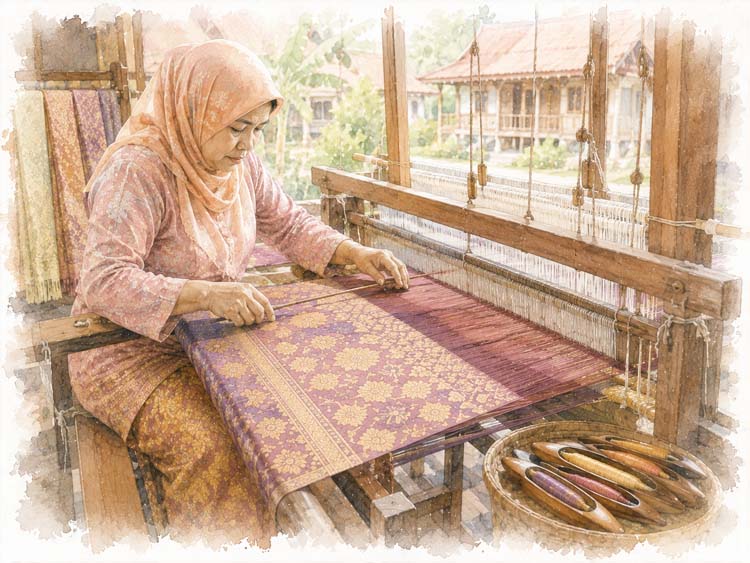
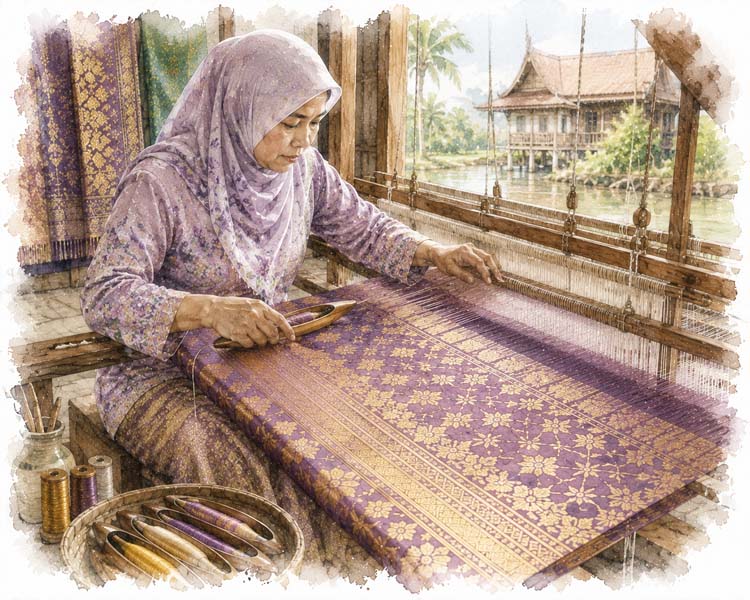
The base cloth is silk, woven on a floor loom, and the pattern is a supplementary weft: an additional metallic thread laid in across selected warp threads and floating over the surface, carrying no structural load. The weaver lifts the required warps using a set of pattern sticks that encode the design, then passes the gold thread through by hand. The ground cloth would be complete without it. The gold is added on top of a textile that already works, which is what supplementary means.
Pattern Held in Sticks
The design is stored physically. Before weaving, a lengthy setup encodes the motif into a series of pattern heddles or sticks held above the loom, each recording which warps to raise for one pass, and once that is done the weaver works through them in sequence. Preparing the pattern can take longer than weaving the cloth. A songket loom carries its design in its own hardware, which is why a complex pattern is a commitment before a single thread is thrown.
The Patron Institution
The courts, explicitly and by regulation. Songket was royal cloth: worn by the sultan and the nobility, given as a mark of favour, and restricted by convention and sometimes by rule from common use, with particular patterns and the fullest gold reserved to the highest ranks. It was woven by women attached to or supplying the palace. The cloth was a legible statement of standing before it was anything else.
Batik on This Coast
Malaysian batik is not a lesser Javanese batik and should not be judged as one. Where Javanese work runs to fine hand-drawn detail in browns, indigos and creams, the east coast tradition uses larger open motifs, brighter colour, and applies dye with a brush directly onto the cloth between waxed outlines rather than building it through repeated immersion. The result is faster, freer and considerably more colourful, and it is a different aesthetic rather than a simplification.
Why the Motifs Are Floral
Both cloths avoid the human and animal figure, because this is a Muslim society and the convention against depicting living forms holds in textile as it does elsewhere. The vocabulary is therefore botanical and geometric: bamboo shoots, rice grains, betel leaves, hibiscus, the pucuk rebung triangular bamboo-shoot border that appears on almost every songket, and interlocking geometry. The constraint produced a repertoire rather than limiting one.
Gold, Real and Otherwise
Historically the metallic thread was gilt-silver wrapped around a silk core, genuinely precious and a large part of a cloth's value, and old pieces can be assessed partly by the quality of the metal. Modern songket almost universally uses gold-coloured synthetic thread, which is stable, cheap and does not tarnish. Neither is dishonest; the difference is enormous in cost and should be stated rather than left for a buyer to assume.
The Named Patterns
Songket designs carry names and the vocabulary is specific rather than decorative. The bamboo-shoot triangle runs as a border on nearly every ceremonial cloth. Others take their names from rice grains, star anise, the honeycomb, the areca palm blossom and the tendrils of climbing plants, and the arrangement of field, border and end-panel follows conventions a knowledgeable wearer reads. A cloth is described by its pattern name in the same way a Scottish tartan is by its sett.
Where It Stands
Both crafts are actively supported: songket is worn at weddings and state occasions across Malaysia, batik has been promoted as national dress, and there are training institutions and designated master weavers. The pressures are the familiar ones. Handwoven songket competes with machine-made brocade of similar appearance, and hand-waxed batik competes with screen-printed cloth carrying batik designs and none of the process behind them.