





Craft Map
The Craft Map
Dhokra belongs to no single place, and any record that claims one is wrong. The craft sits in particular villages across four states, each with its own community, its own repertoire and, in two of the four, its own Geographical Indication. These are the names that belong on a work's record, and the registrations recognize exactly that: the technique is shared, but the place is not.
Kondagaon and Jagdalpur: Bastar Dhokra
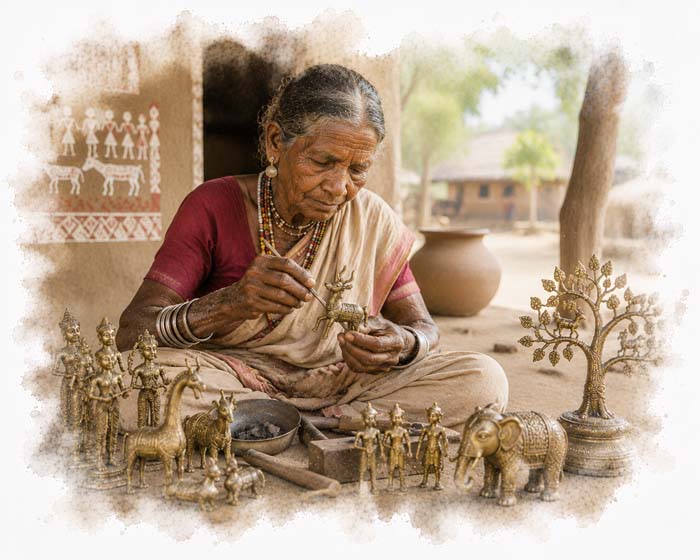
In southern Chhattisgarh, hours inland from Raipur, Kondagaon and Jagdalpur are the two working centres of Bastar casting. The craft is held here by the Ghadwa, whose name carries the sense of shaping and making, and who cast for village shrines long before they cast for anyone else. Kondagaon counts the craft as its district's own product and supports over a hundred and fifty working artisans. Bastar Dhokra has been protected by Geographical Indication since 2014. The yards run on beeswax and low fires, and the pour still happens in the open.
Dwariapur and Bikna: Bengal Dokra
In Bankura district of West Bengal, within reach of Bishnupur, the casting hamlets of Dwariapur and Bikna belong to the craft in the strict sense: a lane of families at the same work. Their output served a countryside needing lamps, measuring bowls and household images rather than temple commissions, which is why the Bengal repertoire runs smaller and more domestic than Bastar's. Bengal Dokra received Geographical Indication protection in 2018. The lanes are working premises, and the clay dries in the open where it is mixed.
Mayurbhanj and Dhenkanal: The Odisha Villages
North Odisha holds the third limb of the belt. Casting families in Mayurbhanj, and at Dhenkanal further south, worked to the same method under the region's forest kingdoms and continue in villages rather than towns. Odisha's casting carries no registration of its own, and that absence is worth stating plainly: a work from here is verified by its village and its family, not by a mark. Baripada is the anchor a visitor can reach.
Khunti: The Jharkhand Casters
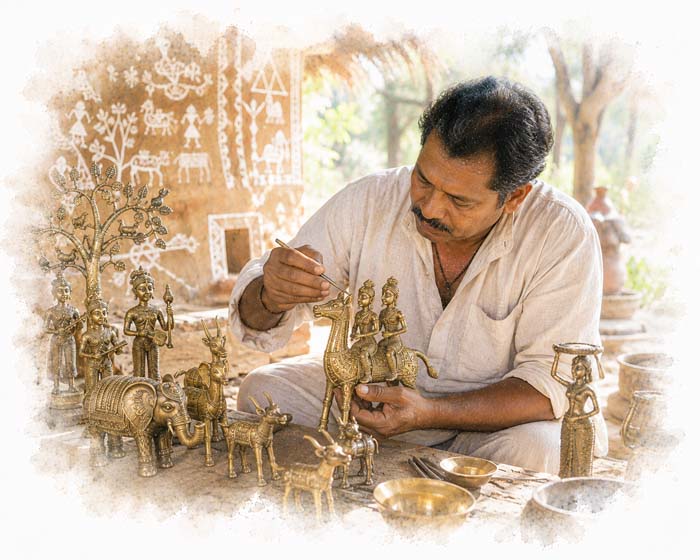
South of Ranchi on the Chhota Nagpur plateau, Khunti is the belt's fourth limb, worked by the Malhor. Their history breaks the belt's pattern: the Malhor were itinerant, moving between settlements for scrap brass and casting where the work was, so the craft arrived repeatedly rather than taking root once. What they cast followed the commission. Alongside lamps and images, the Jharkhand yards turned out anklets and the bells worn by tribal households, objects made to be worn rather than set down in a shrine. Jharkhand holds no registration either; here the maker's name does a mark's work.
Also on the Map
Adilabad in Telangana, cast by the Ojha and registered under Geographical Indication in 2018, the third of the belt's three marks. Bardhaman, working alongside Bankura. One caster's owl is separated from another's by the village, and by nothing else.