Arts, Crafts and Living Ateliers
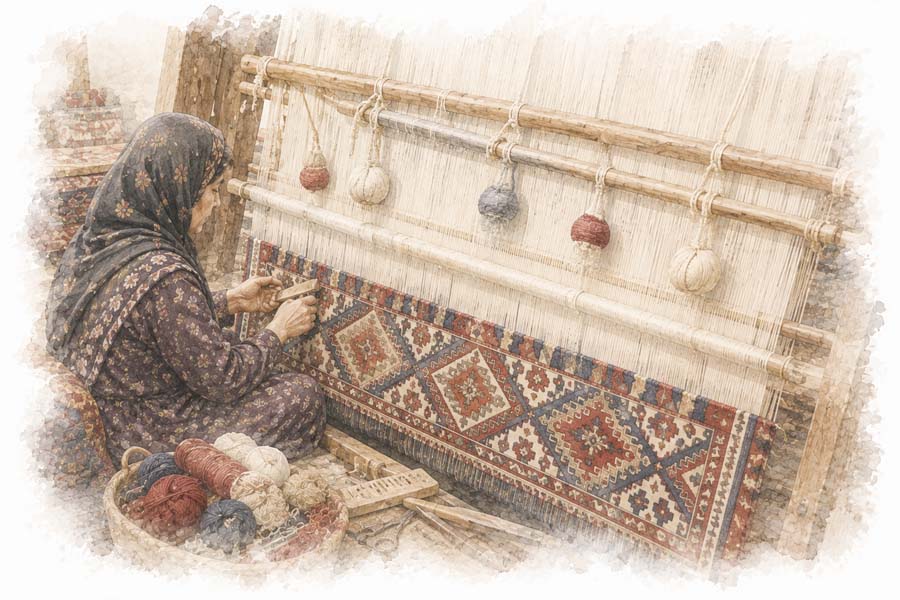
Yazd's termeh looms are indoors and slow, with two people working in coordination and the cloth advancing a hand's width in a day. Kermanshah's giveh production is split between houses and workshops, and the two halves meet only at assembly. Shiraz's painting tradition survives as collections and as a modern practice rather than as a manuscript industry; the city's living craft is inlay work and metal, in the bazaar quarters. Three towns, three completely different working rhythms, and no shared workshop culture to speak of. What unites them is commercial rather than technical.
Reading a Termeh
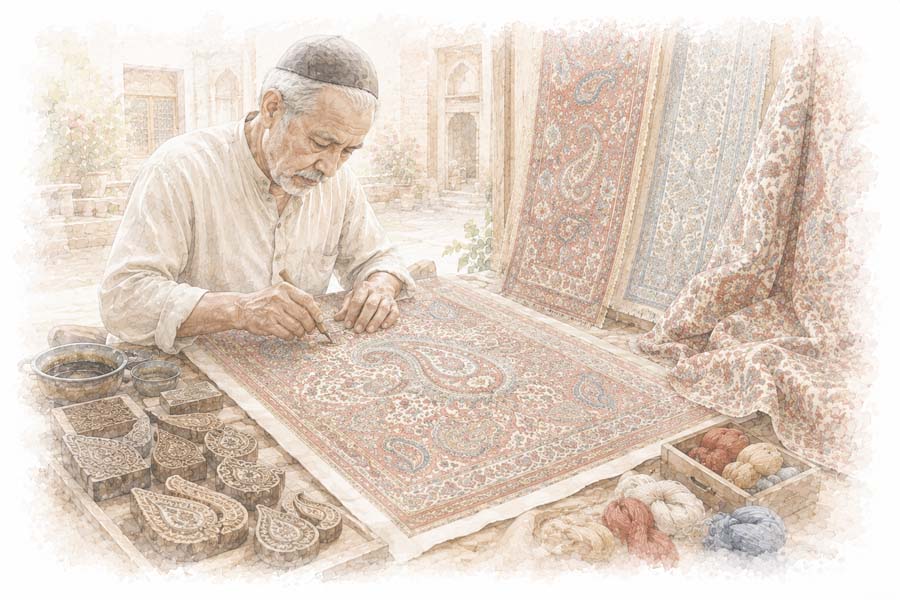
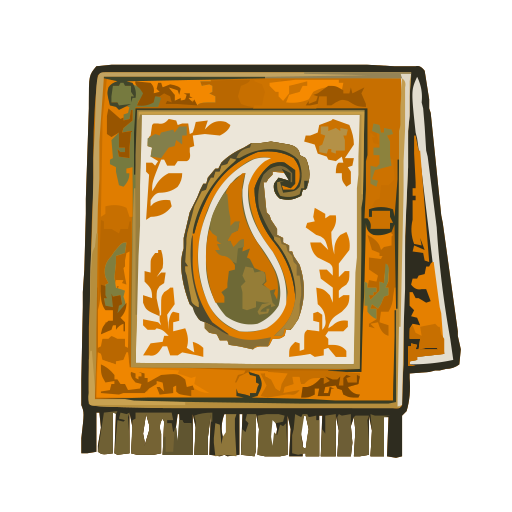
Turn it over. A handwoven termeh carries its pattern in the structure, with floats and a legible reverse, where a printed or machine-jacquard imitation does not. Look at the density of the pattern and remember the rate: an elaborately patterned piece of any size represents weeks rather than days. Ask what the fibre is, since traditional termeh is wool and the silk versions are later and different in handle. And ask whether it was woven in Yazd, because the name travels further than the town does. Termeh is now woven in several places and printed in many more, and the word alone establishes nothing.
Reading a Giveh
The upper is where the craft is. Nalbinding produces a dense, slightly ridged fabric that does not unravel when cut, which is the quickest way to tell it from knitting, and a hand-worked upper shows the small irregularities of a needle rather than the regularity of a machine. Check the sole for what it actually is, since traditional textile and leather soles have largely given way to rubber and the difference is rarely volunteered. And do not be surprised that the pair is identical: that is correct, not a fault.
Shiraz, Without Repeating Isfahan
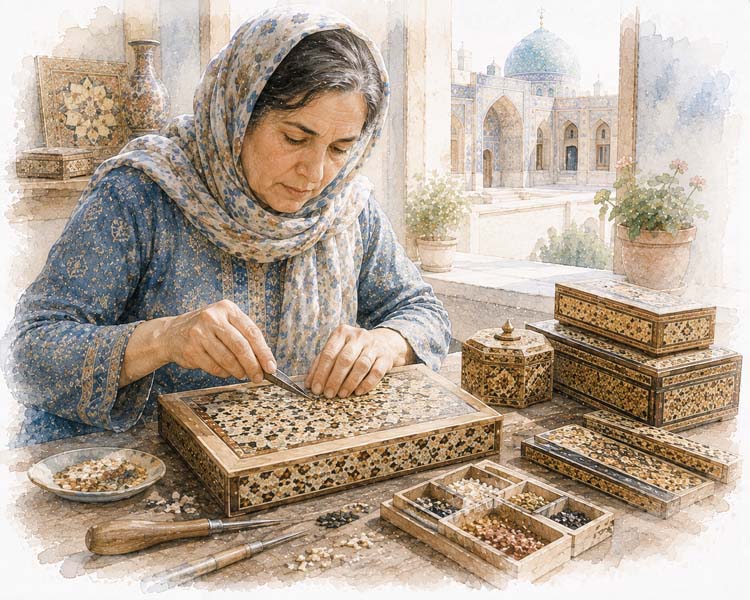
Two of the crafts recorded against this destination, miniature painting and khatam inlay, are also recorded at Isfahan, where the technique and the court context belong. What is specific to Shiraz is different. Its manuscript tradition is older, it is commercial in origin, and its finest period is Timurid rather than Safavid. Its inlay work sits within a bazaar economy rather than a court workshop system. A record that says Persian miniature and stops has skipped two centuries and a change of customer. Both facts are recoverable from the object by anyone who knows to look for them, which is the argument for naming the town on the record.
What Two People at One Loom Actually Means
The staffing of a termeh loom is the part worth understanding before assessing a piece. One person cannot both work the structure and order the weft colours as the pattern advances, so the second role exists for the pattern alone. That has two consequences for a buyer. The first is cost: every centimetre carries two wages, not one. The second is that pattern complexity and labour are directly proportional in a way they are not in printed or jacquard cloth, where an elaborate design costs no more to produce than a plain one. On a termeh, elaboration is the price.
Ateliers, Villages and Artisan Encounters
Yazd is the most rewarding of the three for a visitor, since the weaving is visible and the town's whole fabric, the wind towers and the covered lanes, explains the climate the cloth was made in. Kermanshah's giveh making is rural and dispersed through villages in the province, and reaching it takes intent. Shiraz offers gardens, the bazaar and the collections rather than a manuscript workshop, and being clear about that in advance prevents disappointment.
Tourwit Editions and Provenance
Tourwit works directly with termeh weavers in Yazd and giveh-making households in Kermanshah province rather than through intermediaries. Artisans are paid before the work begins and retain the major share of what a piece realizes. Editions are limited by what a loom can advance in a day and by what a needle can work, and each work is documented at source with its town, its makers, and for a giveh both halves of it, so that the record travels with the object.
Why These Works Matter
Craft collecting tends to prize the court object, and these three are a useful corrective. A termeh was luxury cloth sold to whoever could pay. A Shiraz manuscript was made on speculation. A giveh was made to be worn out. All three are the products of a working economy rather than a patron's taste, and they survived precisely because they were never dependent on one. That is a different kind of pedigree and it is worth understanding as one rather than as its absence.